


CDC Account Explained: Sub-Account vs Investor Account in Pakistan
Every new PSX investor eventually asks the same two questions: where are my shares actually kept? and what happens to them if my broker disappears? The answer to both is the same three letters: CDC. Yet most explanations of the Central Depository Company are buried in regulatory FAQs, and most investors click past the custody section of their account forms without knowing what they agreed to.
This guide explains the custody layer of Pakistani investing in plain English: what CDC is, the real difference between a sub-account and a direct Investor Account, how to look at your shares with your own eyes on CDC's records, what genuinely happens in a broker default, and the small set of habits that make your holdings verifiable and safe.
Key takeaways
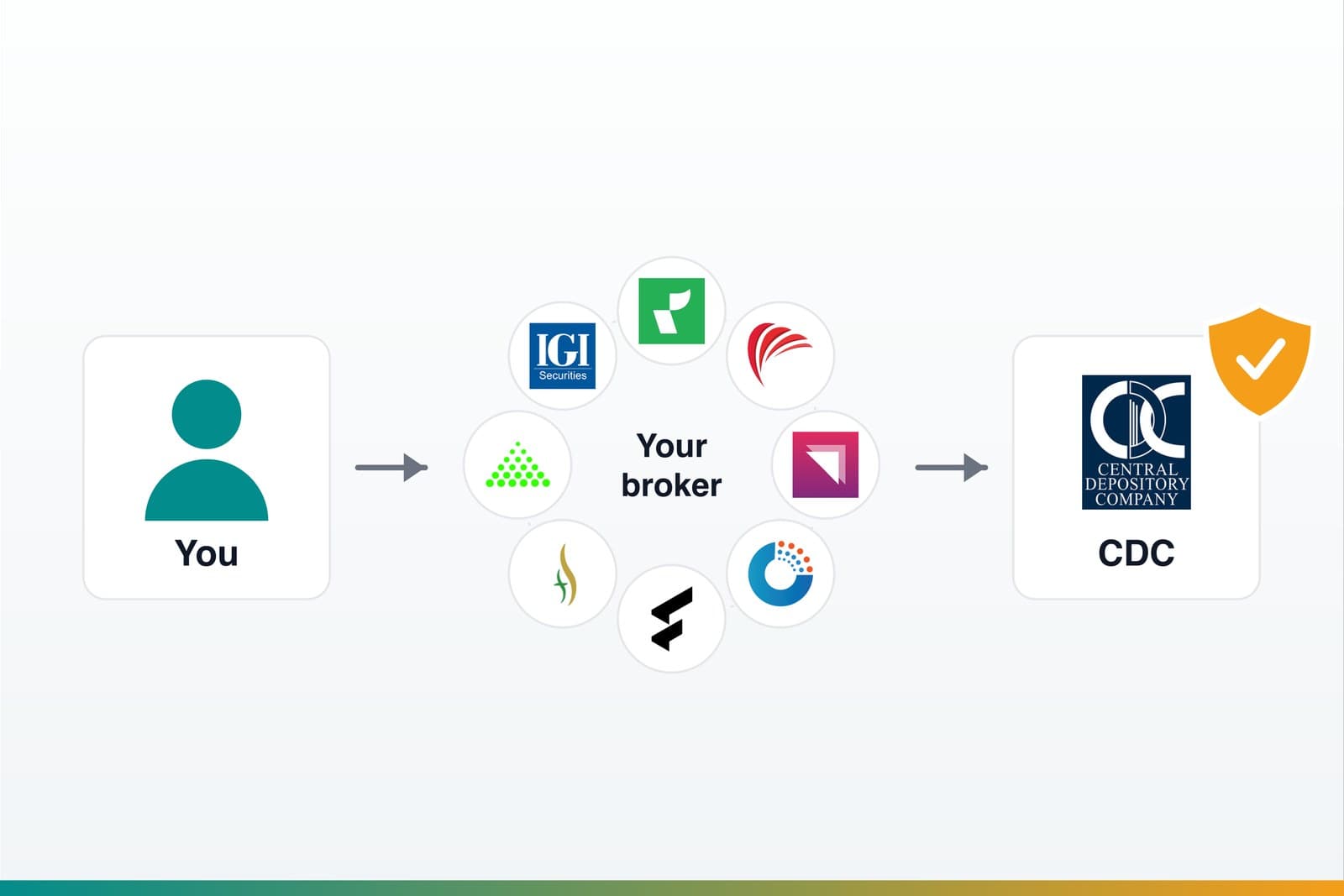
- Your broker executes trades; CDC holds the shares. Listed shares exist as electronic book entries in CDC's Central Depository System - your broker's app is a window onto them, not the vault itself.
- Sub-account vs Investor Account is about who operates the account, not whose name is on the shares. Both are in your name; the sub-account is operated by your broker, the Investor Account only by you.
- A broker default does not swallow your shares. Securities in your name at CDC are not the broker's property. The pressure points in a default are idle cash balances and unauthorized movements - not properly held shares.
- PSX's compensation fund caps at PKR 1,000,000 per claimant for admitted claims against a defaulted broker. Treat it as a backstop, not a substitute for vigilance.
- Check the depository's record, not just the broker's app. CDC Access (web and mobile) and CDC's emailed eStatements let you verify your holdings independently, in minutes.
What CDC actually is
The Central Depository Company of Pakistan Limited (CDC) is the infrastructure company that dematerialised Pakistan's stock market. Before 1997, buying shares meant paper certificates, physical transfers and forgery risk. CDC replaced that with the Central Depository System (CDS): listed securities now exist as electronic book entries, and transfers happen inside the system when trades settle.
Three institutions share the plumbing, and it helps to keep their jobs straight:
| Institution | Job in plain terms |
|---|---|
| PSX | The marketplace where buy and sell orders meet |
| NCCPL | Clears and settles trades, registers your UIN, computes capital gains tax |
| CDC | The depository - keeps the register of who owns which shares |
Your broker is your licensed gateway to all three. But the shares themselves sit at CDC, which is why understanding your CDC arrangement matters more than any feature of your broker's app.
The two ways your shares can be held
When you open a brokerage account, your shares end up in one of two CDC arrangements (many investors eventually use both):
1. The sub-account - operated by your broker
By default, your broker opens a sub-account for you under its own participant account in the CDS. The shares in it are registered in your name - this is not a pooled arrangement - but the account is maintained and operated by the broker on your behalf. That is what makes normal trading frictionless: when you sell, the broker can deliver your shares into settlement without you signing anything.
The convenience has a flip side: the entity operating the account is the same entity you are trusting to act only on your instructions. For an honest, well-run broker this is a non-issue, and the regulatory system (audits, segregation rules, CDC's records themselves) is built around keeping it that way. But it is exactly why independent verification - covered below - is a habit worth having.
2. The Investor Account (IAS) - operated only by you
CDC's Investor Account Services (IAS) lets you open an account directly with CDC, with no broker in the custody chain. The account moves only on your instruction, and its balances are visible to you through CDC's own channels. Opening is now largely digital - registration with CNIC, mobile and email, plus verification - and typically completes within a few working days.
The trade-off is friction: shares in an Investor Account are out of your broker's reach, which means selling them involves first moving them into your sub-account. That is precisely the point - and why the classic setup for a long-term investor is:
Side by side
| Sub-account | Investor Account (IAS) | |
|---|---|---|
| Opened with | Your broker (automatic at onboarding) | CDC directly (optional, separate) |
| Operated by | The broker, on your behalf | You only |
| Shares registered to | You | You |
| Best for | Active trading, settlement convenience | Long-term custody, maximum control |
| Annual maintenance fee | Eliminated by CDC from July 2024 | Modest annual fee (a few hundred rupees) |
| To sell holdings | Broker delivers directly | Move to sub-account first, then sell |
How to look at your shares with your own eyes
The most underused investor protection in Pakistan is free and takes ten minutes to set up: CDC Access, the depository's own portal for account holders.
- CDC Access Web (
cdcaccess.com.pk) shows your account information, activity and reports online, anywhere. - CDC Access Mobile App puts account information and corporate actions on your phone, and lets Investor Account holders perform certain transactions.
- eStatements and eAlerts email sub-account holders and Investor Account holders their account balance statements on a monthly or quarterly cycle, with alerts for activity.
The habit that matters: reconcile the depository's statement against your broker's statement periodically. If your broker's app says you own 500 shares of a company, CDC's record should say the same. Any mismatch is a question for your broker immediately - this is the early-warning system that regulatory processes cannot replace. Your own records in a portfolio tracker complete the triangle: what you think you own, what the broker says, and what the depository says should all agree.
Use Investify for your daily PSX workflow
Open market data, stock pages, charts, news, announcements, watchlists and portfolio tracking from one Investify account.
Track your PSX portfolio alongside your CDC recordsWhat actually happens if a broker shuts down
This is the fear behind most CDC questions, so here is the mechanism, step by step, without varnish.
The starting principle: shares held in the CDC system in your name are your property, not the broker's. A broker's creditors cannot treat properly held client securities as the broker's assets. This is the entire reason the depository model exists.
The process when things go wrong: if PSX declares a securities broker a defaulter, its Regulatory Affairs Division opens a claims process. A public notice goes up on the PSX website the same day and is published in at least two widely circulated newspapers, in English and Urdu, inviting customers to file claims. A Default Committee - industry experts, senior PSX management and TREC holders - reviews the claims.
How admitted claims are paid: first from the defaulter broker's own assets under PSX custody. Whatever remains unsatisfied is then paid from the Centralized Customers Protection Compensation Fund (CCPF) - formerly the Investor Protection Fund - up to a maximum of PKR 1,000,000 per claimant, under Chapter 24 of the PSX Regulations.
Read that cap again, because it shapes the practical advice:
Your protections, in order of usefulness:
- Shares registered in your name at CDC - structural protection; make sure this is true (it is, in any standard setup, but verify).
- Regular CDC Access / eStatement reconciliation - catches problems while they are small.
- Minimal idle cash at the broker - the asset most exposed in a default.
- The CCPF - a real but capped backstop, after the defaulter's assets are exhausted.
- Choosing a well-run broker in the first place - the subject of our broker selection guide.
What a CDC account costs
The depository layer of investing is cheap, and it got cheaper:
- Sub-account holders: CDC eliminated the annual maintenance fee from 1 July 2024 (it also waived CDS connection fees for brokers, while introducing a small intra-account movement fee). What remains at the depository level are small handling charges on settled trades - on the order of fractions of a rupee per share.
- Investor Account (IAS) holders: a modest annual fee - historically in the few-hundred-rupee range after successive reductions - plus small charges for movements between accounts.
- What brokers add on top: account maintenance fees, and the trading costs we cover in detail in our fees guide, are the broker's own tariff, not CDC's.
Since its inception, CDC states it has cut transaction and custody fees by roughly 95% - the direction of travel has consistently been downward. Exact current figures live in CDC's Schedule of Fees, which is the document to check before relying on any number here.
Sahulat accounts and where they fit
If you opened a Sahulat Account - the simplified, low-documentation account for resident investors with a cap of PKR 3 million - the custody picture is the same: your shares sit in a sub-account in the CDC system, operated by your broker, and everything in this guide about verification and protections applies to you. The Sahulat framework simplifies onboarding, not custody. For how Sahulat compares with standard accounts, see our guide to the minimum amount needed to start investing.
A five-minute safety checklist
- Confirm your shares are in an account in your own name (standard, but verify once).
- Register for CDC Access web or mobile, and turn on eStatements/eAlerts.
- Reconcile CDC's statement against your broker's statement at least quarterly.
- Keep idle cash in your bank account, not parked with the broker.
- Consider a direct Investor Account for long-term holdings once your portfolio is meaningful.
- Know the claims process exists - and that the CCPF cap is Rs 1,000,000 per claimant.
Educational note
This article is for general education only. It is not investment, legal or tax advice, and it does not recommend any broker, account structure or security. Custody rules, fee schedules and compensation-fund limits are set by CDC, PSX, NCCPL and SECP and change over time - verify current figures against CDC's Schedule of Fees and the PSX Regulations before acting. In any conflict between this summary and the official rules, the official rules govern. Investify is a market-data and portfolio-tracking app; it is not a broker, a depository or a custodian, and it does not hold your shares.
The bottom line
A CDC account is not paperwork trivia - it is the answer to the two questions every investor should be able to answer: my shares sit at the Central Depository Company, registered in my name, and if my broker fails, those shares are not the broker's assets - my exposure is cash balances and anything unauthorized, backstopped by a compensation fund capped at Rs 1,000,000. The system gives you the tools to verify all of this yourself: a sub-account for convenience, an optional Investor Account for control, and CDC Access to watch both. Ten minutes of setup and a quarterly reconciliation habit buy you more protection than any amount of worrying.
Related reading
Sources and references
- CDC - Investor Account Services
- CDC - IAS FAQs
- CDC - Schedule of Fees
- CDC - CDC Access (web, mobile app, eStatements)
- PSX - Investor Protection Fund / CCPF
- The News - CDC eliminates annual maintenance fee for sub-account holders (2024)
- Business Recorder - CDC relaxes fees for sub-account holders, CDS connection