


PSX Trading Fees & Charges: What a Trade Actually Costs
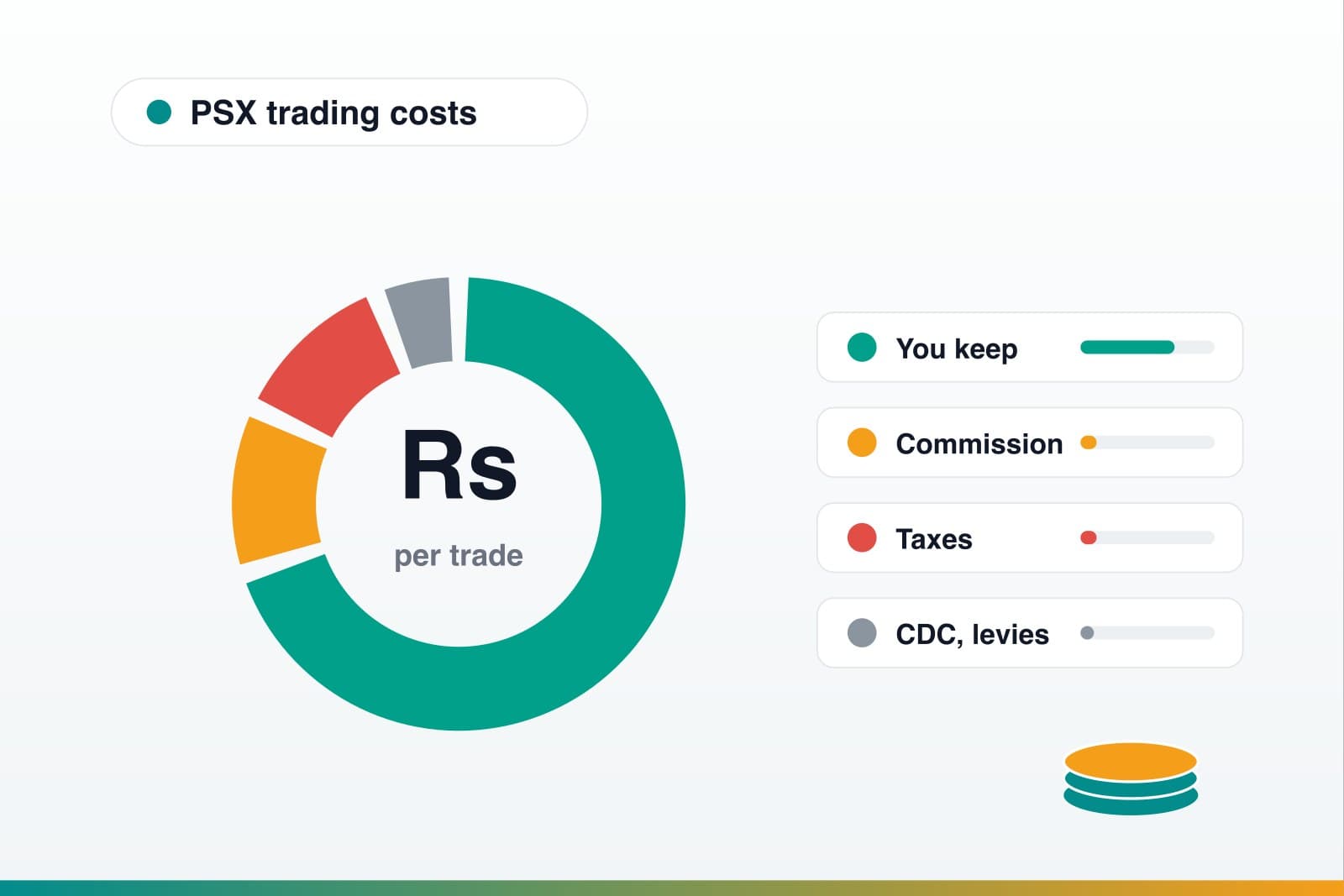
Ask a new investor what it costs to buy shares on the Pakistan Stock Exchange and you will usually hear the broker's headline commission - and nothing else. But a real trade carries a small stack of charges: commission, sales tax on the commission, depository handling, clearing charges, regulatory levies, and then taxes on your gains. None of them is large by itself; together they decide how much of your return you actually keep, especially if you trade small or often.
This guide itemises the full stack with realistic numbers, walks through a complete Rs 100,000 buy-and-sell round trip so you can see where every rupee goes, and shows which costs you can actually control. Rates below are typical structures as of mid-2026 - your broker's written tariff is the binding document, and getting it is your right.
Key takeaways
- Commission is negotiated per broker, not fixed. PSX prescribes no standard rate; a common retail structure is ~0.15% of trade value with a per-share floor, and the realistic market range is roughly 0.05%-0.25% per side.
- Sales tax applies to the commission itself - roughly 13-16% of the commission, depending on your province. It is the stealthiest line on the contract note.
- CDC and NCCPL charges are small: fractions of a rupee per share for depository handling, ~Rs 200/year for UIN maintenance. CDC abolished the sub-account annual fee in 2024.
- A Rs 100,000 round trip costs roughly Rs 365 in trading costs at typical rates - before capital gains tax on any profit.
- Minimums are the small investor's real enemy. Flat or per-share floors can turn a nominal 0.15% into an effective 1%+ on small orders.
- Everything must appear on your contract note. If a charge isn't there and isn't in the tariff you were given, ask.
The full fee stack, itemised
Here is every category of cost a PSX equity investor meets, who charges it, and what it typically looks like:
| Cost | Charged by | Typical shape | When |
|---|---|---|---|
| Brokerage commission | Your broker | ~0.05%-0.25% of value per side; often with a per-share floor (e.g. 3 paisa) or flat minimum | Every buy and every sell |
| Sales tax on commission | Province (via broker) | ~13-16% of the commission | Every trade |
| CDC handling | CDC (via broker) | Fraction of a rupee per share (order of half a paisa) | Settled trades |
| Exchange/regulator levies | PSX, NCCPL, SECP (via broker) | Very small pass-through amounts, itemised on the contract note | Every trade |
| NCCPL UIN maintenance | NCCPL | ~Rs 200/year (individuals) | Annual |
| Broker account maintenance | Your broker (some firms) | Rs 0-~1,000/year | Annual |
| Capital gains tax | FBR (via NCCPL) | 15% of net gains for filers (recent acquisitions) | When you sell at a profit |
| Dividend withholding tax | FBR (via payer) | ~15% filers / ~30% non-filers | When dividends are paid |
Two structural notes. First, the last two rows are taxes on your profits and income, not costs of trading - we cover them fully in our CGT and dividend tax guide. Second, in the ready market brokers charge commission on both sides (buy and sell); for day trades squared the same day, many brokers charge one side only - check your tariff.
The worked example: a full round trip on Rs 100,000
Assume: a filer buys 1,000 shares at Rs 100 (Rs 100,000), later sells all of them at Rs 110 (Rs 110,000). Broker charges 0.15% per side (the per-share floor of 3 paisa doesn't bite at this price), Sindh sales tax 13% on commission, CDC handling taken as half a paisa per share.
| Line | Buy side | Sell side |
|---|---|---|
| Trade value | Rs 100,000 | Rs 110,000 |
| Commission (0.15%) | Rs 150.00 | Rs 165.00 |
| Sales tax on commission (13%) | Rs 19.50 | Rs 21.45 |
| CDC handling (1,000 shares) | ~Rs 5.00 | ~Rs 5.00 |
| Cost per side | ~Rs 174.50 | ~Rs 191.45 |
Total trading cost: ~Rs 366 - about 0.37% of the original investment for the complete round trip. Small exchange/regulator levies add a few more rupees, itemised on your contract notes.
Then the tax on the profit: the gain is Rs 110,000 − Rs 100,000 = Rs 10,000 (strictly, slightly less once costs are accounted for). At the 15% filer CGT rate, NCCPL collects Rs 1,500.
What you keep: Rs 10,000 gain − ~Rs 366 costs − Rs 1,500 CGT ≈ Rs 8,134, or about 81% of the gross profit. That ratio - not the headline commission - is the number worth internalising: on a profitable trade of this size, costs and taxes take roughly a fifth.
The costs you control - and how
Your broker's tariff. The single biggest controllable. Comparing two realistic retail tariffs on Rs 20,000 monthly purchases can mean a difference of thousands of rupees a year. Compare the full schedule - commission, minimums, account fees - not the headline rate, as covered in our broker selection guide.
Your order size. Minimums punish small orders. Batching three Rs 7,000 purchases into one Rs 21,000 order cuts the fixed costs by two-thirds without changing your strategy.
Your trading frequency. Every round trip restarts the fee clock. A portfolio churned monthly pays the full stack twelve times a year; a portfolio adjusted quarterly pays it four. Costs are one of the quiet reasons frequent trading underperforms patient investing for most people - a theme in our common beginner mistakes.
Your filer status. Not a trading fee, but the largest single lever on what you keep: filer CGT and dividend rates are roughly half the non-filer rates.
What you cannot control: sales tax on commission, CDC/NCCPL/regulatory charges, and the tax rates themselves. Fortunately these are either small or apply equally to everyone.
Costs beyond the trade itself
- Account opening: commonly free at digital brokers; some traditional firms charge a modest one-time fee.
- Annual account maintenance: Rs 0 at many digital brokers; up to around Rs 1,000/year where charged.
- NCCPL UIN maintenance: ~Rs 200/year for individuals (Rs 2,500 for corporates).
- CDC sub-account: annual fee eliminated from July 2024; a direct CDC Investor Account carries its own modest annual fee.
- Odd-lot and special trades: small per-trade charges (e.g. Rs 5) at some brokers.
- Futures (DFC) note: if you trade deliverable futures, SECP has clarified that aggregate commission including in-house rollovers must not exceed 2.5% in the same contract - and brokers must disclose the aggregate rate in advance. If rollover charges on your ledger approach that ceiling, ask questions.
How to read your first contract note
Every executed trade produces a contract note - the itemised receipt. The five-minute habit that keeps brokers honest:
- Check the price and quantity match what you ordered.
- Check the commission against your tariff schedule - rate, floor, or minimum, whichever applies.
- Check the sales tax is calculated on the commission, not the trade value.
- Scan the pass-through charges (CDC, levies) - small, but they should be consistent trade to trade.
- Keep the notes - they are your cost records for CGT reconciliation later.
Use Investify for your daily PSX workflow
Open market data, stock pages, charts, news, announcements, watchlists and portfolio tracking from one Investify account.
Track your portfolio and costs context with InvestifyInvestify's role here is context, not billing: your broker's contract notes and statements are the legal record of what you paid, while your portfolio tracker shows what your positions are doing - together they tell you whether your returns are surviving your costs.
Educational note
This article is for general education only and is not investment, tax or legal advice. There is no prescribed brokerage commission on PSX; all rates shown are illustrative structures drawn from published tariffs and official schedules as of mid-2026, and they change. Sales tax rates vary by province, CDC/NCCPL charges are set in their own schedules, and tax rates are set in the annual Finance Act. Always obtain your broker's complete written tariff before funding an account, verify current charges with CDC, NCCPL and FBR, and consult a qualified professional for tax matters. Investify is a market-data and portfolio-tracking app, not a broker, and charges none of the fees described here.
The bottom line
A PSX trade costs more than the commission line, but not mysteriously more: commission, a sales tax on that commission, tiny depository and clearing charges, then taxes on whatever you actually earn. At typical retail rates a Rs 100,000 round trip costs about a third of a percent in trading costs - cheap by most standards - but minimums can multiply that several-fold on small orders, and frequency multiplies everything. Get the written tariff before you fund the account, read your first contract note line by line, batch small orders, file your return, and the fee stack becomes what it should be: a small, known cost of doing business rather than a slow leak in your returns.
Related reading
Sources and references
- PSX - Open an Account & Invest (costs and regulatory levies)
- CDC - Schedule of Fees
- NCCPL - capital market services
- Rafi Securities - published commission & charges (example tariff)
- PSBA Notice 136 / SECP clarification - futures commission ceiling
- The News - CDC eliminates annual maintenance fee for sub-account holders (2024)