



What Is the Minimum Amount Needed to Start Investing in PSX?
"How much do I need to start?" is usually the first question a new investor asks about the Pakistan Stock Exchange (PSX). The honest answer is: less than most people think to technically begin, but more than the bare minimum to do it sensibly.
There is no single official number for everyone, because the practical amount depends on your broker, the price of the shares you choose, trading charges, and how much room you want for diversification and beginner mistakes.
Quick answer
You can technically start small. Since PSX moved to a one-share marketable lot on the regular market, you no longer have to buy shares in bundles of 100 or 500. You can buy a single share. So the minimum to place a trade is roughly the price of one affordable share plus charges, provided your broker account is open.
But "technically possible" and "practical" are different things. A more useful beginner amount is usually higher, because you want enough to spread across a few companies, absorb trading charges without them eating your capital, and learn without betting everything on one stock. (For exactly what those charges are - and why fee minimums hit small orders hardest - see our PSX fees and charges guide.)
Key takeaways
- No single minimum exists. It depends on your broker, share prices, charges and your own goals.
- PSX's one-share lot means you can buy as little as one share on the regular market.
- Opening an account is mostly about KYC and documents; any minimum deposit is set by your broker.
- The Sahulat Account is a simplified option for small and new investors; the current official per-account limit is PKR 3 million at the time of writing.
- Charges and taxes matter more, in percentage terms, when your starting amount is very small.
- Investify is not a broker. It is for research, watchlists and portfolio tracking; real orders go through your licensed broker.
Three different minimums beginners confuse
Most of the confusion around this question comes from mixing up three separate things:
- The minimum to open an account. This is largely about completing KYC and paperwork. Any required starting deposit is set by the broker, not by one fixed national rule.
- The minimum to place a trade. With the one-share lot, this is essentially the price of one share you want plus the applicable charges.
- The minimum that is practical for learning. This is the realistic figure: enough to build a small, slightly diversified position, cover charges comfortably, and experience how investing actually feels without one stock dominating your outcome.
Keeping these three apart is the most useful thing in this whole topic. "I opened an account", "I placed a trade" and "I started investing properly" are three different milestones.
What account type affects your starting amount?
Your account type shapes both your paperwork and your ceiling, not really a floor:
- A Sahulat Account is the lighter-touch, simplified option designed for small and new investors, with a maximum investment limit.
- A standard account has no Sahulat-style ceiling and gives broader access, but usually needs more documentation.
Neither creates a fixed exchange-level rule that says you must invest at least a specific amount. If a minimum deposit matters to you, ask the specific broker.
Sahulat account and standard account basics
The Sahulat Account is built for accessibility. PSX describes it as an account for local retail investors who want to invest with more convenience and simplicity. It can be opened through a brokerage house with simplified documentation, and PSX positions it for students, homemakers, novice investors and people making a first entry into the market.
According to the current official PSX Sahulat Account page and PSX Notice PSX/N-374 dated April 2, 2026, the per Sahulat Account limit is PKR 3 million, and an investor can open multiple Sahulat Accounts with multiple securities brokers, while opening only one Sahulat Account with each broker.
A standard account removes the Sahulat-style ceiling and suits investors who want to put in more or use the full product range. Both account types are about how you access the market and how much you can hold, not a universal minimum you must start with.
How share prices affect the minimum trade amount
Here is where the real "minimum" lives: share prices vary enormously on PSX. Some companies trade for a few rupees a share; large, well-known companies can trade for much higher prices.
A simple illustration of the maths, using hypothetical prices:
- If a share trades around PKR 25, ten shares cost about PKR 250 before charges.
- If a share trades around PKR 1,000, one share costs about PKR 1,000 before charges, and ten shares would be roughly PKR 10,000.
So your minimum trade depends entirely on which share you choose. The one-share lot means you can buy just one share of even a higher-priced company. But remember, buying one share is not the same as building a sensible portfolio.
Examples such as LUCK, OGDC and MEBL are neutral examples to explain listed shares and pricing, not suggestions to buy.
Charges and taxes beginners should not ignore
Every trade carries costs beyond the share price, and these matter more when your starting amount is small. Broadly, expect:
- Brokerage commission charged by your broker. Rates vary by broker, so confirm the exact rate from the broker's tariff schedule.
- Regulatory and market charges connected with PSX, CDC, NCCPL and SECP. These are usually small relative to the trade, but they still matter.
- Sales tax on brokerage, where applicable.
- Capital Gains Tax (CGT) on profits when you sell, handled through the market infrastructure under applicable rules.
Two things matter most: read your broker's tariff schedule, and remember that exact fees and tax rates change. Verify current figures with your broker and official sources rather than relying on a number you saw once.
Why starting too small can be limiting
Starting with a tiny amount is a fine way to learn the mechanics, but it has real drawbacks:
- Charges weigh more. Fixed charges and minimum commissions are a bigger percentage of a small trade.
- You cannot diversify much. A small sum may only stretch to one company, concentrating your risk.
- Emotional pressure rises. When everything is in one stock, every price movement feels bigger.
This does not mean you should not start small. It means you should understand what a small start can and cannot do.
Practical starting ranges: learning vs investing seriously
The ranges below are illustrative only. They are not universal recommendations or advice about what you personally should invest.
- Very small / exploratory: enough to buy one or a few affordable shares and learn the workflow.
- More useful for learning: enough to hold 2 to 5 small positions across different companies.
- Better long-term habit: invest gradually and consistently over time, keep records, and let your understanding grow alongside your portfolio.
The most valuable habit is not hitting a magic number. It is starting within your means and building steadily.
Example starting-amount table
The amounts below are purely illustrative to show trade-offs. What any amount actually buys depends on current prices and charges.
| Starting amount type | What it may allow | What it may not allow | Beginner note |
|---|---|---|---|
| Very small exploratory amount | Buying one or a few low-priced shares; learning order placement and confirmations | Meaningful diversification; buying higher-priced shares | Best treated as tuition for learning the workflow, not as a real portfolio |
| Modest amount | A handful of shares, possibly across 2 to 3 companies if prices are low | Broad diversification; large positions | Charges still weigh relatively heavily; choose deliberately |
| Larger beginner amount | A small, more diversified set of 3 to 5 positions; room to absorb charges | A fully diversified portfolio across many sectors | Closer to a realistic learning-to-invest setup |
| Gradual ongoing investing | Building positions over time and averaging into the market | Instant diversification from day one | Often healthier than obsessing over one starting lump sum |
Why diversification matters even for small portfolios
Diversification means spreading money across several companies rather than one. If all your money is in one share and that company stumbles, your whole position suffers. Spread across a few companies, ideally in different sectors, and one company's bad news hurts less.
For a small starting amount this is a balancing act. Too many tiny positions can rack up charges, while a single position concentrates risk. The point is simply to avoid putting everything in one place when you can reasonably help it.
How to use Investify before putting money in
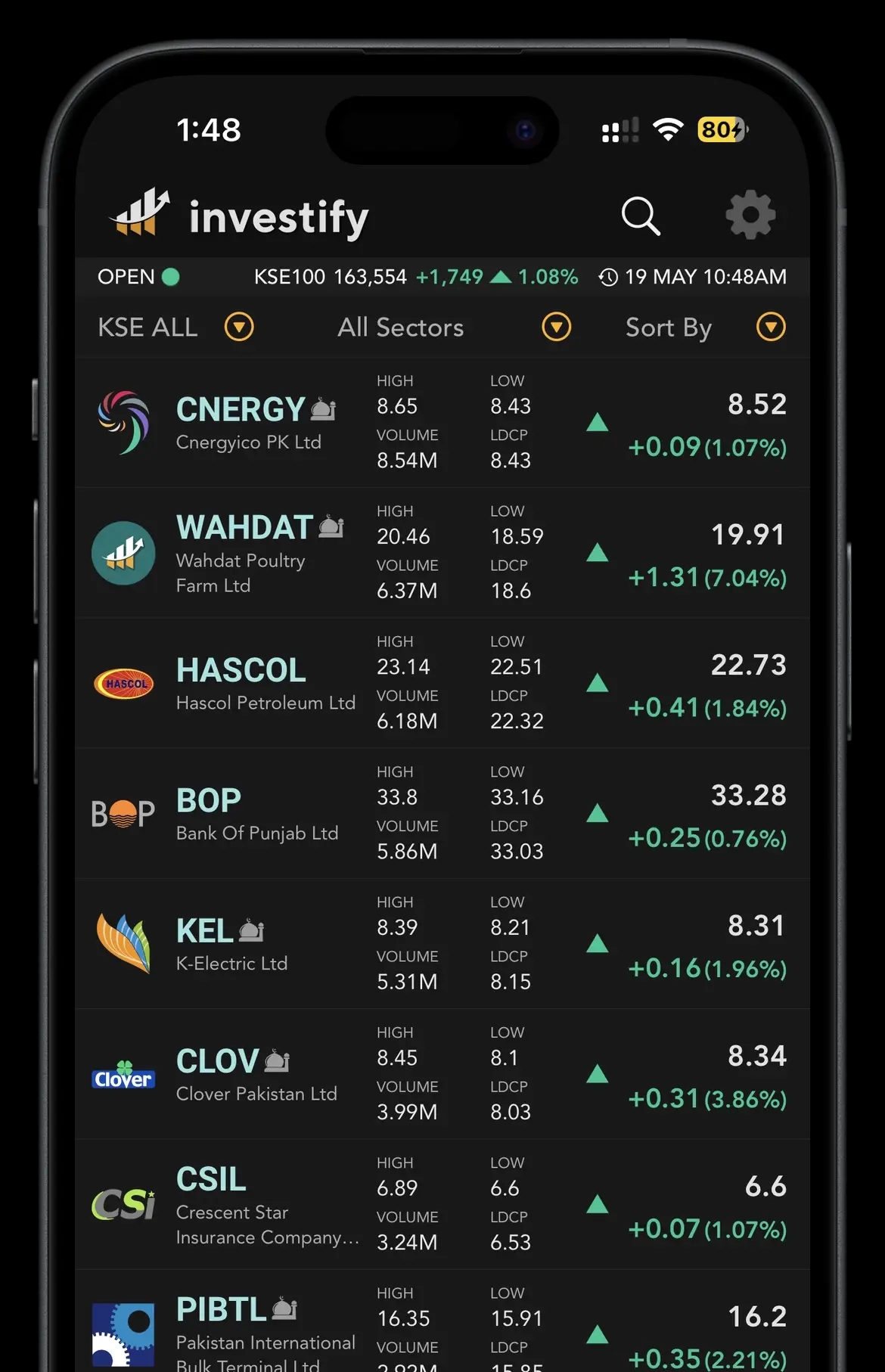
One of the smartest things a beginner can do is research and observe before funding anything. Investify is built for this stage:
- Research shares on detailed stock pages before deciding anything with your broker.
- Watch prices and day ranges to get a feel for how shares move.
- Follow news and announcements that explain why prices move.
- Build a watchlist of companies you are studying.
- Track your portfolio once you do invest, including holdings and dividends.
To be clear: Investify is a PSX market-data, watchlist and portfolio-tracking app, not a broker. It does not execute trades. When you are ready to actually buy or sell, those orders are placed through your licensed securities broker.
Use Investify for your daily PSX workflow
Open market data, stock pages, charts, news, announcements, watchlists and portfolio tracking from one Investify account.
Research PSX stocksBeginner checklist before your first PSX trade
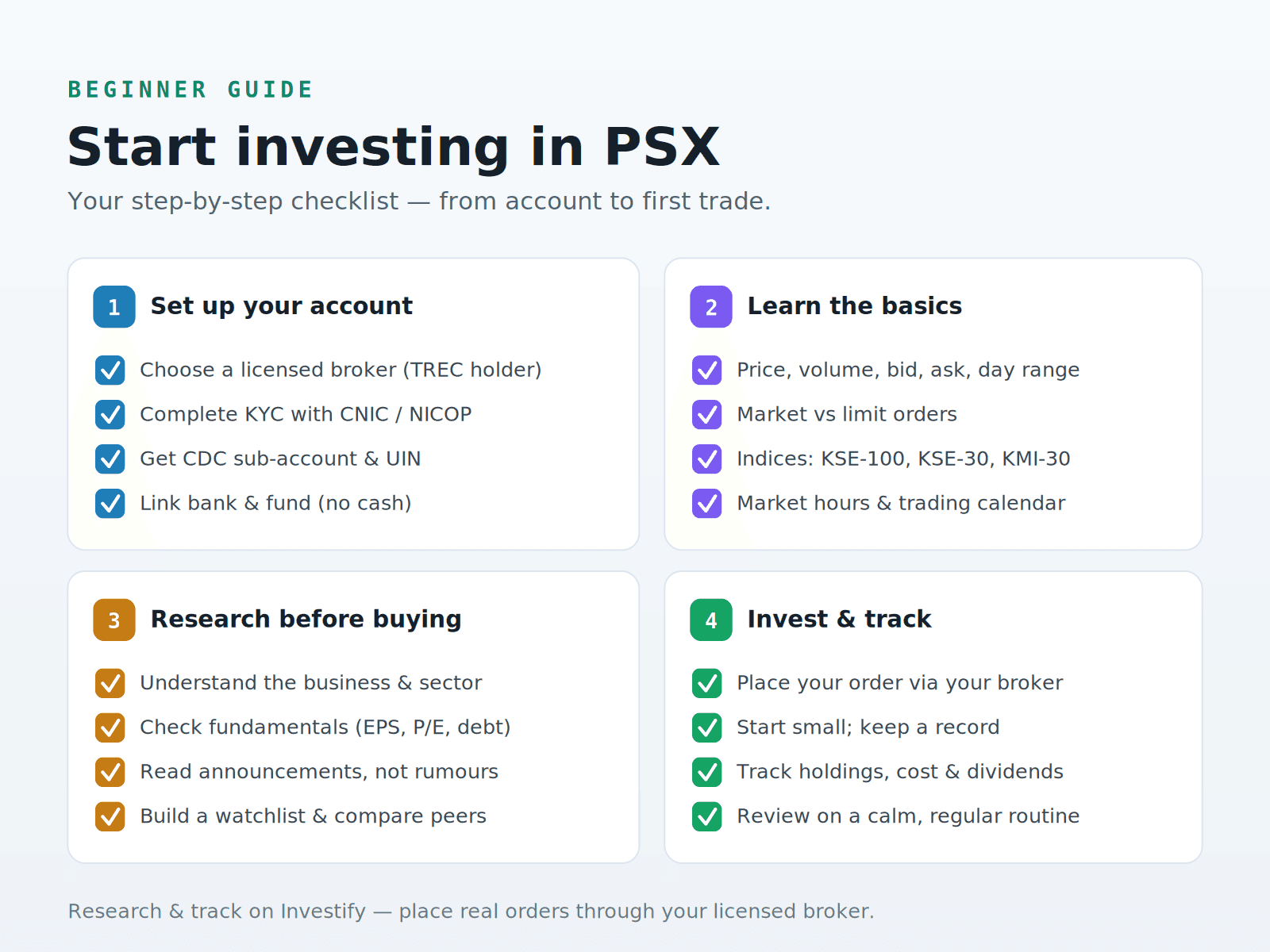
Run through this before you fund an account and place your first order:
- Emergency cash is separate. Keep money you might need soon out of the market.
- No borrowed money. Do not invest with loans or funds you cannot afford to lose.
- You understand your broker's fees. Read the tariff schedule; know commission and charges.
- You know the order basics. Understand how to place an order and what confirmations to expect.
- You checked announcements and fundamentals. Research the company, not tips.
- You have a plan to track it. Set up portfolio and dividend tracking from the start.
- The account is in your own name. Use your own UIN and keep login access secure.
Educational note
This article is for general education only. It explains the factors behind how much to start with on the Pakistan Stock Exchange. It is not personal financial, investment, legal or tax advice, it does not promise returns, and it does not claim any specific amount, stock or strategy is best for everyone.
All amounts and ranges are illustrative. Company symbols are neutral examples, not recommendations. Account limits, charges and tax rules vary by broker and change over time. Verify current details with your broker and official PSX, CDC, NCCPL, SECP and FBR sources, and consult a qualified professional for personal financial or tax matters. Investify is a market-data and portfolio app and is not a broker.
The bottom line
There is no magic minimum to start investing in PSX. Thanks to the one-share lot, you can technically begin with very little: about the price of one affordable share plus charges. But starting well usually means having enough room to diversify a little, absorb charges, and avoid staking everything on one company.
Decide an amount that fits your own life, keep emergency money and borrowed money out of it, and use Investify to research shares, follow news, build a watchlist and track your portfolio. Actual trades should go through your licensed broker.
Related reading
Sources and references