


How to Start Investing in the Pakistan Stock Exchange as a Beginner
Most people in Pakistan have heard that "the stock market" can grow your savings, but very few actually know how to begin, and that gap stops a lot of capable people from ever starting. This guide is built to close that gap completely. If you have never bought a share in your life and are not sure what a broker, CDC account or KSE-100 even means, you are in exactly the right place.
We will walk the whole journey, in plain language, from the right mindset all the way to placing your first order and tracking it afterwards, keeping everything specific to the Pakistan Stock Exchange (PSX) and using real Pakistani market examples so each idea actually sticks. Nothing here assumes prior knowledge. Take it one section at a time and, by the end, you will have a clear, calm plan.
One thing to know up front, because it shapes everything: a tool like Investify helps you research the market and track your investments, but it is not a broker. Your actual buying and selling happens through a licensed securities broker. We will explain exactly what that means as we go.
Quick answer: how do you start investing in PSX?
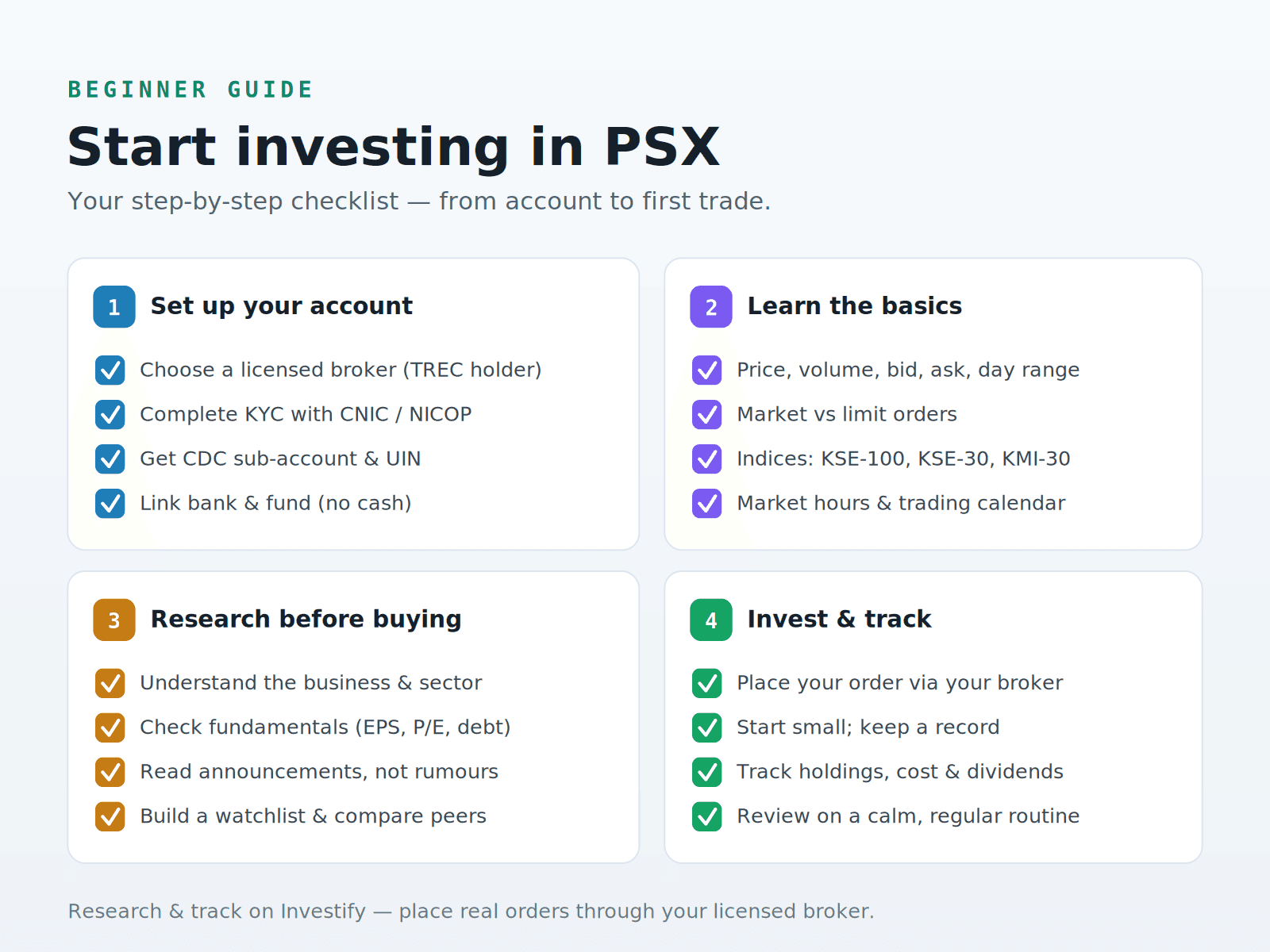
If you want the whole journey in one glance, here are the steps. The rest of the article explains each one properly.
- Learn the basics - understand what a share is and how the market works.
- Decide your capital - choose an amount you can genuinely afford to invest and leave invested.
- Choose a licensed broker - use a broker regulated for PSX trading.
- Open a trading account - complete KYC and the required investor/custody setup.
- Fund your account - through banking channels, not informal cash arrangements.
- Research companies - business, fundamentals, announcements, sector context.
- Place orders through your broker - the broker's platform is where real trades happen.
- Track your portfolio - record holdings, costs, dividends and performance.
- Build a routine - check the market and your watchlist regularly, calmly.
Throughout steps 1, 6, 8 and 9, Investify is your research-and-tracking companion. Steps 5 and 7 happen with your broker. Keep that division clear and the whole process gets much simpler.
What is the Pakistan Stock Exchange?
Let us start from zero. A stock exchange is an organised marketplace where shares of companies are bought and sold. The Pakistan Stock Exchange (PSX) is the regulated platform where investors trade shares in Pakistan's listed companies. PSX has hundreds of listed companies across many sectors, from banks and cement makers to fertiliser, oil and gas, power, technology and more.
Think of it like a giant, regulated market. In a vegetable mandi, buyers and sellers meet and prices are set by what people will pay. PSX is the same basic idea, but instead of vegetables, the goods are tiny ownership slices of real businesses, and instead of haggling face to face, buyers and sellers are matched electronically through licensed brokers.
You will often hear the term KSE-100 and even "KSE" used loosely for the market. That is a leftover from history: the old Karachi Stock Exchange (KSE) merged with the Lahore and Islamabad exchanges in 2016 to form PSX, but the famous index names kept the KSE label. So the exchange is PSX; the KSE-100 is its best-known index. If this distinction is fuzzy, the dedicated explainer clears it up: KSE vs PSX: What Is the Difference?.
The cast of characters is small: listed companies sell shares, shares are the ownership slices, investors are people like you, brokers are licensed firms that place your orders, and PSX is the exchange where it all happens.
Before opening an account: understand what you are buying
Here is the single most important idea in this entire guide, and it changes how you think about everything else:
A share is a small piece of ownership in a real business.
When you buy a share of LUCK as a neutral example, you become a tiny part-owner of a real company, not the owner of a betting slip. If the business does well over time, your slice can become more valuable and may pay you a share of the profits through a dividend. If it does poorly, your slice can lose value.
Because of that, share prices move for real reasons, though often in unpredictable ways. The main drivers include:
- Company earnings - how much profit the business actually makes.
- Expectations - what investors think will happen next.
- News and announcements - results, dividends, management changes and material information.
- Sector conditions - for example, cement demand rising with construction activity or fertiliser demand tied to the farming cycle.
- Liquidity - how easily a share is bought and sold.
- Macro factors - interest rates, inflation, the rupee and the broader economy.
How much money do you need to start?
The honest answer: there is no universal perfect amount. What is enough depends on your finances, risk tolerance and goals.
A few realities to weigh:
- You can start small. In many cases, you can begin with small share quantities, so you do not need a large bundle to learn the mechanics.
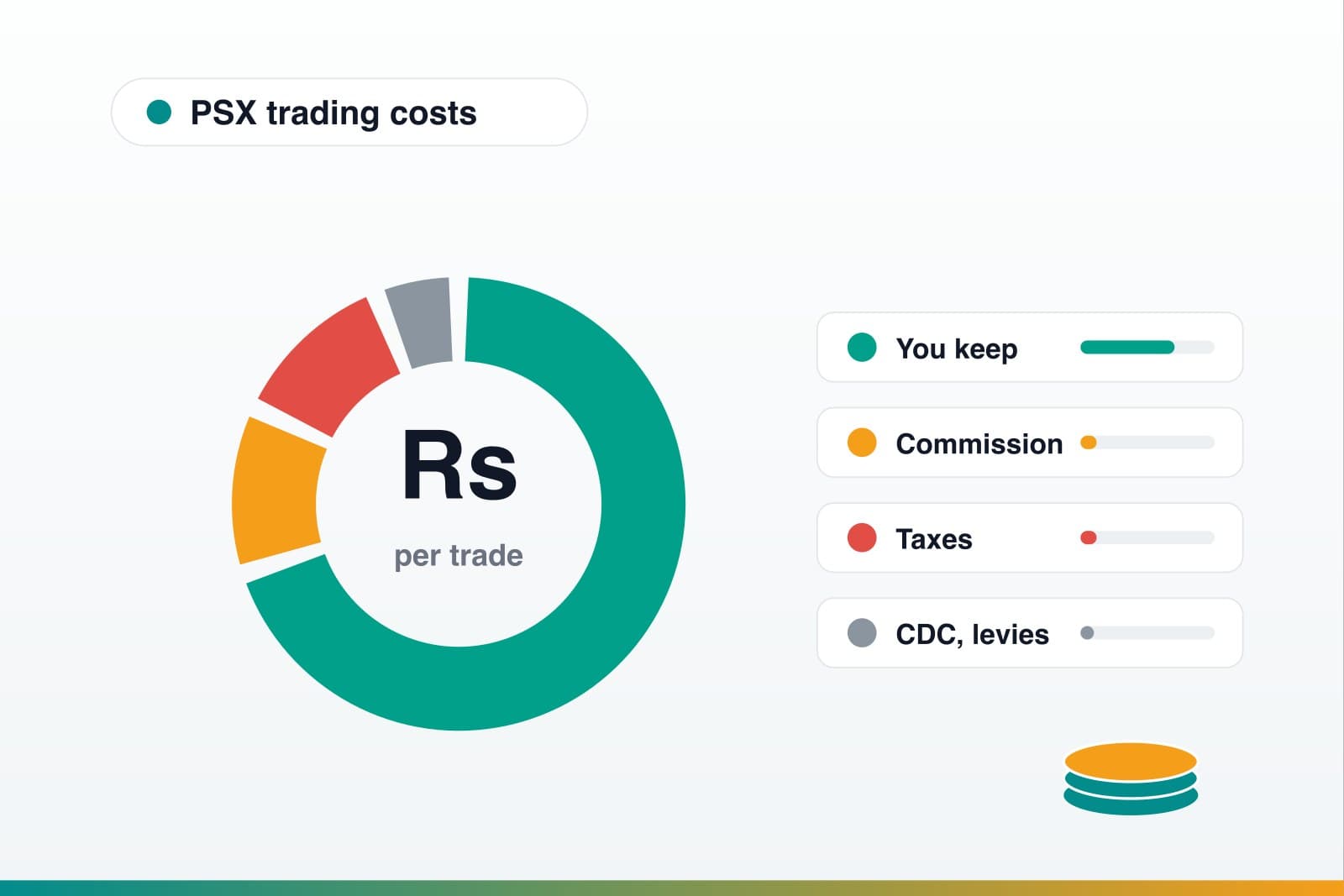
- But very small amounts have limits. Trading involves costs such as brokerage commission, taxes and other charges, and these weigh more heavily on a tiny investment.
- Diversification matters. If your amount is too small, you may be forced into one or two names, which increases concentration risk.
- Think of your first amount as a learning budget. It should be enough to understand the process, but never money you may need soon.
There is no single figure this guide will declare right, because that depends on you. For a fuller discussion of starting amounts, costs and trade-offs, see What Is the Minimum Amount Needed to Start Investing in PSX?. And if you are considering a Sahulat Account, its specific limits and rules are best confirmed in the dedicated account guide and directly with your broker, since such limits can change.
The accounts and parties involved
To buy shares, a few accounts and institutions work together behind the scenes. It sounds like a lot at first, but your broker sets most of it up for you in one application. Here is the plain-language version:
- Broker / TREC holder: the licensed firm through which you place orders. You cannot trade with PSX directly; the broker is your gateway.
- Trading account: your account with the broker, used to place buy and sell orders.
- CDC sub-account: where your shares are held electronically through Central Depository Company infrastructure. Think of CDC as a secure digital custody layer for your shares.
- UIN (Unique Identification Number): a single investor identifier that tags your trades across the market.
- NCCPL: the clearing house that helps settle trades, making sure money and shares change hands correctly.
- Bank account: your own bank account, linked to the trading account, used to deposit funds and receive proceeds and dividends.
A simple way to picture it: the broker is the shopfront where you place orders, CDC is the custody layer that records what you own, and NCCPL is part of the clearing and settlement infrastructure that helps transactions complete properly. For the full, step-by-step setup, see Complete Steps to Open a PSX Trading Account in Pakistan.
Choose a licensed stock broker
Your broker is the most important early decision, more important than your first stock, because everything flows through it. You must use a licensed broker: an active broker/TREC holder regulated for Pakistan capital market trading.
When comparing brokers, look at:
- Licensing status - confirm the firm is active and licensed.
- Account-opening process - many brokers now offer digital onboarding.
- Trading platform - is the app or website stable and easy to use?
- Fees and commission - ask for the full tariff schedule.
- Support - how easily can you reach them, especially as a beginner?
- Research and market data - some brokers provide useful research.
- Branch and digital support - a nearby office matters to some, while others are happy fully online.
- Mobile and web access - make sure it fits how you will actually use it.
There is no single best broker. Different firms suit different investors. The dedicated guide walks through this in detail: How to Choose a Stock Broker in Pakistan.
Open and fund your PSX trading account
Once you have chosen a broker, opening the account follows a clear sequence. The full details, including overseas options, are in the account-opening guide. Here is the overview.
- Choose your broker from the step above.
- Fill the account-opening form and complete KYC, the identity checks regulated firms must do.
- Provide your documents, such as CNIC or NICOP, signature specimen and contact details; biometric or identity verification is standard.
- Link your bank account in your own name for funding and receiving proceeds and dividends.
- Get the required custody and investor identifiers, which are set up as part of onboarding.
- Deposit funds through banking channels into the broker's official designated account.
- Use the broker's platform for real orders once funded.
Make sure your CNIC, mobile number, email and address are consistent across broker and market infrastructure records. Mismatches are a common cause of delays.
If you are an overseas Pakistani, options generally exist to invest from abroad, including routes such as Roshan Digital Account linked investing - see our full guide to investing in PSX through the Roshan Digital Account. Because exact requirements change, verify the current process directly with your bank, your broker and official sources before starting.
Learn the basic PSX terms
Before you read a single stock page, it helps to know the vocabulary. Here are the essential terms every beginner should recognise.
| Term | What it means |
|---|---|
| Symbol / ticker | A short code for a company, such as HBL or OGDC. |
| Last traded price / current price | The price at which the most recent trade happened. |
| Previous close | The final price from the last trading session, used as the baseline for today's change. |
| Change and change % | How much the price has moved versus the previous close, in rupees and percentage terms. |
| Volume | How many shares have traded. |
| Bid | The highest price a buyer is currently willing to pay. |
| Ask / offer | The lowest price a seller is currently willing to accept. |
| Spread | The gap between bid and ask. |
| Day range | The lowest and highest price the share has traded at today. |
| Market order | An order to buy or sell immediately at the best available price. |
| Limit order | An order to buy or sell only at a price you specify or better. |
| Regular market | The main market where ordinary share trading happens. |
| Index | A single number summarising a group of companies, such as the KSE-100. |
Two of these deserve their own deep-dives: for how all the numbers on a quote fit together, see How to Read a PSX Stock Quote: Price, Volume, Bid, Ask and Day Range; and for when the market is open, see PSX Market Hours and Trading Calendar.
Understand indices before stocks
Before judging any single share, glance at the indices. They tell you how the whole market, or a big slice of it, is doing. The three a beginner should know:
- KSE-100 - the main benchmark for the Pakistan stock market.
- KSE-30 - a narrower index of liquid large-cap companies.
- KMI-30 - a Shariah-compliant benchmark of screened companies.
Why look at indices first? Because one stock is not the market. Imagine you check a share you own and it is down 1%. You might panic. But if you first glanced at the KSE-100 and saw the whole market down that day, you would understand your stock may simply be moving with the tide, not suffering a company-specific problem. The full explainer is here: KSE100, KSE30 and KMI30 Explained for Beginners.
Build your first watchlist before buying
Here is a habit that separates calm investors from rushed ones: watch before you buy. A watchlist is a saved list of companies you want to follow, so you can learn how they behave without putting money in yet.
A practical approach is to group your watchlist by theme:
- Banks such as HBL or MEBL
- Cement such as LUCK
- Oil and gas such as OGDC
- Fertiliser such as EFERT
- Technology
- Dividend-paying names you are studying
- High-volume stocks you want to monitor
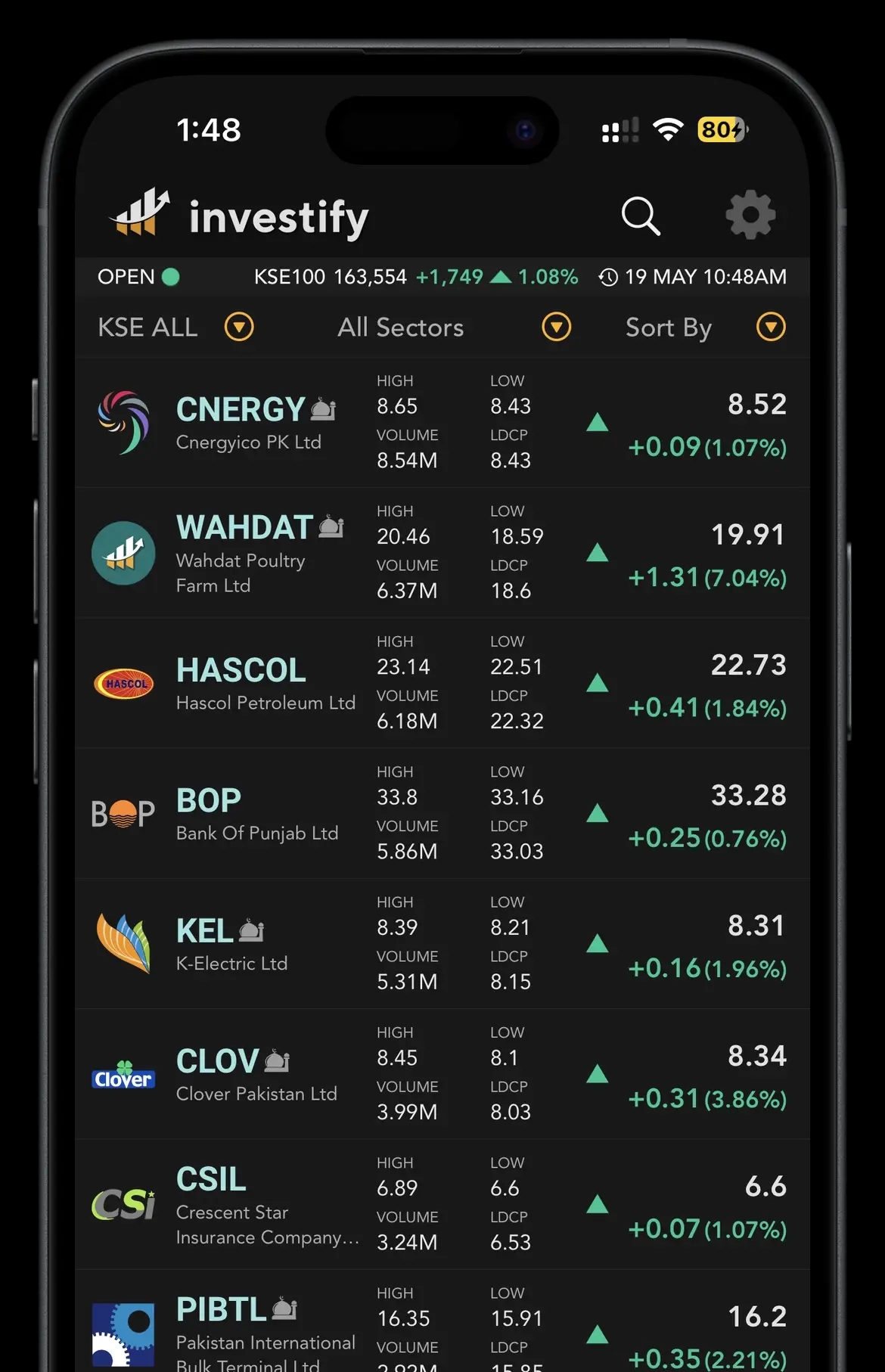
These are neutral examples to show how to organise a watchlist, not recommendations to buy. On Investify, you can build watchlists and see followed companies' latest prices and announcements in one place. Spend time here first: watching a handful of companies for a few weeks teaches you more than rushing into a purchase.
How to research a PSX company before buying
When a company on your watchlist interests you, research it properly before buying. You are trying to answer one question: Do I understand this business and want to own a piece of it?
A sensible checklist:
- Business model - what does the company actually do and how does it make money?
- Sector - how is the company's whole industry doing?
- Financials - is it profitable, and how is it trending?
- Announcements - what has the company recently filed?
- Annual and quarterly reports - the company's own disclosures.
- News - relevant developments, traced back to primary sources.
- Chart and volume - how has the price behaved, and how actively does it trade?
For example, a fertiliser company like EFERT earns by making and selling fertiliser, so its fortunes tie to agriculture and input costs. A cement maker like LUCK depends on construction and infrastructure demand. A bank like HBL earns largely from lending and deposits, which connects it to interest rates. These examples show how business models differ; they are not recommendations.
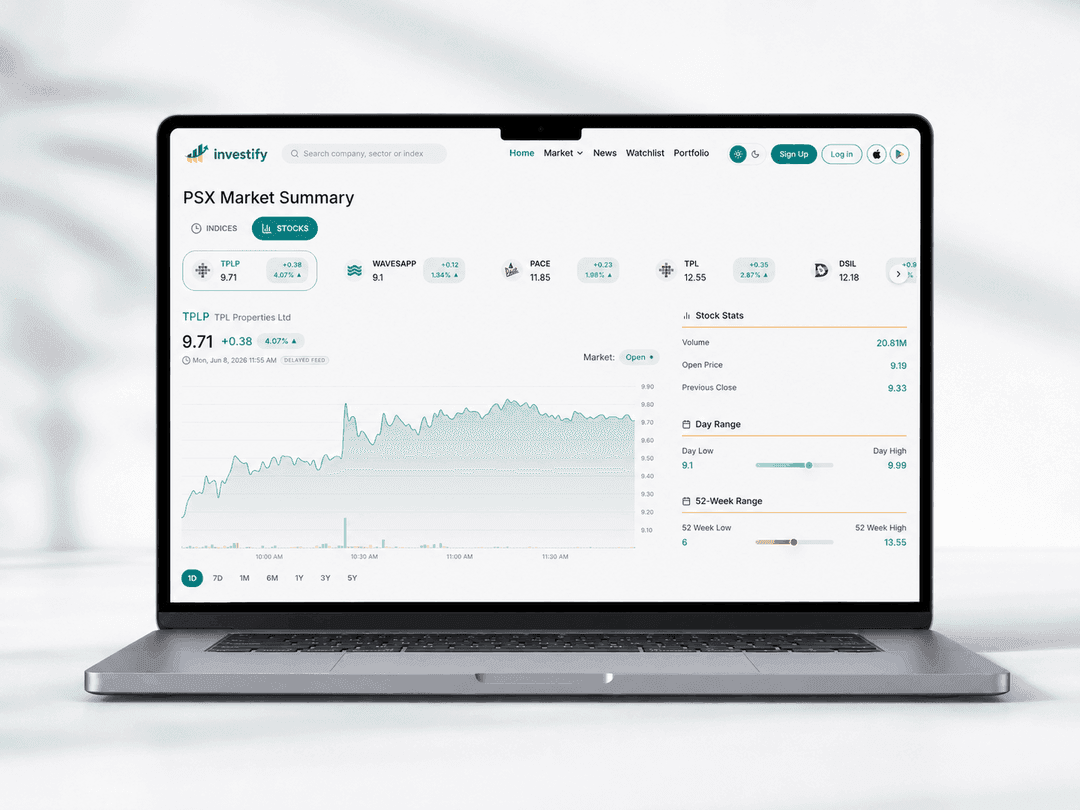
Investify's stock pages are built for this: each company page brings together its quote/live price, chart, fundamentals, technicals, announcements, profile and competitor or related context where available. The full method is in How to Research PSX Companies Before Buying Shares.
Read fundamentals without overcomplicating them
Fundamentals are the numbers that describe a company's financial health and value. You do not need to be an accountant. Start with a handful:
- EPS (earnings per share) - profit divided by the number of shares.
- P/E (price-to-earnings) - the share price divided by EPS.
- Dividend yield - annual dividend as a percentage of the share price.
- Payout ratio - what portion of profit is paid out as dividends.
- Book value - the company's accounting net worth per share.
- Debt - how much the company owes.
- Profit margins - how much profit the company keeps from its sales.
Use charts for context, not prediction
A price chart shows how a share has moved over time. It is useful for context, but it is a record of the past, not a prediction of the future. Investify's charts typically offer periods like 1D, 7D, 1M, 6M, 1Y, 3Y and 5Y.
Two simple habits get you most of the value:
- Zoom out before you zoom in. Look at a 1Y or 3Y view first to see the overall trend, then a 1M or 7D view for recent movement.
- Read the volume bars beneath the price to see whether a move happened on heavy participation or just a few thin trades.
Follow PSX announcements and news
This is one of the most valuable daily habits, and beginners often skip it. Listed companies file announcements through PSX, including financial results, dividend declarations, board-meeting notices and corporate actions. This is material information: official facts that frequently explain why a share is moving.
The practical lesson: when a stock jumps or drops, your first question should be is there an announcement? not what is the rumour? Announcements are primary, verified information; tips are not. Investify surfaces company announcements and market news alongside the data, so you can connect a price move to the filing behind it.
Use Investify for your daily PSX workflow
Open market data, stock pages, charts, news, announcements, watchlists and portfolio tracking from one Investify account.
Open InvestifyDecide your beginner strategy
Strategy sounds intimidating, but it really means deciding how you want to invest, in line with your goals and risk tolerance. A few common choices:
- Long-term investing vs short-term trading. Long-term investors buy shares of businesses they understand and hold through market cycles. Short-term trading tries to profit from quicker price moves, which is harder, riskier and often more cost-heavy.
- Dividend investing vs growth investing. Some investors prefer steady-paying dividend companies for income; others prefer growth companies they hope will rise in value over time. Each has trade-offs, explained here: Dividend Stocks vs Growth Stocks on PSX.
- Sector diversification. Spreading your money across different sectors softens the blow if one industry struggles.
- Cash allocation. You do not need to invest everything at once; keeping some cash gives flexibility.
- Risk tolerance. Be honest about how much volatility you can stomach without losing sleep.
There is no universally best strategy. The right one fits your goals, time horizon and temperament.
Place your first order through your broker
When you have researched a company and decided to invest, you place the order on your broker's platform. This is the step that does not happen on Investify or any market-data app. Two basic order types:
- Market order - buys or sells immediately at the best available price.
- Limit order - buys or sells only at a price you set or better.
After your order executes, you should receive a trade confirmation. As of 2026, regular ready-market settlement on PSX has moved to a T+1 settlement cycle, meaning settlement generally happens one business day after the trade date. Always verify current settlement mechanics and exceptions with PSX, NCCPL or your broker. Keep a record of every purchase: symbol, quantity, price and date.
Track your portfolio after buying
Buying is only half the job; tracking is what keeps you in control over time. For each holding, you want to know your average cost, your gain or loss, the dividends you have received, your sold history and your reason for buying.
Why bother? Because a single balance figure on a broker screen hides a lot. It may not clearly show your cost basis, dividends as a separate stream of return, or whether you have become too concentrated in one stock or sector. Good records turn vague feelings into clear facts.
Investify's portfolio tools let you record holdings, buy/sell activity and dividends, and see your average cost, gains and losses, and allocation in one clean view. As always: Investify tracks; your broker executes. The complete approach is in How to Create and Track a PSX Stock Portfolio.
A simple weekly routine for beginner PSX investors
You do not need to watch the market all day. In fact, that usually leads to worse decisions. A light, consistent routine works far better:
| Cadence | Time | What to do |
|---|---|---|
| Daily | 5-10 min | Check the market overview, glance at your watchlist, and scan announcements for holdings and watchlist companies. |
| Weekly | Around 30 min | Review your portfolio, read company updates and relevant news, and update your notes. |
| Monthly / quarterly | Longer | Read quarterly results and dividend announcements, and review annual or quarterly reports for businesses you own. |
This rhythm keeps you informed without tipping into obsessive, emotion-driven checking. For a deeper version of the daily habit, see How to Use Investify as Your Daily PSX Market Watch.
Common beginner mistakes to avoid
Most early losses come from a short list of avoidable mistakes. Knowing them in advance is half the battle:
- Buying tips blindly without understanding the company.
- Chasing gainers - piling into whatever rose most today.
- Panic-selling during normal market dips.
- Ignoring announcements that explain what is really happening.
- Ignoring fees and taxes, which quietly reduce returns.
- Concentrating everything in one stock or one sector.
- Overtrading - buying and selling too often, racking up costs.
- Keeping no records, so you cannot learn from your decisions.
- Not understanding the business you are investing in.
Each of these is unpacked in Common Mistakes Beginners Make in the Pakistan Stock Exchange.
Beginner checklist: before you buy your first PSX share
Run through this simple checklist before you confirm any first purchase. If you can honestly tick every box, you are approaching it the right way:
- I understand the company - what it does and how it earns.
- I checked the latest quote and volume.
- I checked recent announcements.
- I checked basic fundamentals.
- I compared sector context - how peers and the index look.
- I know my risk and how much I could lose.
- I know my order type - market vs limit.
- I am using a licensed broker.
- I can afford the risk - this is not emergency or borrowed money.
- I recorded my reason for buying, so I can review it later.
Educational note
This article is for general education only. It is not investment, financial, legal or tax advice, it does not recommend buying or selling any security, and it does not promise or guarantee any return. Company names and symbols mentioned, such as HBL, OGDC, LUCK, MEBL and EFERT, are used purely as neutral examples to explain concepts. They are not recommendations. Rules, fees, account requirements and tax treatment vary and change over time. Always verify current details with your licensed broker and official sources such as PSX, SECP, CDC, NCCPL and, for tax, FBR. Consult a qualified professional for guidance specific to your situation. Investify is a market-data, research and portfolio-tracking app and is not a broker; real orders are placed through your licensed securities broker.
The bottom line
Starting on the Pakistan Stock Exchange is not complicated once you see the whole path: understand that a share is a piece of a real business, decide an amount you can afford, open an account with a licensed broker, learn the basic terms and indices, research before you buy, place your first order through your broker, and then track your portfolio with a calm, consistent routine. Do that, and you have already avoided the mistakes that trip up most beginners.
The mindset matters as much as the mechanics: be calm, informed and consistent rather than rushed, emotional or tip-driven. Markets reward patience and punish panic. And as you go, Investify can be your daily PSX companion for market data, stock research, news, announcements, watchlists and portfolio tracking, while your actual trades happen through your licensed broker. Start small, keep learning, and let good habits compound over time.
Sources and references
- Pakistan Stock Exchange (PSX)
- PSX - Investing 101: Stock Market for Beginners
- PSX - Guide to Investors
- PSX - T+1 settlement cycle implementation
- PSX Data Portal (DPS)
- SECP - Securities & Exchange Commission of Pakistan
- SECP - Jamapunji Investor Education
- CDC Pakistan - Central Depository Company
- NCCPL - National Clearing Company of Pakistan
- FBR - Federal Board of Revenue
- Investify - PSX market data, research, watchlist and portfolio