



How to Research PSX Companies Before Buying Shares
When you buy a share on the Pakistan Stock Exchange (PSX), you are not buying a lottery ticket or a number on a screen. You are buying a small slice of a real business, with real revenue, real debt, real management and real risks.
That simple shift in mindset changes the research process. The question stops being only "is the price going up?" and becomes "is this a business I understand, and does the current price make sense for the risk?"
This guide gives you a repeatable research workflow for PSX-listed companies. It will not tell you what to buy, and no amount of research removes market risk. But a good routine removes many avoidable mistakes, and that is worth a lot.
Key takeaways
- A share is part of a business. Research the company, not just the price line.
- Build a repeatable workflow: what it does, quote/chart, fundamentals, announcements, sector, reports, news, watchlist and written reason.
- Fundamentals and charts answer different questions. Use them together, and treat technicals as context, not commands.
- Read primary sources such as PSX filings, announcements and annual or quarterly reports.
- A good company is not automatically a good buy at any price, and research reduces avoidable mistakes but does not remove market risk.
- Investify is a research and tracking app, not a broker. Real orders go through your licensed broker.
1. Start with what the company actually does
Before any numbers, answer the most basic question: how does this company make money? What does it sell, who buys it, and what affects its business? Fuel prices, interest rates, the rupee, government policy, energy costs and global commodity prices can all matter depending on the sector.
This matters because it frames everything else. A bank, cement maker, fertiliser producer and technology company each earn differently, so the numbers you look at, and what counts as normal, depend on understanding the business first.
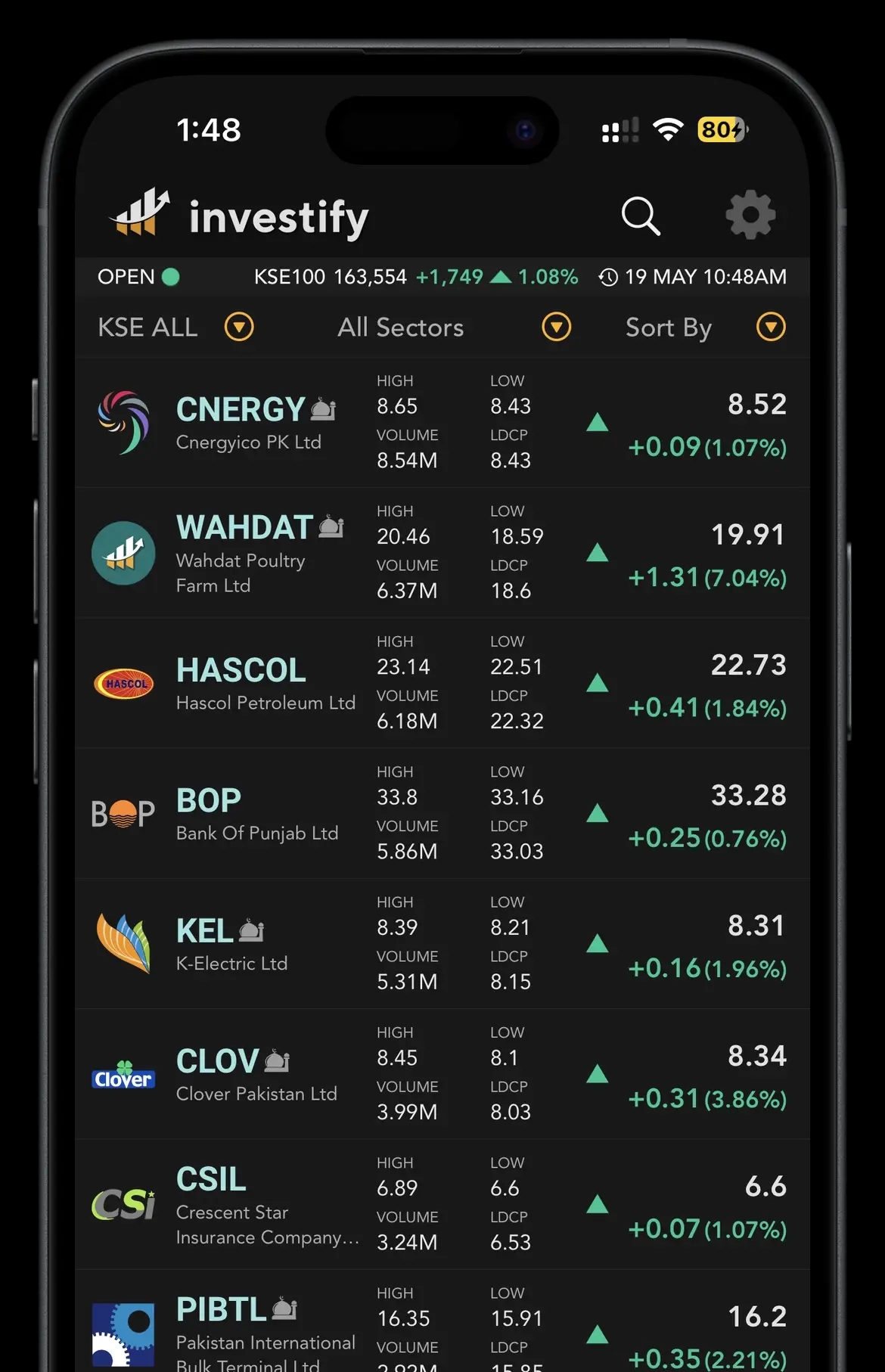
You might open a stock page like HBL, MEBL or OGDC to see the company name, sector and basic market context. These are neutral examples only, not recommendations.
2. Read the stock quote, chart and volume first
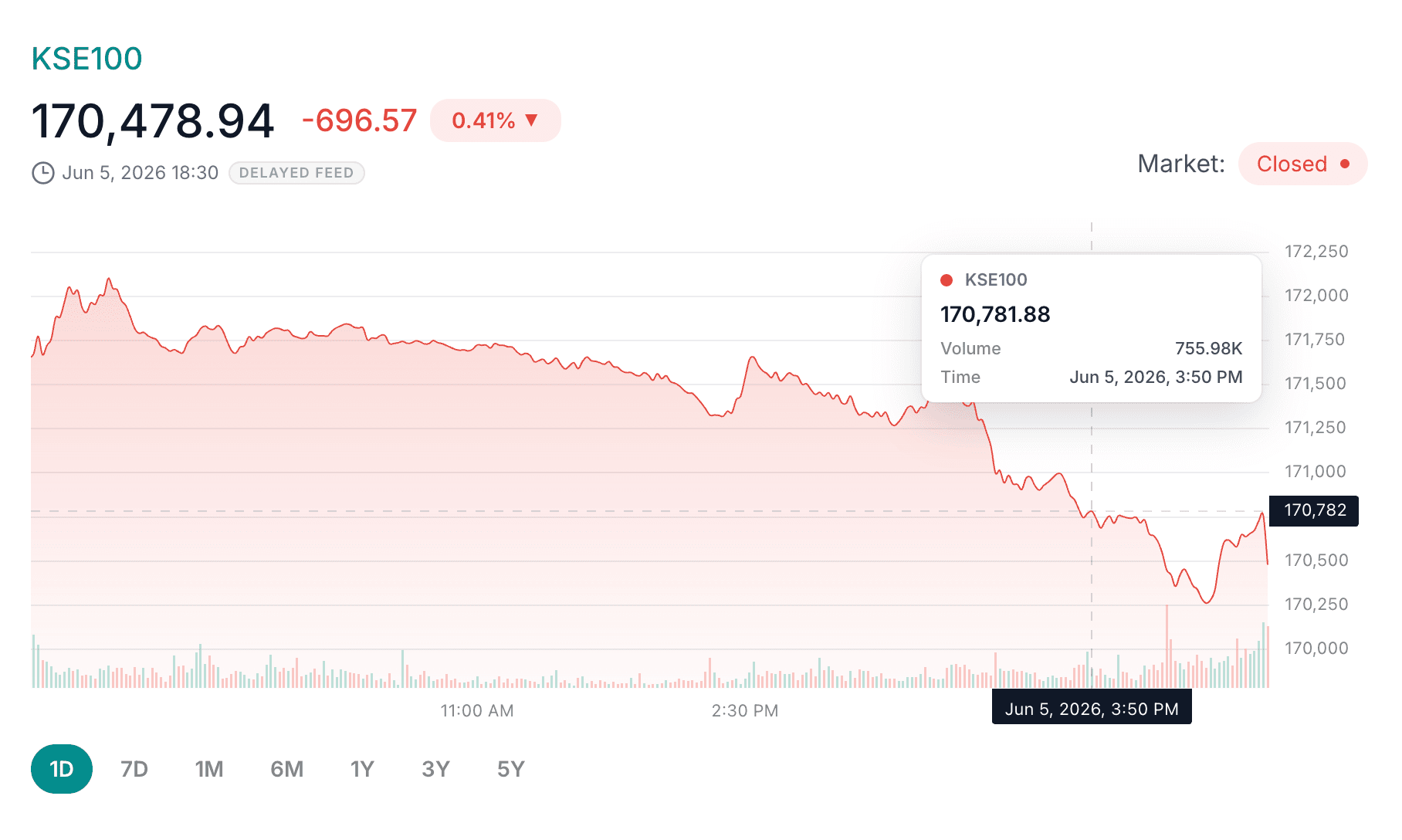
Next, get the lay of the land from the quote page: the current price, change, timestamp, chart and volume. This is not where you decide everything. It is where you orient yourself.
On the chart, zoom out before you zoom in. Look at a 1Y or 3Y period for the broader trend, then 1M or 7D for recent movement. Glance at volume to see whether recent moves happened on heavy participation or thin trading. The goal is context: where has this price been, and how actively is it trading?
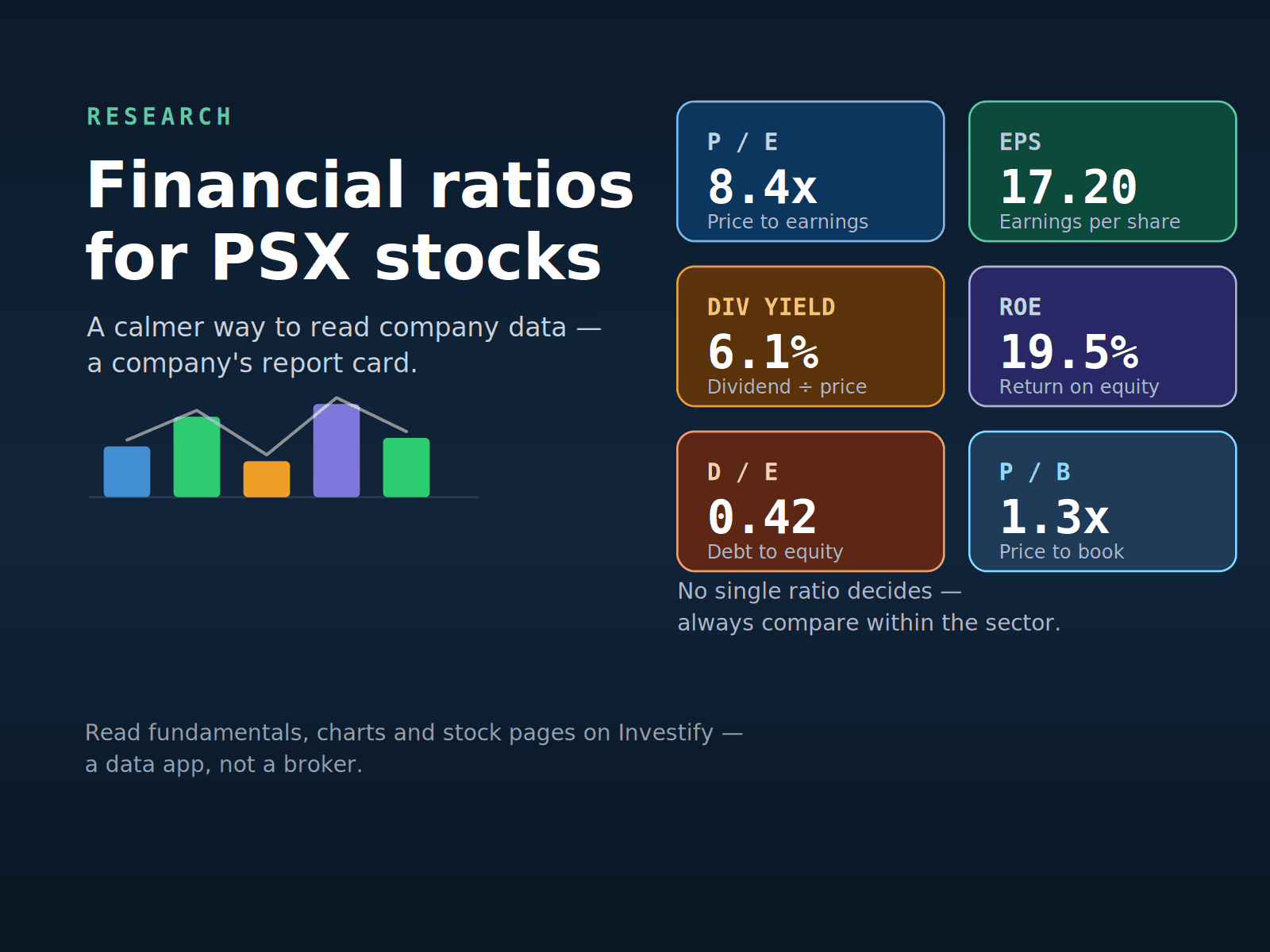
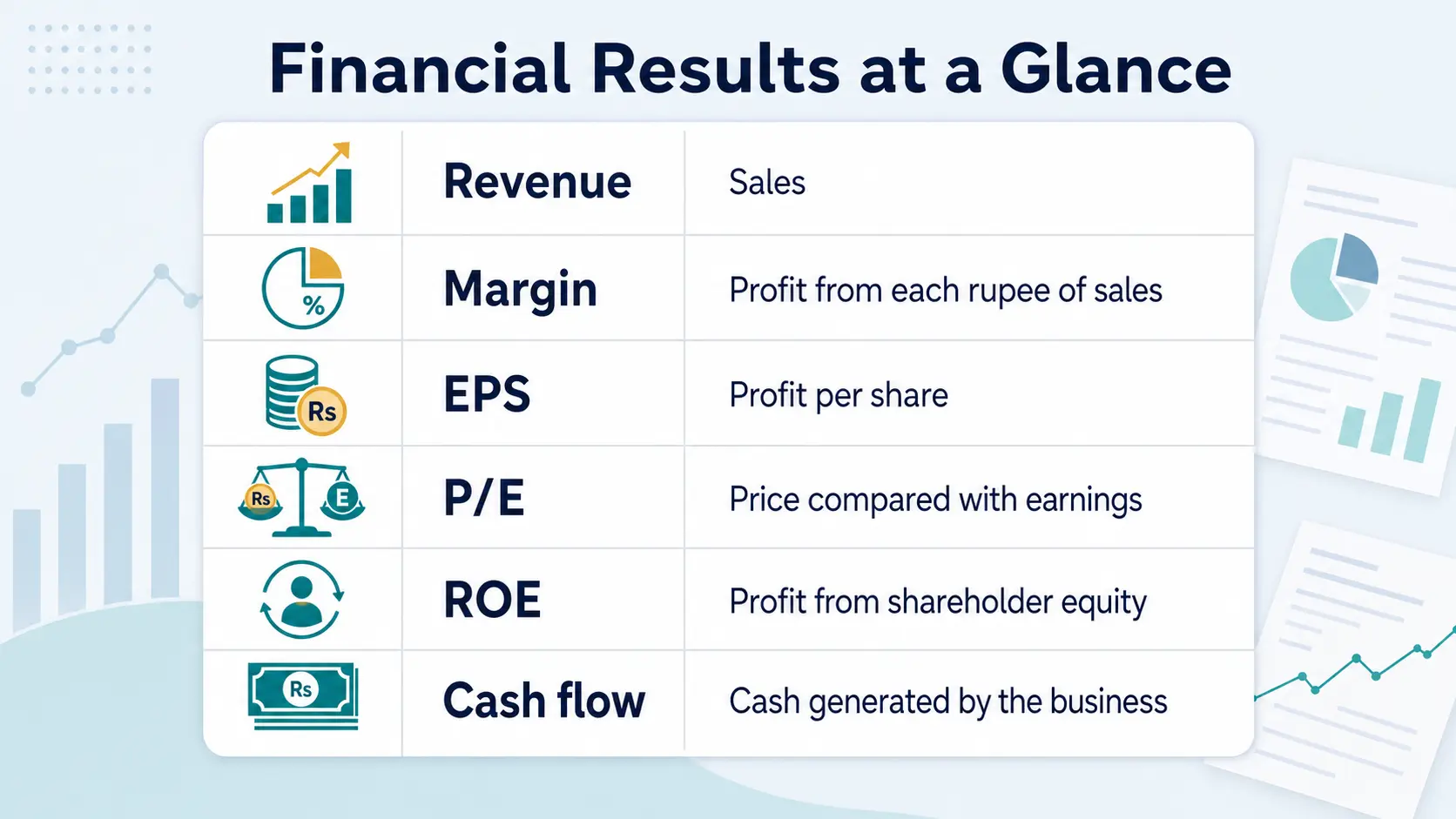
3. Check fundamentals: earnings, EPS, P/E, payout, dividends and ratios
Now move to the substance. The Fundamentals tab, for example HBL fundamentals, shows financial and valuation context such as earnings, EPS, P/E, payout, dividends and key ratios where available. This is where you start judging the business, not just the price.
| Item | What it tells you | Beginner caution |
|---|---|---|
| EPS (earnings per share) | Profit earned per share | A jump can come from a one-off gain, not core business, so check why |
| P/E ratio | Price paid per rupee of earnings | Low is not automatically cheap; compare within the same sector |
| Book value | Accounting net worth per share | Can be affected by asset revaluations or old asset values |
| Payout ratio | Share of profit paid as dividends | Very high payouts may be hard to sustain |
| Dividend yield | Dividend income relative to price | A high yield can mean a falling price, not generosity |
| Debt-to-equity | How much the company relies on borrowing | Healthy levels differ by sector; high debt adds risk when rates rise |
| Profit margin | Profit kept from each rupee of sales | Watch for one-off items and cyclical swings |
| Cash flow | Actual cash the business generates | Profit on paper is not the same as cash in hand |
| Revenue growth | Whether the top line is expanding | One good quarter is not a trend; look across periods |
The golden rule with fundamentals: compare within the same sector, and never judge on a single number or one year.
4. Read PSX announcements before buying
This is the step beginners often skip. Listed companies file announcements through PSX: financial results, dividend declarations, board-meeting notices and corporate actions. These often explain exactly why a price is moving.
Buying without checking announcements means you can walk into a stock right after material news you did not know about.
On Investify, the Announcements tab, for example HBL announcements, gathers these filings alongside the price and fundamentals. Always scan recent announcements before acting.
5. Use technicals as context, not as commands
Investify's Technicals tab, for example HBL technicals, shows momentum indicators and reference levels such as RSI, STOCH, MACD, moving averages, pivot points and support or resistance. These can add useful context about trend and momentum.
But hold them lightly: no indicator is a buy or sell signal on its own, and none guarantees the future. RSI's overbought or oversold zones can stay stretched in strong trends. MACD crossovers are context, not certainty. Support and resistance levels can break on news. Use technicals to inform trend awareness, never as automatic instructions.
6. Compare the company with its sector
A company never exists in a vacuum. To judge whether its numbers are good, compare it with sector peers. A profit margin, P/E ratio or debt level only means something relative to similar businesses: banks against banks, cement against cement, fertiliser against fertiliser.
A figure that looks alarming in one sector can be normal in another. Sector comparison also helps you see whether a company is keeping up with, leading or lagging its industry.
7. Read annual reports and quarterly financial statements
For deeper research, go to the source: the company's annual report and quarterly financial statements, which are filed through PSX and available through official company or PSX/DPS channels. You do not need to read every page. Focus on:
- The financial statements: income statement, balance sheet and cash flow.
- The chairman's or directors' review, which explains the period in management's words.
- The notes, especially those on debt, contingencies and unusual items.
These are primary-source documents and usually much more useful than second-hand summaries. Reading even parts of them puts you ahead of most casual investors.
8. Check debt, cash flows and profitability
Three things deserve special attention because they reveal a company's resilience:
- Debt: How much does the company owe, and can it service that debt if interest rates or business conditions change?
- Cash flows: Is the business generating real cash, or only reporting accounting profit?
- Profitability: Are margins steady, improving or shrinking, and why?
Together these tell you whether a business is solid or stretched. A price chart alone cannot show that.
9. Look for dividends, bonus shares and corporate actions
Part of a company's return picture can come from dividends, bonus shares, rights issues and other corporate actions. These are announced through PSX. A company's dividend history and policy can tell you about consistency and how it treats shareholders.
Just remember that past dividends do not guarantee future ones, and a high yield can sometimes reflect a falling price rather than strength.
10. Follow news, but separate news from noise
News gives context that filings cannot always give: industry shifts, policy changes, management moves or macroeconomic developments. But not all news is equal.
Signal is verifiable information that affects the business, such as a results announcement or regulatory change. Noise is rumour, hype and speculation dressed up as insight.
A good habit: when news moves a price, trace it back to a primary source such as a PSX announcement or company statement before treating it as fact.
11. Use external official and reputable sources
Beyond Investify, several official and reputable sources can strengthen your research. Use them together. Each has a role and a limitation.
| Source type | What it helps with | Caution |
|---|---|---|
| PSX website and Data Portal | Filings, announcements, notices, market data and financial reports | Data is as-is; verify latest filing dates |
| Company annual and quarterly reports | Financials, management review and notes | Long documents; focus on statements, review and key notes |
| SECP | Regulatory framework and investor resources | Regulatory, not stock-specific advice |
| CDC / NCCPL | Custody, clearing, tax and market infrastructure topics | Operational topics, not company analysis |
| Broker research reports | Analyst views, sector context and estimates | Opinions with assumptions and possible interests; read critically |
| Business news coverage | Context, events and industry developments | Separate verified news from speculation |
12. Build a watchlist before buying
Research is rarely a one-day job. Use a watchlist to follow the companies you are studying. Track their prices, announcements and news over time so you understand how a company behaves through different market conditions before you commit money.
Watching first and buying later is one of the calmest habits an investor can build.
13. Write down your investment reason
Before you buy, write a short note: why you are buying, roughly what price you are considering, what you expect from the business, and what would make you reconsider.
This single habit does more than it looks. Months later, when the price moves, you can re-read your own reasoning instead of reacting to fear or hype.
A simple PSX company research checklist
Run this in order before buying:
- Understand the business: what it does and how it earns.
- Read the quote and chart: orient on price, trend and volume.
- Check fundamentals: earnings, profitability, debt, dividends and ratios.
- Scan PSX announcements: results, dividends, board meetings and corporate actions.
- Glance at technicals: momentum context, not commands.
- Compare with sector peers: judge the numbers in context.
- Read the reports: annual and quarterly statements, review and key notes.
- Assess debt, cash flow and profitability: is the business solid or stretched?
- Follow the news: separate signal from noise and trace claims to primary sources.
- Use official sources: PSX/DPS, SECP, CDC/NCCPL and company filings.
- Add to a watchlist: observe over time before committing.
- Write your reason: a short note you can revisit.
Here is a consolidated view of that same workflow:
| Step | What to check | Why it matters | Where to look |
|---|---|---|---|
| Quote and chart | Price, trend, volume | Orientation and context | Investify quote page; PSX/DPS market data |
| Fundamentals | Earnings, ratios, debt, dividends | Judges the business and valuation context | Investify Fundamentals tab; annual and quarterly reports |
| Announcements | Results, dividends, corporate actions | Explains price moves and avoids surprises | Investify Announcements tab; PSX/DPS |
| Annual report | Audited statements, review, notes | Primary-source depth | PSX/DPS financial reports; company investor relations pages |
| Sector comparison | Peers' ratios and performance | Numbers only mean something in context | Investify; PSX/DPS; sector data |
| News | Industry, policy, company events | Context beyond filings | Reputable business news; primary sources |
| Watchlist and notes | Ongoing tracking and written reason | Calmer, accountable decisions | Investify watchlist and portfolio tools |
Use Investify for your daily PSX workflow
Open market data, stock pages, charts, news, announcements, watchlists and portfolio tracking from one Investify account.
Research PSX companiesEducational note
This article is for general education only. It explains a research workflow for Pakistan Stock Exchange companies. It is not investment, financial, legal or tax advice, it does not promise returns, and it does not recommend buying or selling any security.
Company symbols mentioned are neutral examples used to show the workflow, not recommendations. Research reduces avoidable mistakes but does not remove market risk. Prices can fall regardless of how thorough your homework is. Verify current information from official sources such as PSX, SECP, CDC, NCCPL and company filings, and consult a qualified professional for personal financial or tax matters.
The bottom line
Researching a PSX company before buying comes down to mindset and routine. Remember that you are buying part of a business, then work through the same checklist every time: understand what it does, read the quote and chart, dig into fundamentals, check announcements, compare with the sector, read reports, weigh debt and cash flow, follow news, and write down your reason.
Use Investify stock pages, fundamentals, technicals, announcements, watchlists and portfolio tools to run this workflow in one place. Place any actual trade through your licensed broker. Good research will not make you right every time, but it can make your decisions more informed, deliberate and less prone to avoidable mistakes.
Related reading
Sources and references