Pakistan has more than one exchange rate. Banks trade with each other at the interbank rate, exchange companies buy and sell cash in the open market, and banks quote their own customers in between. Here is each one for today, with its source.
Every chinese yuan rate, side by side
Rate
Buying
Selling
Updated
Bank customer rateSBP weighted average of what banks quote customers
41.42
41.480.00
November 16, 2026
National Bank (NBP)NBP's morning rate sheet, transfers up to USD 5,000
41.48
41.55+0.03
November 17, 2026
InterbankState Bank of Pakistan closing rate between banks
41.48+0.02
November 16, 2026
How far above interbank
Each selling rate minus the interbank rate, in rupees per 1 CNY. The gap is what the counter adds.
National Bank (NBP)+0.07
Bank customer rate0.00
Interbank (SBP), the zero line: 41.48
Converter
CNY to PKR converter
Convert at the rate that fits what you are doing. Selling foreign cash at an exchange company uses the open market buying rate; buying it uses the selling rate. Money sent home through a bank arrives close to the bank and interbank rates.
You get about
This rate is not published for this currency.
Indicative. Exchange companies and banks set their own counter rates, which can differ by amount, city and time of day.
CNY to rupees today
Amount
Open market (you sell)
Interbank
1 CNY
-
Rs 41.48
100 CNY
-
Rs 4,148
1,000 CNY
-
Rs 41,479
All currencies
Currency rates in Pakistan today
Open market buying and selling rates and the State Bank's interbank rate for the currencies Pakistanis use most, from the Gulf to North America. Rupees per one unit of each currency.
National Bank of Pakistan publishes a rate sheet every working morning: what it charges its customers to buy or sell currency by transfer (TT) and as cash notes. These are one bank's rates, set at the start of the day, for amounts up to USD 5,000.
NBP exchange rate today: Tuesday, November 17, 2026
How the rupee has moved against this currency: the open market selling rate, the State Bank's interbank rate and the international market rate, day by day.
Use the left and right arrow keys to move through the days.
High (Open market selling, 3M)
38.99
3 Sept 2026
Low (Open market selling, 3M)
38.85
12 Oct 2026
Change (Open market selling, 3M)
0.00
0.00%
Daily closing values. Open market history starts from what dealers and ECAP published; interbank before our own records comes from the State Bank's published rates.
Daily rates
Chinese Yuan rate in Pakistan, last 30 days
The closing rate for each working day. The interbank rate is the State Bank's; the open market rates are the dealers' (or ECAP's close where dealers have none).
Chinese Yuan rate in Pakistan, last 30 days
Date
Interbank
Open buying
Open selling
Change
17/11/2026Tuesday
-
38.55
38.90
-
16/11/2026Monday
41.48
38.55
38.90
+0.02
13/11/2026Friday
41.46
38.55
38.90
−0.02
12/11/2026Thursday
41.48
38.55
38.90
+0.01
11/11/2026Wednesday
41.47
38.55
38.90
−0.01
10/11/2026Tuesday
41.49
38.55
38.90
+0.01
06/11/2026Friday
41.48
38.55
38.90
0.00
05/11/2026Thursday
41.48
38.55
38.90
+0.03
04/11/2026Wednesday
41.45
38.55
38.90
−0.01
03/11/2026Tuesday
41.46
38.55
38.90
−0.18
02/11/2026Monday
41.64
38.55
38.90
+0.06
30/10/2026Friday
41.58
38.55
38.90
+0.04
29/10/2026Thursday
41.55
38.55
38.90
+0.03
28/10/2026Wednesday
41.52
38.55
38.90
0.00
27/10/2026Tuesday
41.51
38.55
38.90
0.00
26/10/2026Monday
41.51
38.50
38.95
+0.02
23/10/2026Friday
41.50
-
-
+0.01
22/10/2026Thursday
41.49
38.45
38.90
+0.03
21/10/2026Wednesday
41.46
38.45
38.90
0.00
20/10/2026Tuesday
41.46
38.45
38.90
+0.02
19/10/2026Monday
41.44
38.40
38.85
+0.03
16/10/2026Friday
41.41
38.40
38.85
+0.03
15/10/2026Thursday
41.38
38.40
38.85
0.00
14/10/2026Wednesday
41.38
38.40
38.85
+0.01
13/10/2026Tuesday
41.38
38.40
38.85
−0.01
12/10/2026Monday
41.38
38.40
38.85
−0.01
09/10/2026Friday
41.39
-
-
+0.06
08/10/2026Thursday
41.33
38.35
38.98
+0.02
07/10/2026Wednesday
41.32
38.30
38.92
−0.01
06/10/2026Tuesday
41.32
38.30
38.92
0.00
Change: the interbank rate against the previous working day. Dates are dd/mm/yyyy.
Find the rate on a date
Tax returns, invoices and contracts often need the rate of a past day. Pick a date to see that day's rates.
Often asked
Understand the rates
How the chinese yuan rate works in Pakistan
Short guides to the rates on this page: which one applies to you, why the open market costs more than interbank, and how to send money home at a fair rate.
Chinese Yuan
The chinese yuan rate in Pakistan
China is Pakistan's largest trading partner and its main source of imports, from machinery and electronics to solar panels. It also drives the China-Pakistan Economic Corridor (CPEC), and thousands of Pakistani students study in Chinese universities, so many people ask for the yuan rate to pay invoices, fees and living costs.
The yuan is not freely floating. China's central bank sets a daily reference rate and lets the yuan trade within a band around it, and the State Bank of Pakistan and the People's Bank of China have a bilateral currency swap arrangement. The yuan is also called the renminbi (RMB); this page shows the CNY rate.
Why yuan cash quotes can look odd
Yuan notes are traded far less than dollars in Pakistan, and a dealer's quote can sit well below the official rate. This page leaves out a cash quote that is far from the interbank rate, so the yuan page leans on the interbank and National Bank rates and shows an open market figure only when it is plausible.
Which rate applies
Which rate do you actually get?
Which rate applies to you
What you are doing
The rate that applies
Buying CNY cash in Pakistan (for travel, Hajj, Umrah or fees)
Open market selling rate
Selling CNY cash you brought home
Open market buying rate
Receiving money from abroad into a bank account or app
Your bank's buying rate, close to the interbank rate
Paying a foreign invoice or fee through a bank
Your bank's selling rate, a little above interbank
Spending abroad on a Pakistani debit or credit card
Your bank's card rate (check your statement), plus any charges
Exchange companies and banks set their own rates around these benchmarks, so ask for the exact rate before you agree.
Interbank vs open market
Interbank and open market rates, explained
Interbank rate. Banks buy and sell foreign currency with each other all day for trade payments, loans and remittances. The State Bank of Pakistan publishes the closing rates every working day in its mark-to-market revaluation sheet. This is the official rate that news reports quote and that banks use as their base.
Open market rate. Licensed exchange companies buy and sell cash notes over the counter. Each company sets its own buying and selling rates; the Exchange Companies Association of Pakistan (ECAP) publishes an end-of-day closing rate for the main currencies, which the State Bank posts on its website. During the day, dealers update their rates as demand changes.
Why the open market costs more. Cash has to be imported, stored, insured and counted, and exchange companies earn their margin on the gap between buying and selling. When dollars are scarce, the gap to interbank widens; when supply is good, it narrows. Pakistan's IMF programme has asked the authorities to keep this gap small, and a large gap is usually a sign of pressure on the rupee.
Bank customer rates. In between sit the rates banks quote their own customers. The State Bank publishes a weighted average of them each day, which this page shows as the bank customer rate.
Sending money home
Sending money to Pakistan at a fair rate
Use banks, licensed exchange companies or approved apps. Money sent through legal channels is counted in Pakistan's official remittances, and the State Bank's Pakistan Remittance Initiative works with banks to keep transfers fast and cheap. Hundi and hawala are illegal and you have no protection if something goes wrong.
Compare the total cost, not just the fee. A transfer with no fee can still cost more if the exchange rate is poor. Work out how many rupees will arrive for the amount you send, and compare that number across providers.
Check the rate against interbank. The interbank rate on this page is the benchmark. A provider whose rate sits far below it is taking a bigger margin.
Overseas Pakistanis can also hold accounts at home. The State Bank's Roshan Digital Account lets Pakistanis abroad open a bank account in Pakistan online, hold foreign currency or rupees, and invest, including in shares on the Pakistan Stock Exchange.
Track the rate before you send
Rates move every day. Check the interbank and open market chinese yuan rates here before you send or collect money, and use the converter to see what an amount is worth today.
What moves the rate
What moves the rupee
The rupee's value is set by how many dollars come into Pakistan against how many go out.
Dollars going out: paying for imports (oil, machinery, food), repaying foreign loans, and companies sending profits abroad.
Dollars coming in: exports, remittances from Pakistanis abroad, foreign investment, and loans from lenders such as the IMF.
The State Bank's reserves: higher reserves give the market confidence; falling reserves put pressure on the rupee.
Global prices: higher oil prices raise the import bill and the demand for dollars.
Investify does not forecast exchange rates. For the day's market news, see our rupee and dollar news, and for how the rupee affects shares, see the PSX market.
Buying or selling cash
Tips for buying or selling foreign currency cash
Use a licensed exchange company or bank. The State Bank licenses exchange companies and lists them on its website. Avoid street dealers.
Bring your CNIC or passport. Exchange companies must record who they deal with, and may verify your identity biometrically.
Ask for the rate first, then the receipt. Confirm the buying or selling rate before you hand over money, count the notes at the counter, and keep the receipt.
Rates vary by city, amount and time of day. The open market rates on this page are a benchmark from Karachi's market; your counter may differ a little.
Rupee news
Latest rupee and dollar news
Daily exchange rate reports and currency market stories from the Investify News Desk.
Short answers to what people ask most about exchange rates in Pakistan.
What is the chinese yuan rate in Pakistan today?
On November 16, 2026: The State Bank's interbank rate is Rs 41.48.
How many Pakistani rupees is 100 CNY today?
At the interbank rate the same amount is Rs 4,148. Your bank or exchange company may quote a slightly different rate.
What is the NBP chinese yuan rate today?
On its rate sheet for November 17, 2026, National Bank of Pakistan sells CNY at Rs 41.55 and buys at Rs 41.48 for transfers (TT). The sheet is published in the morning and covers amounts up to USD 5,000.
What is the difference between the interbank and open market rate?
The interbank rate is the rate banks trade foreign currency at with each other; the State Bank of Pakistan publishes its closing rate every working day. The open market rate is what licensed exchange companies charge for cash, with a buying rate (what they pay you) and a higher selling rate (what you pay them). The open market selling rate is usually a few rupees above interbank.
Who sets the dollar rate in Pakistan?
No one fixes it. Since 2019 Pakistan has had a market-based exchange rate: banks set the interbank rate by trading, and exchange companies set their own cash rates. The State Bank of Pakistan publishes the official closing rates and can step into the market to smooth sharp moves.
Which rate do I get when money is sent to me from abroad?
Money sent through a bank or an approved app is converted at the bank's or provider's buying rate, which is usually close to the interbank rate. Providers may also charge a fee or keep a margin in the rate, so compare how many rupees will actually arrive.
What is the ECAP rate?
ECAP is the Exchange Companies Association of Pakistan. At the end of each working day it publishes the open market closing buying and selling rates for the main currencies (US dollar, euro, pound, yen, dirham and riyal), and the State Bank of Pakistan posts the sheet on its website. This page shows it as the open market close.
When are the rates updated?
Dealer rates in the open market change through the day, usually from about 10 am Pakistan time; we check them every 15 minutes. The State Bank's interbank and bank customer rates are published once each working day in the afternoon, and ECAP's closing rate in the evening. The international market rate updates every few minutes. Banks and the State Bank do not publish rates on weekends and public holidays.
Is it the yuan, the RMB or the renminbi?
They name the same currency. Renminbi (RMB) is the name of China's currency and the yuan is its main unit, much as sterling is the currency and the pound its unit. CNY is the code for the yuan traded in mainland China, which is the rate shown on this page.
Where can I find the chinese yuan rate on a past date?
Use the rate on a date tool on this page: pick any day to see that day's interbank and open market rates. On weekends and holidays it shows the last working day before, which is the rate that applies.
Will the chinese yuan rate go up or down?
Nobody can say reliably, and Investify does not forecast exchange rates. The rate depends on Pakistan's imports, exports, remittances, debt payments and the State Bank's reserves. Follow the daily rates and market news on this page to see how it is moving.
Will I get exactly this rate at an exchange company?
Not necessarily. The rates here are benchmarks: the State Bank's published rates and the open market rates reported by dealers and ECAP. Each bank and exchange company sets its own counter rate, which can vary with the amount, the city and the time of day.
Sources and method
Interbank rate: the READY rate in the State Bank of Pakistan's daily mark-to-market revaluation sheet, published each working day. Earlier years come from the State Bank's published rates.
Bank customer rate: the State Bank of Pakistan's daily weighted average of the rates banks quote their customers.
Open market close: the Exchange Companies Association of Pakistan's end-of-day buying and selling rates, as published by the State Bank of Pakistan.
Open market dealer rates: buying and selling rates reported by dealers during the day, checked every 15 minutes.
International market rate: an indicative rate from a global currency feed (Sarmaaya), checked every 5 minutes. It is not the interbank rate.
NBP rate sheet: National Bank of Pakistan's transfer (TT) and cash note rates to its customers, from the rate sheet it publishes each working morning.
These rates are for information only. They are not an offer to buy or sell currency and not financial advice. Confirm the rate with your bank or exchange company before you transact.
Reviewed November 2026
Built for PSX investors
The whole market.At a glance.
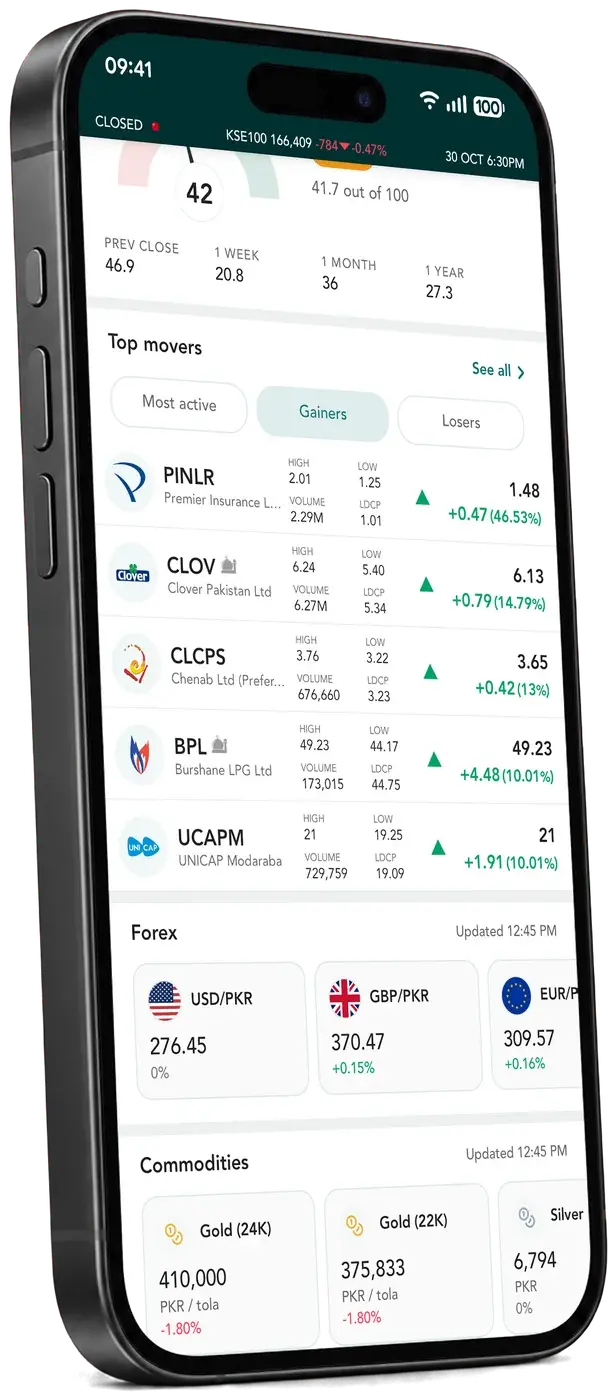
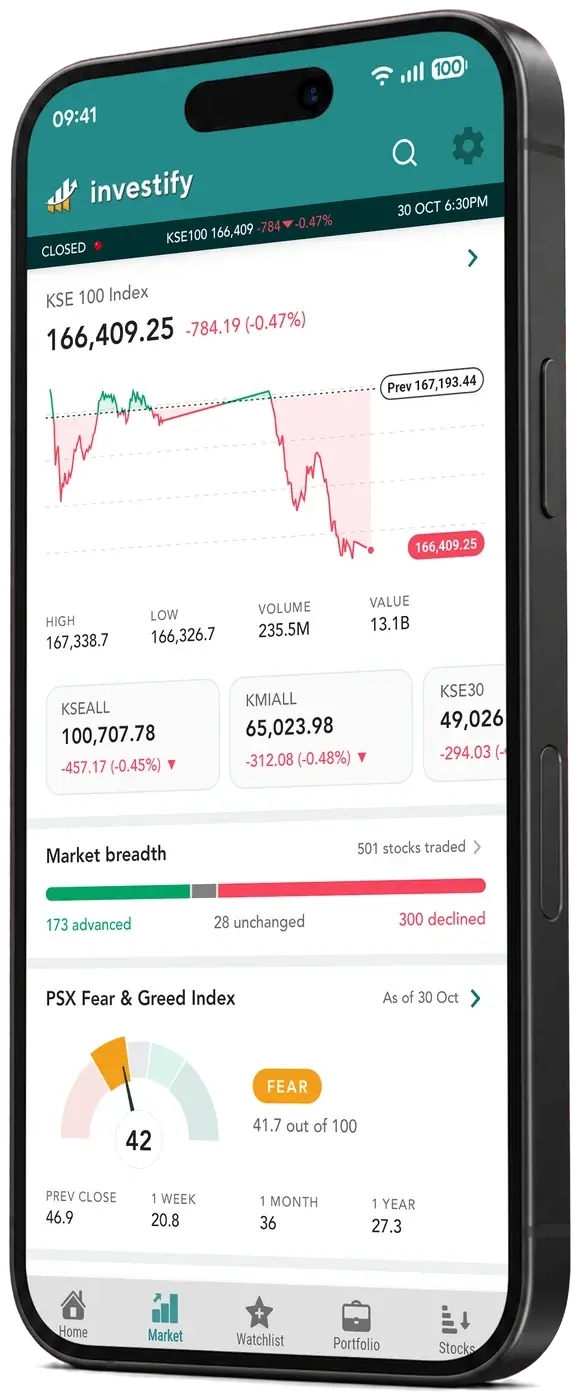
KSE-100, market breadth, the Fear & Greed meter, top movers, gold and forex.