
SWP Calculator
THE POT
Live off your savings, month by month
YOUR MONEY LASTS
All 20 years
With Rs 28,122,101 left at the end (+181% on what you started with), after taking out Rs 18,000,000.
Took out
− Rs 1.8 crore
It earned meanwhile
+ Rs 3.61 crore
Left at the end
Rs 2.81 crore
THREE SAFE NUMBERS
You use 71% of what is safe
Rs 105,862
the most a month for 20 years
Rs 94,888
a month that lasts forever
Rs 7,084,673
saved, for Rs 75,000 a month
WHAT YOU TAKE, WHAT IT EARNS
You take 9% a year, it earns 12%
Take less than it earns and the pot never runs out. A plan that only works at a high average return can still fail if the market falls in the first few years.
KEEP UP WITH PRICES
A flat amount buys less every year
Set it near inflation. See Pakistan inflation history.
At 7% inflation, Rs 75,000 a month buys about Rs 19,381 of today's shopping in 20 years.
- Balance left
- Total withdrawn so far
Withdrawals are taken at the end of each month, after that month's return. Returns are not guaranteed and figures are before tax. For a fixed monthly income with no market risk, compare the National Savings monthly-profit schemes.
How the SWP calculator works
You start with a corpus, choose a monthly withdrawal, an expected yearly return and a number of years. Each month the calculator adds that month's return to the balance and then pays out the withdrawal. If the balance reaches zero before the period ends, it tells you the exact month the money runs out. Otherwise it shows what is left.
- C
- starting corpus
- W
- monthly withdrawal
- i
- monthly return = (1 + annual return)^(1/12) − 1
- n
- number of months
Setting that to zero gives the largest flat withdrawal a corpus can pay for n months: W = C × i × (1 + i)^n ÷ ((1 + i)^n − 1), the same formula as a loan payment. With a yearly increase there is no single formula, so the calculator finds the answer by repeated search (bisection) on the same month-by-month engine. If you only want to spend what the corpus earns, W = C × i and the balance never falls.
A worked example
Take Rs 10,000,000 earning 12% a year with Rs 75,000 withdrawn every month for 20 years. Total withdrawals are Rs 18,000,000, and Rs 28,122,101 is still there at the end. The most this corpus could pay for 20 years with a flat withdrawal is Rs 105,862 a month, and it can pay Rs 94,888 a month indefinitely, because that is only what it earns.
| Monthly withdrawal | Outcome after 20 years | Total withdrawn |
|---|---|---|
| Rs 50,000 | Rs 50,902,378 left | Rs 12,000,000 |
| Rs 75,000 | Rs 28,122,101 left | Rs 18,000,000 |
| Rs 100,000 | Rs 5,341,825 left | Rs 24,000,000 |
| Rs 125,000 | Runs out in year 13, month 7 | Rs 18,839,846 |
| Rs 150,000 | Runs out in year 9, month 11 | Rs 15,903,135 |
Two things change the picture. If your income should keep pace with prices, raise the withdrawal by 5% a year: the same corpus now pays Rs 75,000 in year one and Rs 189,521 in year 20, and the outcome is: Rs 1,709,108 left. The safe starting amount for that plan falls to Rs 76,353 a month, or Rs 55,351 if it must last forever. And if the return is 9% instead of 12%, the original plan ends as: Rs 8,130,230 left.
Who uses a withdrawal plan in Pakistan
- Retirees. Living off savings needs a withdrawal that lasts as long as you do. Combine this with the retirement calculator to find the corpus you need, the SIP calculator to see how to save it, and the VPS pension calculator for the Voluntary Pension System.
- Mutual fund investors. Some fund houses offer systematic redemption on their funds, and in others you simply redeem units every month. Check the fund's terms and costs with the AMC (listed on MUFAP) before relying on it.
- People with a windfall. A gratuity, a provident fund payout or a property sale can be parked in a fund or deposit and drawn down monthly. See the gratuity calculator.
- National Savings alternative. The monthly-profit schemes pay a stated rate with no market risk and no risk of running out before maturity, but the rate resets and the profit is taxed. Compare them with the National Savings calculator.
Risks to plan for
- Return risk. Withdrawing during a market fall sells units at low prices and leaves less to recover. A plan that works at an average 12% can fail if the first few years are poor, so test a cautious rate and keep a margin.
- Inflation. A flat withdrawal loses buying power every year. Use the yearly increase, and check your assumption against Pakistan's CPI history.
- Tax and costs. Redemption gains, profit and fund fees reduce what you keep. The calculator shows figures before tax, so subtract them from your return; the capital gains tax calculator gives the rate for your fund.
- A cushion helps. Many investors keep a year or two of withdrawals in a low-risk fund or deposit so they never have to sell equities in a downturn.
Sources and assumptions
- Calculation: each month balance = balance × (1 + monthly return) − withdrawal, with the withdrawal raised every 12 months by the yearly increase
- Maximum sustainable withdrawal: found by bisection so the balance reaches exactly zero after the last withdrawal; matches the annuity formula when the withdrawal is flat
- Withdrawal that lasts forever: corpus × (1 − (1 + g) ÷ (1 + r)) ÷ present value of 12 monthly rupees; corpus × monthly return when g is zero
- National Savings: monthly-profit schemes and current rates
- MUFAP: mutual fund returns, fund types and redemption terms
Results are estimates for information and planning only, not tax, legal or investment advice. Check your own case with a tax adviser, your broker or the official source before acting.
FAQ
SWP Calculator: common questions
What is a systematic withdrawal plan (SWP)?+
An SWP means taking a fixed amount out of an investment every month while the rest stays invested and keeps earning. It turns a lump sum, such as retirement savings or mutual fund units, into a regular income. The question it answers is how long the money lasts at a given withdrawal and return.
How is the SWP balance calculated?+
Each month the balance earns that month's return and then the withdrawal is taken out: balance = balance × (1 + monthly return) − withdrawal. With a 12% yearly return the monthly return is 1.12^(1/12) − 1, about 0.949%. If you add a yearly increase, the withdrawal is raised by that percentage every 12 months. Rs 10,000,000 at 12% paying Rs 75,000 a month for 20 years leaves Rs 28,122,101.
How much can I withdraw each month from my corpus?+
It depends on the return and how long it must last. At 12% a year, Rs 10,000,000 can pay up to about Rs 105,862 a month for 20 years if the withdrawal stays flat, and Rs 94,888 a month if you only want to spend what it earns. A yearly increase in the withdrawal lowers the safe starting amount. The Plan check box in the results shows the limit for your inputs.
Can the money last forever?+
Yes, if you withdraw no more than the corpus earns. With a flat withdrawal that is the corpus times the monthly return, so the balance never falls. If your withdrawal also rises every year, the starting amount must be lower, and it is impossible if the return does not beat the yearly increase. In practice, markets are uneven, so leave a margin.
Should the withdrawal rise with inflation?+
Usually yes: a fixed Rs 75,000 buys less every year. Use the yearly increase in the Keep up with prices card, near your inflation assumption. A 5% yearly increase on the same example brings the last-year withdrawal to Rs 189,521 and changes the outcome to: Rs 1,709,108 left.
SWP or National Savings monthly-profit schemes?+
National Savings schemes that pay profit monthly give a stated rate set by the government, and your capital stays intact until maturity, so there is no market risk and no running out of money (but the rate resets and profit is taxed). An SWP from funds or shares can earn more over time but its value rises and falls. Many retirees combine both. Use the National Savings calculator to compare the monthly income.
Are SWP withdrawals taxed in Pakistan?+
Withdrawals from mutual funds are redemptions, and any gain in the units you redeem is taxed as a capital gain, with the rate depending on the fund type, how long you held the units and your filer status. Profit on deposits and National Savings is subject to withholding tax. The calculator shows figures before tax, so reduce the return or the withdrawal by your expected tax.
Keep going
Related tools
Retirement Calculator
The savings you need to retire, and the monthly investment that gets you there.
SIP Calculator
What a fixed monthly investment in PSX stocks or mutual funds can grow to, with yearly step-up.
National Savings (NSS) Profit Calculator
Profit on Behbood, Defence, Regular Income, Special and Short Term certificates after tax.
PSX guides
Learn the ideas behind the numbers

How to Start Investing in the Pakistan Stock Exchange as a Beginner
A complete beginner guide to investing in the Pakistan Stock Exchange: account setup, brokers, PSX concepts, research, risk management, portfolio tracking and daily market routines.
Read guide
Dividend Stocks vs Growth Stocks on PSX
A beginner-friendly PSX guide comparing dividend stocks and growth stocks, including risks, investor fit, sectors, interest rates and market cycles.
Read guide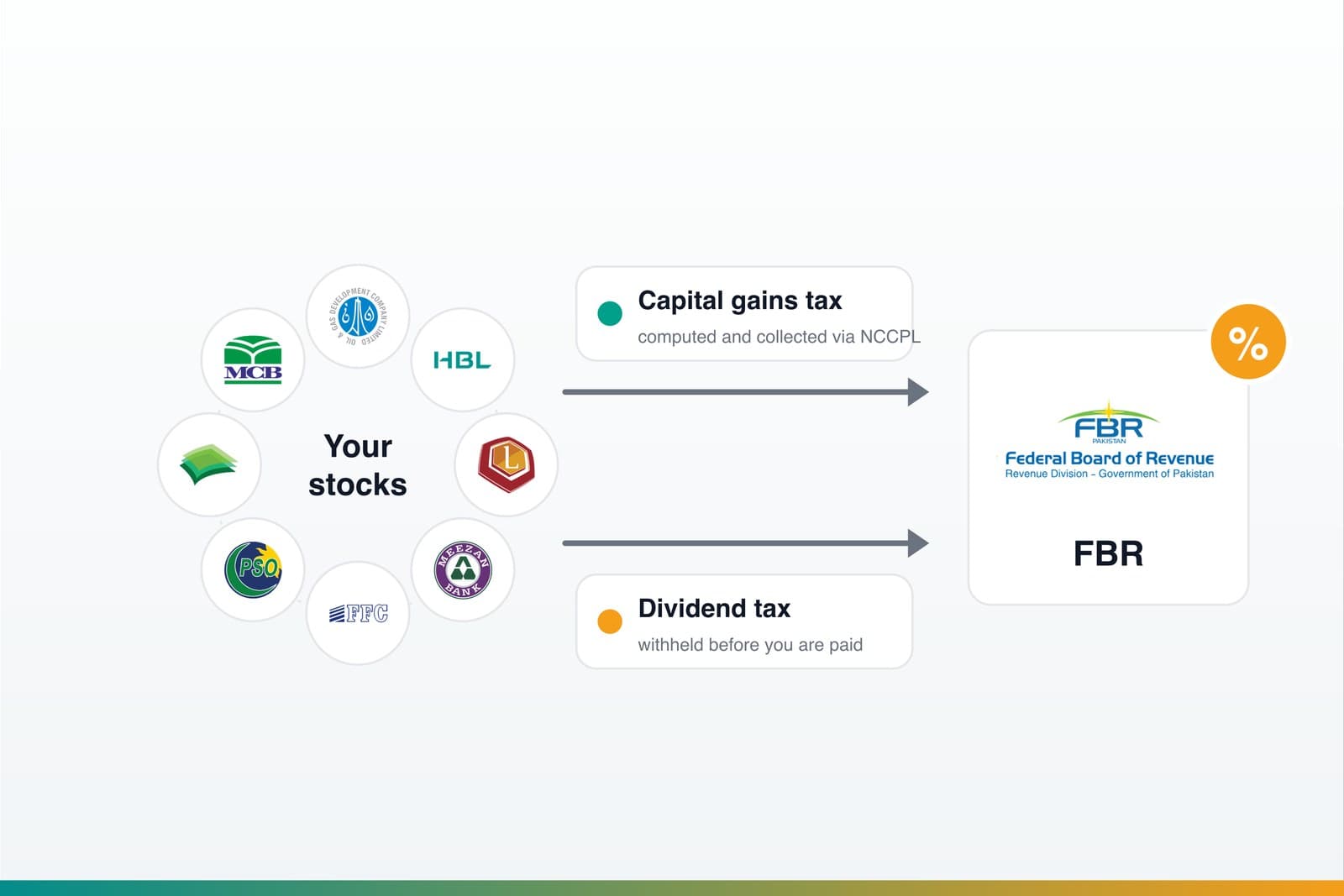
Capital Gains Tax & Dividend Tax on PSX Stocks (Pakistan)
A plain-English guide to how capital gains tax (CGT) and dividend tax work on Pakistan Stock Exchange shares - filer vs non-filer rates, how holding period and acquisition date matter, how NCCPL collects CGT, and what you still have to declare.
Read guide