
Lumpsum Investment Calculator
THE SEED
Put money in once and let it grow
IN 10 YEARS
Rs 1,853,611
Your Rs 5 lakh grows 3.71× to Rs 18.54 lakh.
- Put inRs 500,000
- GrowthRs 1,353,611
THE SAME SEED, OTHER SOIL
Where you put it matters most
Planning returns, not promises: equity can fall a third or more in a bad year. Tap a row to use it.
WHAT TIME DOES
Leave it longer, it grows faster
5.3 years
to double at 14%
+Rs 1,715,358
if you leave it 5 more years
- Put in
- Growth
How the lumpsum calculator works
You enter the amount you will invest once, the average yearly return you expect and the number of years. The calculator grows the money by one year of return at a time, so the table shows exactly what you would hold at the end of every year and the chart shows how the gains pile up on top of your original amount.
- P
- amount invested once
- r
- expected annual return (14% is 0.14)
- n
- years
- i
- annual inflation, used for the value in today's money
Tax, when you enter it, is charged on the gain only (future value minus what you put in) and never on the original amount. If you add a monthly top-up, the calculator switches to the same month-by-month engine as the SIP calculator, so the two always agree.
A worked example
Put Rs 500,000 to work for 10 years. At 14% a year it grows to about Rs 1,853,611, a gain of Rs 1,353,611. At 11%, a bank-deposit or income-fund style return (the 12% policy rate less about a point for fees), the same money reaches Rs 1,419,710. The gap of Rs 433,900 is what three extra points of return are worth over a decade, before accounting for the extra risk of equity-like investments.
| Annual return | Value after 10 years | Gain | Worth in today's money at 7% inflation |
|---|---|---|---|
| 8% | Rs 1,079,462 | Rs 579,462 | Rs 548,744 |
| 11% | Rs 1,419,710 | Rs 919,710 | Rs 721,709 |
| 14% | Rs 1,853,611 | Rs 1,353,611 | Rs 942,282 |
| 18% | Rs 2,616,918 | Rs 2,116,918 | Rs 1,330,308 |
Two things stand out. First, time does most of the work: the 14% case earns Rs 1,353,611 on Rs 500,000, far more than the first few years suggest, because each year compounds on the last. Second, inflation takes a real bite: in today's rupees the 8% case is worth only Rs 548,744, a gain of just Rs 48,744 over ten years. If tax on gains took an illustrative 15%, the 14% result would fall by Rs 203,042, to Rs 1,650,569.
Lump sum or SIP?
A lump sum puts all your money to work from day one, so when markets rise it tends to beat spreading the same total over months. The price is timing risk: if you invest everything just before a fall, you carry the full loss and wait longer to recover. A SIP trades some of that upside for smoother entry prices and fits a monthly salary.
The two are not either-or. Add a monthly top-up of Rs 10,000 under More options and the same Rs 500,000 at 14% for 10 years puts in Rs 1,700,000 and grows to Rs 4,346,534. If you have a large amount to invest at once and the market feels expensive, moving it in over several months is a common middle path. To work out what monthly amount a goal needs, try the goal planner.
Pakistan context: returns, inflation and tax
- Where the return comes from. Bank deposits, National Savings schemes and income or money market funds follow the State Bank's policy rate, so they pay less when rates fall. PSX shares and equity funds can return more in the long run but are volatile. Use the compound interest calculator for deposits that quote a profit rate with monthly payout.
- Inflation. The calculator's default of 7% is an assumption: it is the FY2026 average of 7.05%, while the latest reading is 10.3% year on year for September 2026. Pakistan's inflation has swung from low single digits to nearly 38% in recent years, so check the inflation calculator and use a figure you are comfortable with.
- Tax. Capital gains, dividends and deposit profit are taxed under different rules, and your filer status changes the rate. Read the PSX capital gains and dividend tax guide and use the capital gains tax calculator before settling on the rate to enter.
Common mistakes
- Using last year's return as a forecast. Pick an average you could plausibly earn over the whole period.
- Comparing a nominal result across long periods without adjusting for inflation. The "today's money" line is the fairer yardstick.
- Forgetting tax and costs. Brokerage, fund charges and tax all reduce what you keep.
- Confusing the return you expect with the CAGR you actually got. Work backwards from real results with the CAGR calculator.
Sources and assumptions
- Calculation: future value = amount × (1 + annual return)^years, compounded yearly; no fees or taxes unless you enter a tax rate
- Inflation-adjusted value: future value ÷ (1 + inflation)^years. The default 7% is an assumption, not a forecast
- State Bank of Pakistan: policy rate and monetary policy statements
- Pakistan Bureau of Statistics: Consumer Price Index
- MUFAP: mutual fund returns and factsheets
Results are estimates for information and planning only, not tax, legal or investment advice. Check your own case with a tax adviser, your broker or the official source before acting.
FAQ
Lumpsum Investment Calculator: common questions
What is a lumpsum investment?+
A lumpsum investment is a single, one-time amount that you invest and leave to grow, instead of investing a smaller amount every month. In Pakistan that could be a mutual fund purchase, a block of PSX shares, a National Savings certificate or a bank term deposit funded from a bonus, savings or the sale of an asset.
How is the future value of a lumpsum calculated?+
Future value = amount × (1 + annual return)^years. For example, Rs 500,000 at 14% a year for 10 years becomes 500,000 × 1.14^10, about Rs 1,853,611. The calculator compounds once a year and shows each year's value in the table, so the totals you see always match the formula.
What return should I assume for a lumpsum in Pakistan?+
Use a long-run average, not last year's result. Bank deposits, National Savings and income or money market funds follow the State Bank policy rate, so a planning range of 11 to 12% after fees is common while rates stay near today's levels (the policy rate has been 12% since October 27, 2026). Equity funds and PSX shares have averaged more over long periods but fall sharply in bad years, so 12 to 15% is a reasonable middle case. Run a cautious, a middle and an optimistic rate to see the spread.
Is a lumpsum better than a SIP?+
If the market rises over time, a lumpsum invested on day one usually ends higher because all of the money works for the whole period. A SIP spreads your purchases over many prices and suits a monthly salary, and it softens the damage of investing everything just before a fall. When you have a lump sum in hand, a common compromise is to invest it in several instalments over a few months. Add a monthly amount under More options, or open the SIP calculator, to compare.
How does inflation change what my investment is worth?+
Inflation reduces what each rupee buys, so the final amount is worth less in today's terms. Rs 500,000 growing at 14% for 10 years reaches Rs 1,853,611, but at an assumed 7% inflation that is worth about Rs 942,282 in today's rupees. Turn on Show today's money under More options to see this for your own numbers, and change the inflation figure to match your view.
Is the profit from a lumpsum investment taxed?+
Gains are generally taxed when you sell or redeem, and dividends or profit on deposits are taxed when paid. The rate depends on the asset (shares, mutual fund units, deposits), how long you held it and whether you are on the Active Taxpayers List. Enter a tax rate under More options to see the after-tax value, and use the capital gains tax calculator to find the rate that applies to you.
Are the results guaranteed?+
No. The calculator assumes the same return every year, but real investments rise and fall. Bank deposits and National Savings pay a stated rate, while shares and mutual funds do not. Treat the result as an illustration of how time and rate interact, not as a forecast.
Keep going
Related tools
SIP Calculator
What a fixed monthly investment in PSX stocks or mutual funds can grow to, with yearly step-up.
CAGR Calculator
Compound annual growth rate between two values, and the value a target CAGR gives.
Compound Interest Calculator
Compounding daily, monthly, quarterly, half-yearly or yearly, with regular additions.
PSX guides
Learn the ideas behind the numbers
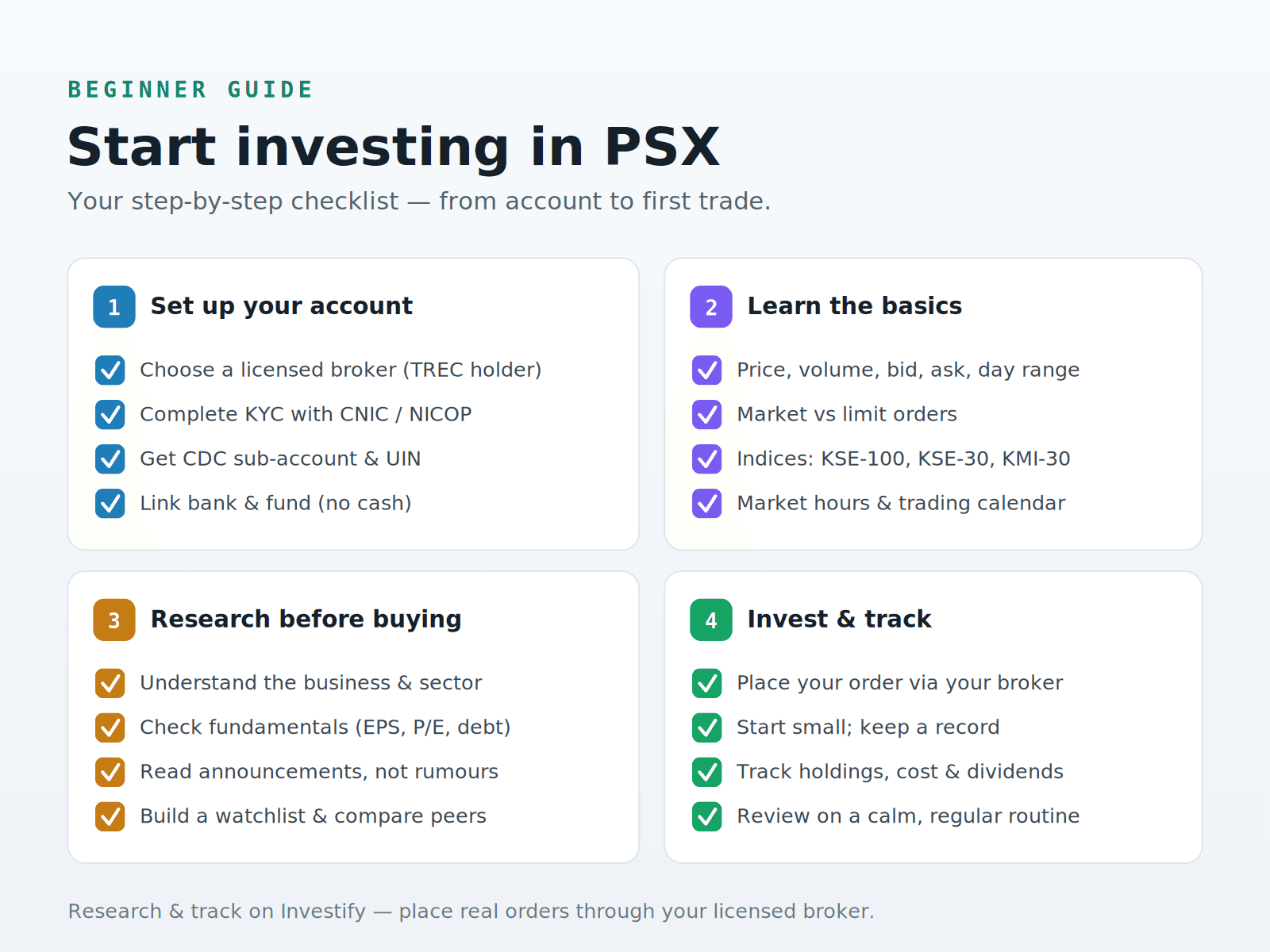
How to Start Investing in the Pakistan Stock Exchange as a Beginner
A complete beginner guide to investing in the Pakistan Stock Exchange: account setup, brokers, PSX concepts, research, risk management, portfolio tracking and daily market routines.
Read guide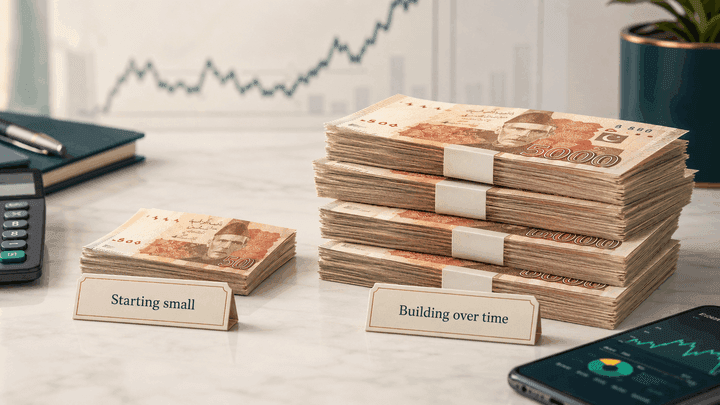
What Is the Minimum Amount Needed to Start Investing in PSX?
Understand how much money a beginner may need to start investing in the Pakistan Stock Exchange, including account requirements, share prices, charges and practical starting ranges.
Read guide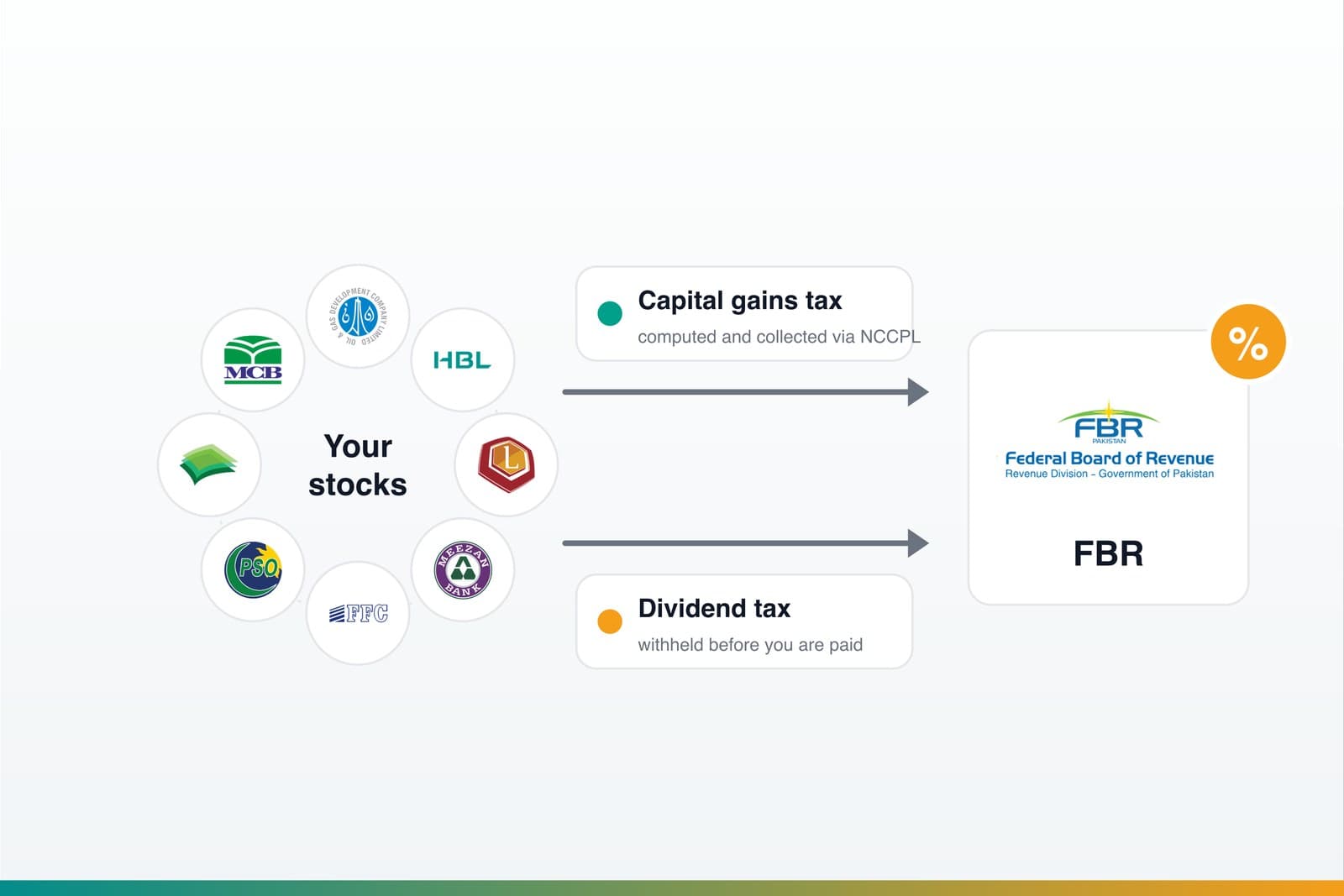
Capital Gains Tax & Dividend Tax on PSX Stocks (Pakistan)
A plain-English guide to how capital gains tax (CGT) and dividend tax work on Pakistan Stock Exchange shares - filer vs non-filer rates, how holding period and acquisition date matter, how NCCPL collects CGT, and what you still have to declare.
Read guide