
VPS Pension Calculator
THE PENSION POT
A little every month grows into a pension
AT RETIREMENT, IN 25 YEARS
Rs 39,929,569
You put in Rs 60 lakh; growth adds Rs 3.39 crore.
Tax-free lump sum (50%)
Rs 2 crore
on the day you retire
Then a pension of
Rs 186,998
a month for 20 years
THE TAX CREDIT
Rs 20,000 a month really costs you Rs 17,689
Your average tax rate is 11.6%, so each rupee you put in cuts your tax by about 11.6%. Over 25 years the credit adds up to Rs 693,333.
36 lakh
AT RETIREMENT
Half tax-free in hand, the rest as a monthly pension
Rs 2 crore goes into an income payment plan or an annuity.
Paid at the end of each month, before any tax on the pension. Withdrawals before retirement, and a lump sum above 50%, are taxable.
GROW IT EVERY YEAR
Raise it as your pay rises
IN TODAY'S MONEY
Prices rise over the years too
- Put in
- Growth
Returns are examples, not forecasts: pension fund returns change every year and are not guaranteed. The tax credit uses tax year 2027 slabs.
How the VPS tax credit works
Contributions to an approved pension fund under the Voluntary Pension System Rules earn a tax credit under section 63 of the Income Tax Ordinance. The credit is calculated at your average tax rate, not your top rate, and it is limited to contributions of 20% of your taxable income.
- A
- your tax for the year before any credits (including surcharge)
- B
- your taxable income for the year
- C
- the lesser of your contributions and 20% of your taxable income
The calculator computes A and B from the tax year 2027 slabs, so a salaried person is taxed on the salaried table and a business owner on the non-salaried table. It then credits each year of your plan separately, so a rising contribution or income is handled year by year. Your employer can apply the credit to your monthly salary tax if you give documentary evidence of the contribution.
A worked example
Take a salary of Rs 3,600,000 a year, with tax of Rs 416,000: an average rate of 11.6%. Contributing Rs 20,000 a month is Rs 240,000 a year, well under the limit of Rs 720,000, so the credit is Rs 27,733 and the real cost of the contribution is Rs 212,267, or Rs 17,689 a month. Kept up for 25 years at 13% a year, the account grows to about Rs 39,929,569 from Rs 6,000,000 contributed, and the credits add up to Rs 693,333 of tax saved. A business owner with the same income has a higher average rate and gets a credit of Rs 54,000 a year on the same contribution.
What the credit is worth at different incomes
The same contribution of Rs 20,000 a month (Rs 240,000 a year) earns a different credit depending on your income and whether it is salary or business income. This table is worked out by the same engine as the calculator.
| Yearly taxable income | Salary: average rate | Salary: yearly credit | Business: average rate | Business: yearly credit |
|---|---|---|---|---|
| Rs 1,200,000 | 0.5% | Rs 1,200 | 7.5% | Rs 18,000 |
| Rs 2,400,000 | 6.5% | Rs 15,600 | 17.1% | Rs 41,000 |
| Rs 3,600,000 | 11.6% | Rs 27,733 | 22.5% | Rs 54,000 |
| Rs 6,000,000 | 18.4% | Rs 44,160 | 29.8% | Rs 71,600 |
| Rs 12,000,000 | 26.5% | Rs 63,480 | 41.2% | Rs 98,780 |
The lesson is that the credit is generous at high incomes and small at low ones. Below Rs 600,000 of taxable income there is no tax, so no credit. If you contribute more than 20% of your taxable income, only that part earns the credit: Rs 100,000 a month on a Rs 3,600,000 salary is Rs 1,200,000 a year, but credit is worked out on Rs 720,000. A catch-up allowance for people who joined at age 41 or older expired on June 30, 2019.
How much can a VPS account grow to?
The growth depends on what you invest in. VPS offers equity, debt and money market funds and allocation schemes that mix them with different amounts of equity. The returns below are illustrative assumptions for low, medium and high volatility schemes, used to show the range, and they are not forecasts. The table shows the balance after 25 years, contributing at the start of every month.
| Monthly contribution | Low volatility (11%) | Medium volatility (13%) | High volatility (15%) |
|---|---|---|---|
| Rs 10,000 | Rs 14,534,611 | Rs 19,964,785 | Rs 27,565,608 |
| Rs 20,000 | Rs 29,069,223 | Rs 39,929,569 | Rs 55,131,216 |
| Rs 30,000 | Rs 43,603,834 | Rs 59,894,354 | Rs 82,696,823 |
| Rs 50,000 | Rs 72,673,057 | Rs 99,823,923 | Rs 137,828,039 |
Compare these with a plain mutual fund plan in the SIP calculator, or work out how much you need in total with the retirement calculator. Inflation matters over 25 years: set it in the today's money card to see the balance in today's rupees.
At retirement: the lump sum and the income plan
You choose a retirement age between 60 and 70. Up to 50% of the balance can be taken as a tax-free lump sum under clause (23A) of the Second Schedule. The remainder has to be used to buy an annuity or to start an income payment plan, so it pays you a monthly pension instead of a lump sum. Taking more than 50% as cash, or withdrawing before retirement, makes the amount taxable.
For the example above, the Rs 39,929,569 balance gives a tax-free lump sum of Rs 19,964,785 and leaves Rs 19,964,785 for the income plan. If that earns 10% a year and is paid out evenly over 20 years, the monthly pension is about Rs 186,998. If the plan earned 8% instead, it would be Rs 163,542. Payouts are shown before tax: the treatment of income plan instalments depends on the plan, so confirm it with your pension fund manager.
Things to know before you start
- Eligibility. The credit is for individuals with a National Tax Number or CNIC who have salary or business income, and it counts only new contributions, not balances moved from provident or pension schemes.
- Evidence. Keep the contribution receipts from your pension fund manager and give them to your employer, or claim the credit when you file your return.
- Lock-in. The tax benefit comes with a commitment: early withdrawals are taxed. Do not put in money you may need in the next few years.
- Compare options. A provident fund or gratuity from your employer may already cover part of your retirement; see the provident fund calculator and the gratuity calculator, and the salary tax calculator for the effect of the credit on your monthly tax.
Sources and assumptions
Rates checked October 31, 2026 against the Finance Act 2026 and FBR's tax year 2027 rate card.
- FBR, Income Tax Ordinance, 2001 (amended up to June 30, 2026)
- FBR, Finance Act 2026
- FBR Withholding Tax Rates Card, tax year 2027
- SECP, Voluntary Pension System Rules, 2005
- pkrevenue.com, section 63 pension fund tax credit, tax year 2027
- Growth: month-by-month compounding of each contribution (invested at the start of the month). Pension: level monthly payment that uses up the balance over the chosen years
Results are estimates for information and planning only, not tax, legal or investment advice. Check your own case with a tax adviser, your broker or the official source before acting.
FAQ
VPS Pension Calculator: common questions
What is the Voluntary Pension System (VPS) in Pakistan?+
VPS is a regulated, individual pension account run by licensed pension fund managers under the SECP's Voluntary Pension System Rules, 2005. You contribute any amount, any time, and choose how it is invested across equity, debt and money market funds or an allocation scheme such as high, medium or low volatility. The balance is yours, it can be moved between managers, and withdrawals before your chosen retirement age are taxed.
How does the VPS tax credit work?+
The credit equals your average tax rate times the lesser of what you contributed and 20% of your taxable income (section 63). Your average rate is your tax before credits divided by your taxable income. On a salary of Rs 3,600,000 the average rate is 11.6%, so a contribution of Rs 240,000 earns a credit of Rs 27,733.
How much tax can I save with a VPS contribution?+
As much as your average tax rate on the contribution, up to a contribution of 20% of your taxable income. It is a credit at your average rate, not a deduction at your top rate, so it is worth less than many people expect for salaried people with modest income and more for high earners and business owners. The same Rs 240,000 a year saves Rs 1,200 at a salary of Rs 1,200,000 and Rs 63,480 at Rs 12,000,000.
Who can claim the VPS tax credit?+
An individual who holds a National Tax Number or CNIC and earns income chargeable as salary or as business income, and who contributes to an approved pension fund under the VPS Rules. Moving an existing balance from an approved employment pension, annuity or occupational savings scheme into a VPS account does not qualify for the credit.
Is the lump sum at retirement tax free?+
Up to 50% of the accumulated balance received at retirement, on disability or to nominated survivors on death is exempt (Second Schedule, clause 23A). The rest must go into an income payment plan or an annuity. Withdrawals before retirement, and anything above 50% taken as cash at retirement, are taxable.
At what age can I take my VPS pension?+
You choose a retirement age between 60 and 70. The rules also allow retirement after 25 years of contributions, and early exit for disability or on death. Check the exact conditions in your pension fund manager's offering document before you rely on a date.
Are VPS returns guaranteed?+
No. Returns come from the funds you choose and change every year. Money market and debt sub-funds tend to follow interest rates, and equity-heavy allocation schemes can fall sharply in a bad year. The returns offered in the calculator are examples to show the range, not a forecast.
Is the monthly pension from the income plan taxed?+
The calculator shows the pension before any tax. The Ordinance once exempted income payment plan instalments, but that exemption was omitted by the Finance Act 2022, so the treatment of payouts depends on the plan and the current rules. Ask your pension fund manager and a tax adviser before planning around a tax-free pension.
Keep going
Related tools
Retirement Calculator
The savings you need to retire, and the monthly investment that gets you there.
Salary Income Tax Calculator 2026-27
Your salary as a payslip under the Finance Act 2026 slabs, with seven legal ways to pay less tax.
Provident Fund Calculator
Your provident fund balance at retirement from your and your employer's contributions.
PSX guides
Learn the ideas behind the numbers
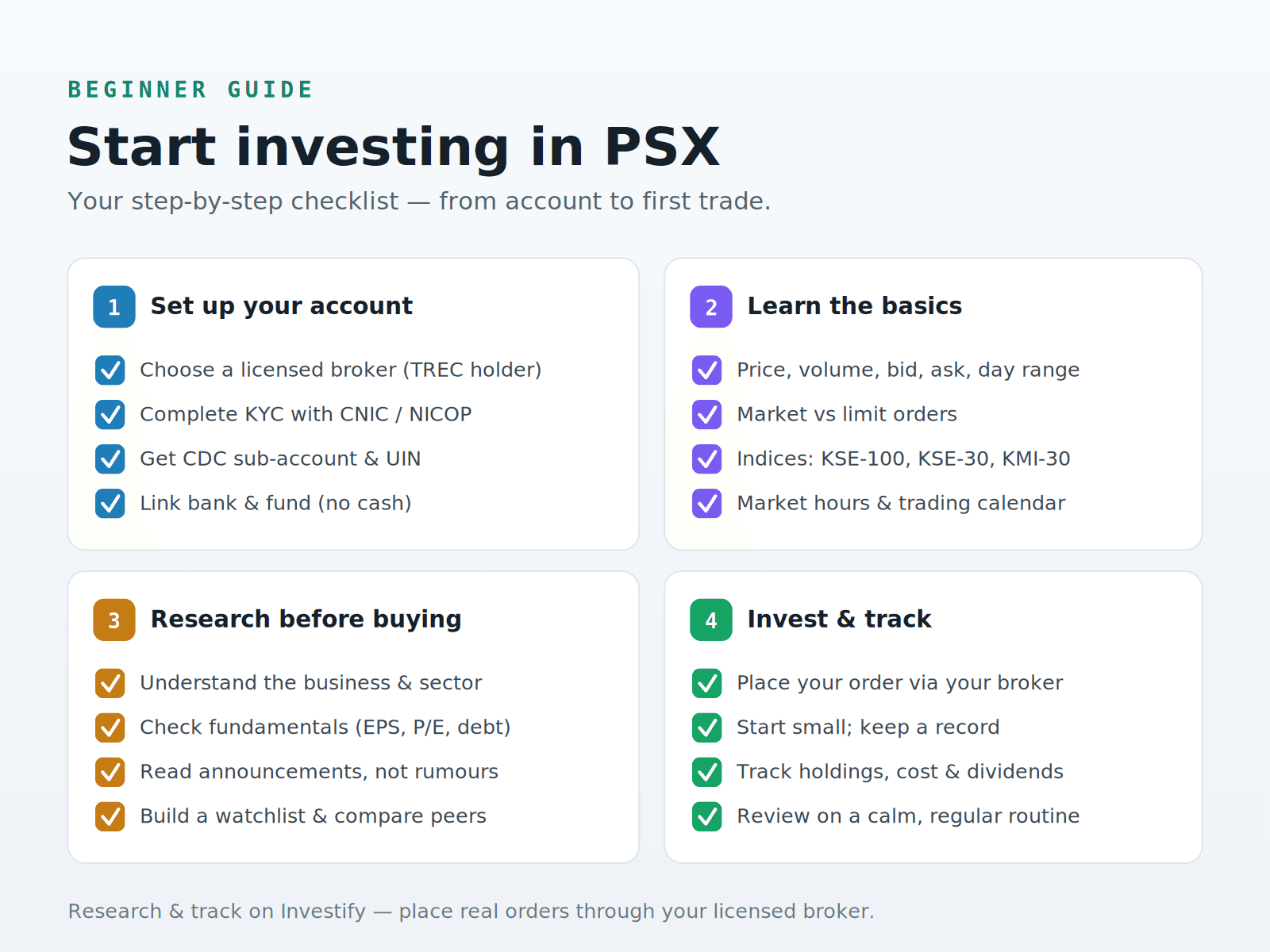
How to Start Investing in the Pakistan Stock Exchange as a Beginner
A complete beginner guide to investing in the Pakistan Stock Exchange: account setup, brokers, PSX concepts, research, risk management, portfolio tracking and daily market routines.
Read guide
What Is the Minimum Amount Needed to Start Investing in PSX?
Understand how much money a beginner may need to start investing in the Pakistan Stock Exchange, including account requirements, share prices, charges and practical starting ranges.
Read guide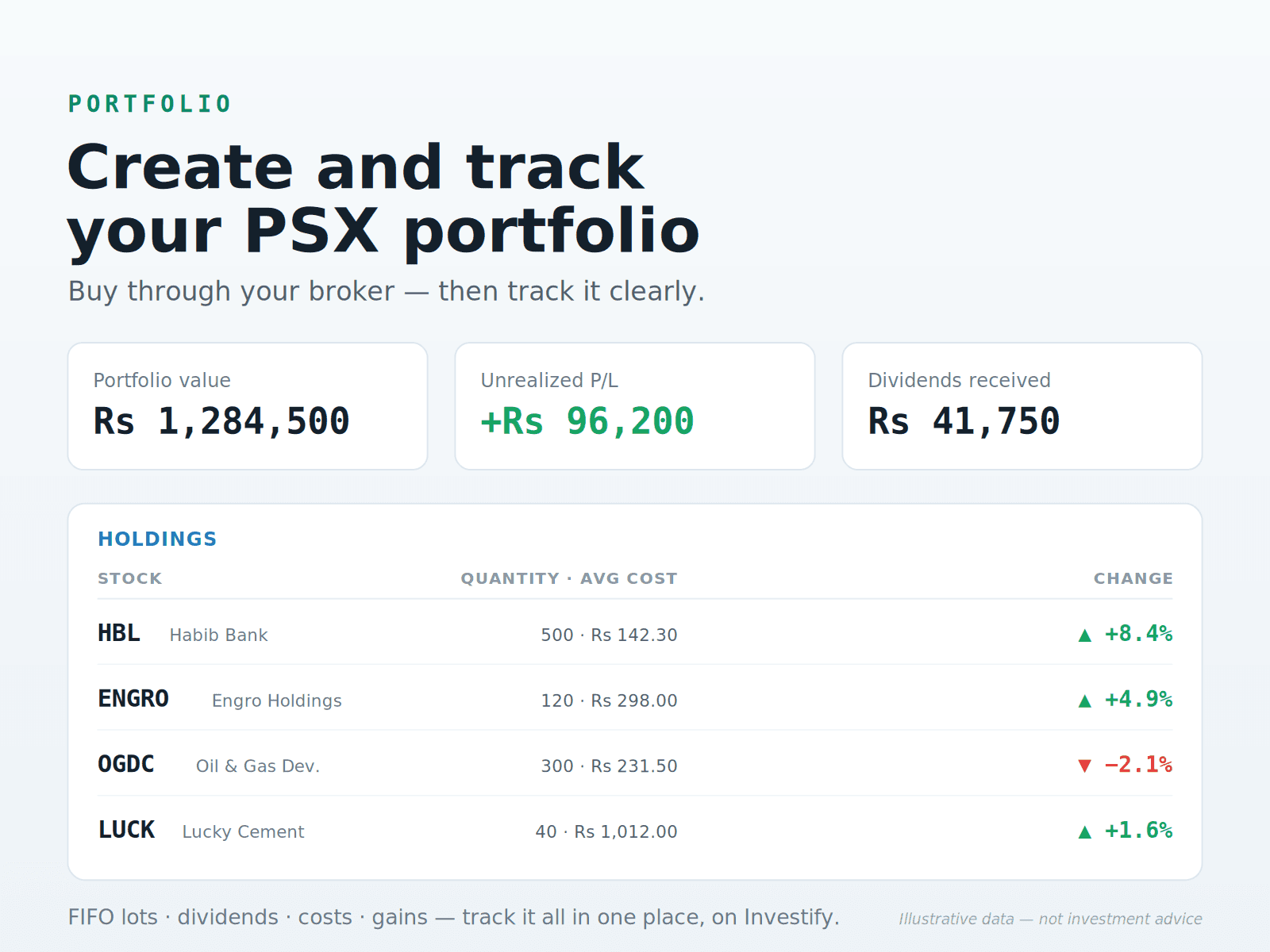
How to Create and Track a PSX Stock Portfolio
Learn how to create a PSX stock portfolio through a licensed broker and track it with FIFO, dividends, costs and corporate actions.
Read guide