
Bonus Shares & Stock Split Calculator
THE CORPORATE ACTION
What did the company announce?
Loading live data for ENGROH. Example figures show until it arrives.
1 bonus share for every 10 held.
YOU RECEIVE
+100bonus shares
The pie stays the same size, it is cut into more, smaller slices. Then the tax takes a bite: Rs 1,818.
1,000 shares
at Rs 200.00
Rs 200,000
1,100 shares
at Rs 181.82
Rs 200,000
After tax you hold Rs 198,182 (-Rs 1,818)
THE TAX ON BONUS SHARES
10% of Rs 18,182: Rs 1,818
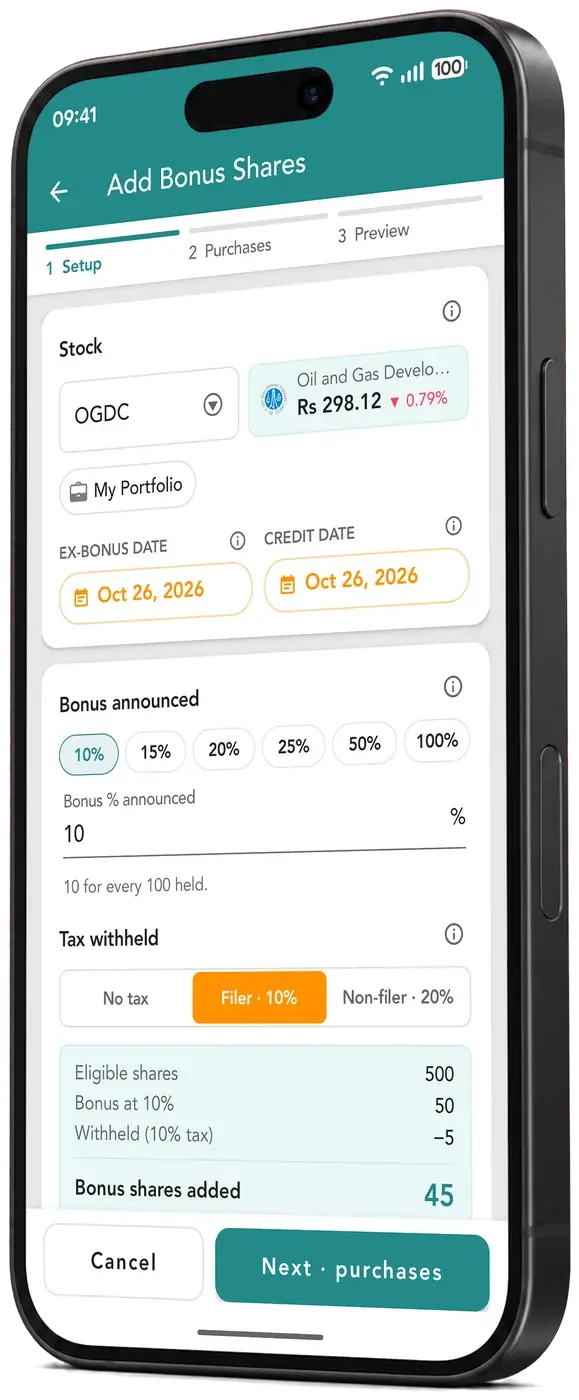
Section 236Z, final tax, filer rate. The bonus shares are valued at Rs 181.82 (the ex-bonus price). Pick how it is paid:
The company withholds part of the bonus until the tax is paid, deposits the tax within 15 days of book closure and can sell withheld shares to recover it. Follow your company's notice.
YOUR NEW AVERAGE COST
Your average cost becomes Rs 137.61
Rs 150.00 → Rs 137.61
average cost per share
The same money spread over more shares. Broker apps and charts adjust old prices for the bonus, so the drop on the ex-date is not a loss.
The ex-bonus price is theoretical: the market price after the ex-date can differ. Capital gains tax on a later sale uses the dates and costs in NCCPL's records. To compare with an issue where you pay for new shares, see the right shares calculator.
How the bonus shares calculator works
A bonus issue gives shareholders new shares for free, in proportion to what they hold. PSX notices quote it as a percentage: a 10% bonus is 10 new shares for every 100 held, or 1 for 10. The company capitalises part of its reserves, so there is more paper but the same business, and the share price adjusts down to match. The calculator works out the whole-share entitlement, the adjusted price, your new average cost and the tax.
- B
- bonus percentage, for example 10
- Price
- share price before it goes ex-bonus
- Cost
- your total cost: shares held × average price
A worked example
You hold 1,000 shares bought at an average of Rs 150.00. The company announces a 10% bonus and the share trades at Rs 200.00. You receive 100 bonus shares, the price adjusts to Rs 181.82, and before tax the holding is still worth Rs 200,000. The tax then decides what you keep:
| Case | Tax | Shares you end with | Cash you pay | Value after tax | New average cost |
|---|---|---|---|---|---|
| Filer, company sells shares | Rs 1,818 | 1,090 | Rs 0 | Rs 198,182 | Rs 137.61 |
| Filer, pays cash | Rs 1,818 | 1,100 | Rs 1,818 | Rs 198,182 | Rs 136.36 |
| Non-filer, company sells shares | Rs 3,636 | 1,080 | Rs 0 | Rs 196,364 | Rs 138.89 |
Either way the tax costs a filer Rs 1,818, 0.9% of the holding, and a non-filer Rs 3,636. The bonus itself adds no value: the price falls by the same proportion as the shares rise.
Tax on bonus shares (section 236Z)
Under section 236Z of the Income Tax Ordinance the company issuing bonus shares withholds tax on their value: 10% for filers and 20% for non-filers in tax year 2027. It is a final tax, so nothing more is due on the bonus shares themselves. The rate is in the FBR withholding tax rate card and the Finance Act 2026 brief.
Which price values the shares. The rate card says "value of bonus shares" and nothing more, but section 236Z of the Ordinance is specific: for listed companies it is the day-end price on the first day of book closure. By then the share already trades ex-bonus, so the calculator values the shares at the ex-bonus price by default: that gives Rs 1,818 of tax on the example. The earlier, pre-ex price would give Rs 2,000. The ex-bonus price is theoretical, so enter the actual closing price under More options when you know it.
How it is collected. The company withholds part of your bonus shares until the tax is paid. You can pay in cash to have them released. If you do not, the company can sell enough of the withheld shares to recover the tax. Under section 236Z the company deposits the tax with FBR within 15 days of the book closure. Your company's notice gives the payment method and the dates. Both outcomes are shown side by side in the calculator.
Fractions of a share
Only whole shares are credited, so 105 shares at a 10% bonus entitle you to 10.5: 10 shares and a fraction of 0.5. Companies combine the fractional entitlements into whole shares and sell them in the market. Some pay the proceeds to the shareholders entitled, which would be about Rs 91 here at the ex-bonus price. Others give them to a charitable institution. The notice says which, so the calculator lets you show the fraction as paid or not paid.
Stock splits and reverse splits
A split does not capitalise reserves. It divides each share into several of a lower face value. A 2-for-1 split turns 1,000 shares at Rs 500.00 and a Rs 10 face value into 2,000 shares at Rs 250.00 and a Rs 5 face value; your cost per share halves too. A reverse split goes the other way: a 1-for-10 consolidation turns 1,005 shares at Rs 20.00 into 100 shares at Rs 200.00 plus a fraction. Neither changes the size of your stake, and no bonus-share tax applies.
| Bonus issue | Stock split | |
|---|---|---|
| Face value | Unchanged | Divided by the split ratio |
| Your total value | Unchanged before tax | Unchanged |
| Tax | 10% / 20% on the value of bonus shares | None |
| Reserves | Capitalised | Not used |
After the bonus
Compare the effect with a cash payout using the dividend calculator (cash dividends have their own rates, see the dividend tax calculator), and with an issue where you have to pay for the new shares in the right shares calculator. To combine your old and new purchases into one average, use the stock average calculator. When you later sell, capital gains tax is worked out by NCCPL from its records of when and at what cost each lot was acquired, see the capital gains tax calculator.
Sources and assumptions
Bonus share tax rates checked October 31, 2026 against the FBR rate card for tax year 2027. The valuation basis, the 15-day deposit and the sale of withheld shares were checked against section 236Z of the Income Tax Ordinance as amended to June 30, 2026.
- FBR Withholding Tax Rates Card, tax year 2027
- KPMG Taseer Hadi & Co., A Brief of Finance Act 2026
- FBR, Income Tax Ordinance 2001 (amended up to June 30, 2026): section 236Z (valuation on the first day of book closure, deposit within 15 days, sale of withheld shares)
- Pakistan Stock Exchange, company announcements and book closure notices
- Method: ex-bonus price = price × 100 ÷ (100 + bonus %); total cost spread over the shares held afterwards
Results are estimates for information and planning only, not tax, legal or investment advice. Check your own case with a tax adviser, your broker or the official source before acting.
FAQ
Bonus Shares & Stock Split Calculator: common questions
How are bonus shares calculated?+
Multiply your shares by the bonus percentage and divide by 100. A 10% bonus (1 share for every 10) on 1,000 shares gives 100 new shares. Only whole shares are credited, so 105 shares earn 10 and leave a fraction of 0.5.
What happens to the share price after a bonus issue?+
The price adjusts down in proportion to the new shares, because the same company value is spread over more shares. A 10% bonus at Rs 200.00 gives a theoretical ex-bonus price of Rs 181.82. Your holding is worth the same before tax: 1,000 shares at Rs 200.00 and 1,100 shares at Rs 181.82 are both Rs 200,000.
Is there tax on bonus shares in Pakistan?+
Yes. For tax year 2027, the company issuing bonus shares withholds 10% of the value of the bonus shares from filers and 20% from non-filers, under section 236Z of the Income Tax Ordinance. It is a final tax. On 100 bonus shares valued at Rs 18,182, a filer's tax is Rs 1,818.
How is the tax on bonus shares collected?+
The company collects it by withholding part of your bonus shares until the tax is paid. You can pay it in cash to have them released, and if the tax is not paid the company can sell enough of the withheld shares to recover it. In the example the company would sell 10 of the 100 bonus shares, and you would end with 1,090 shares. The company's notice gives the dates and the method. The calculator shows both outcomes side by side.
Which price is used to value bonus shares for the tax?+
Section 236Z of the Income Tax Ordinance values the bonus shares at the day-end price on the first day of book closure. By that day the share already trades ex-bonus, so the calculator defaults to the ex-bonus price, Rs 181.82 in the example, which gives a filer Rs 1,818 of tax. Valuing the shares at the earlier Rs 200.00 would give Rs 2,000. Enter the actual closing price under More options once it is known.
How does a bonus issue change my average cost?+
Your total cost stays the same and is spread over more shares. If you paid an average of Rs 150.00 on 1,000 shares and receive 100 bonus shares, your new average cost is Rs 136.36. If the company sells 10 shares to recover the tax, it is Rs 137.61.
What happens to a fraction of a bonus share?+
Only whole shares are credited. Companies combine the fractional entitlements into whole shares and sell them in the market. What happens to the proceeds, whether they are paid to the shareholders entitled or given to a charitable institution, is stated in each company's notice. The calculator shows the fraction and lets you choose whether it is paid in cash or not paid.
What is the difference between a bonus issue and a stock split?+
A bonus issue adds shares by capitalising the company's reserves, keeps the face value, and attracts the bonus-share tax. A split divides each share into several of a lower face value and charges no tax. A 2-for-1 split turns 1,000 shares at Rs 500.00 into 2,000 at Rs 250.00, with the same total value.
Keep going
Related tools
Right Shares Calculator
Theoretical ex-right price, cost to subscribe and the value of your rights.
Stock Average Price Calculator
Your average cost after several buys, and how many shares bring it down to a target.
Dividend Income Calculator
Dividend income from your PSX shares after withholding tax, per payout and per year.
PSX guides
Learn the ideas behind the numbers

PSX Company Announcements Explained: Results, Dividends, Board Meetings, Book Closure, Rights and Bonus Issues
Learn what PSX company announcements mean - results, dividends, book closure, bonus shares and rights issues - and how to read them in Investify.
Read guide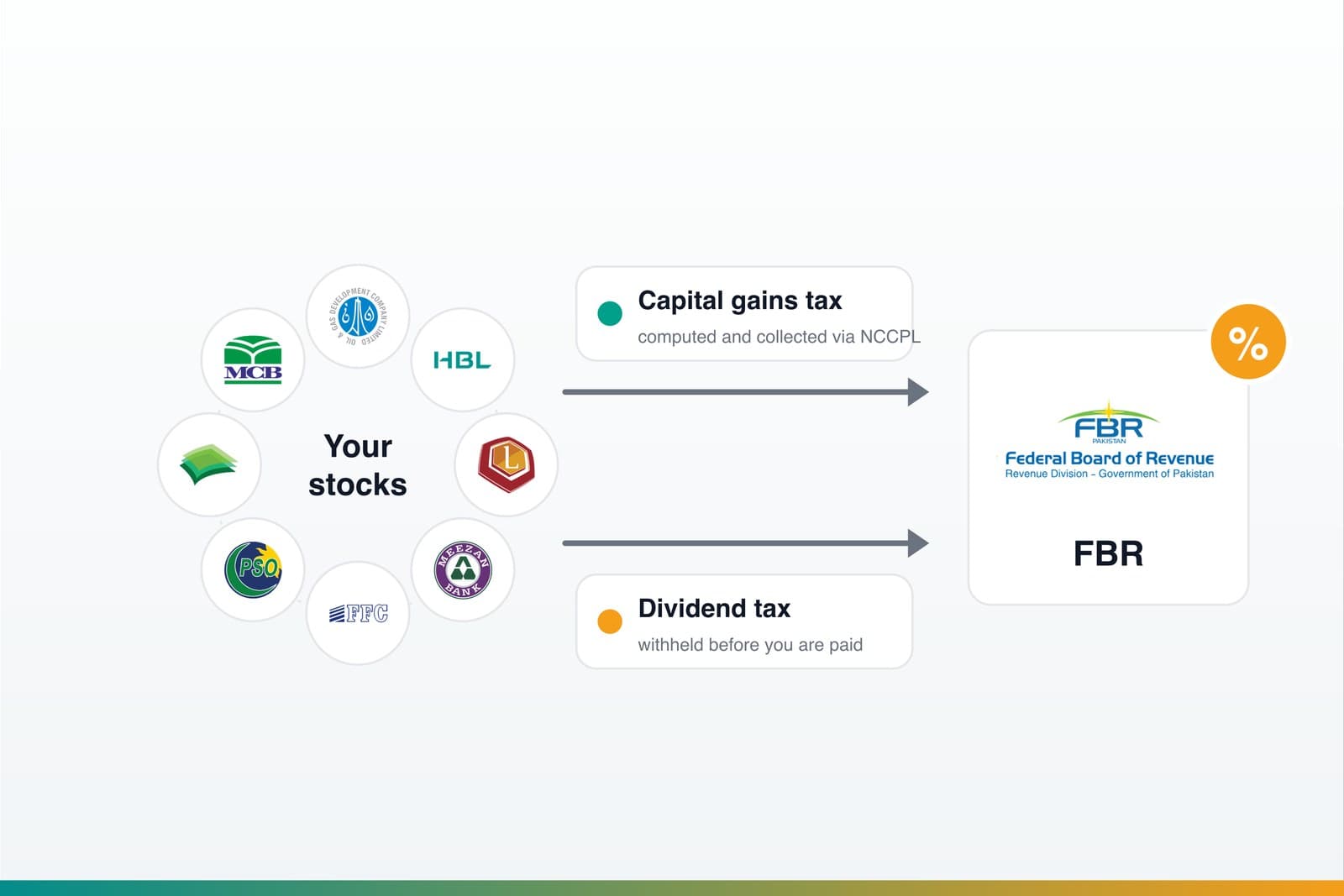
Capital Gains Tax & Dividend Tax on PSX Stocks (Pakistan)
A plain-English guide to how capital gains tax (CGT) and dividend tax work on Pakistan Stock Exchange shares - filer vs non-filer rates, how holding period and acquisition date matter, how NCCPL collects CGT, and what you still have to declare.
Read guide
How to Read a PSX Stock Quote: Price, Volume, Bid, Ask and Day Range
Learn how to read a Pakistan Stock Exchange quote, including current price, change, volume, bid, ask, day range, market status and what each field means for everyday PSX investors.
Read guide