
Gratuity Calculator
YOUR SERVICE
What you get when you leave
Standing Order 12 uses the wages of your last month. Many employers pay on basic salary by contract, so check yours.
YOUR GRATUITY
11 years counted × Rs 100,000 a year
Rs 1,100,000
- Tax-freeRs 75,000
- Taxable, added to your incomeRs 1,025,000
Service: 10 years, 7 months. Paid from your employer directly; you can change that under Where it is paid from.
ONE MORE YEAR
Your next counted year comes in 12 months
Under Standing Order 12 a part-year counts as a full year once it is more than six months. At 10 years, 7 months, the next year counts after 12 more months of service and adds Rs 100,000 before tax. Timing a resignation around it can be worth a whole month's salary.
Months into your current year. From month 7 the year counts.
WHERE IT IS PAID FROM
From an approved fund, all Rs 1,100,000 would be tax-free
Clause 13(iv): the lesser of 50% of the gratuity or the rupee limit. Second Schedule, Part I, clause 13. Not sure which one you are? Ask HR whether the gratuity is paid from an approved gratuity fund.
If your employer runs a provident fund you contribute to, and the employer puts in at least as much as you do, Standing Order 12 says no gratuity is payable for the years that fund has existed. A similar proviso covers an approved pension fund the employer contributes to. Estimate the fund benefit in the provident fund calculator.
How gratuity is calculated
Gratuity is a terminal benefit paid when employment ends. For workers covered by the Industrial and Commercial Employment (Standing Orders) Ordinance, 1968, Standing Order 12 sets it at 30 days' wages for every completed year of service, or any part of a year above six months, calculated on the wages for the last month of service.
- Daily wage
- monthly wage ÷ 30 (or ÷ 26 working days if your employer uses that basis)
- Days per year
- 30 by default; your policy may say 15, 45 or 60
- Counted years
- completed years + 1 when the leftover part is more than six months
On the default basis (÷ 30 and 30 days) this is simply one month's wage for every counted year. The six-month rule can make a big difference: one extra day of service past six months adds a whole year's gratuity.
A worked example
An employee with a last drawn salary of Rs 100,000 and 10 years 7 months of service has 11 counted years, so the gratuity is Rs 1,100,000. With 10 years and exactly 6 months only 10 years count and the gratuity is Rs 1,000,000. Dividing by 26 working days instead of 30 gives Rs 1,269,231 for the first case.
| Completed years | 30-day month | 26-day month |
|---|---|---|
| 5 | Rs 500,000 | Rs 576,923 |
| 10 | Rs 1,000,000 | Rs 1,153,846 |
| 15 | Rs 1,500,000 | Rs 1,730,769 |
| 20 | Rs 2,000,000 | Rs 2,307,692 |
| 25 | Rs 2,500,000 | Rs 2,884,615 |
| 30 | Rs 3,000,000 | Rs 3,461,538 |
The table assumes a Rs 100,000 monthly wage and no part-year. Scale it for your own wage, or use the calculator above.
Pakistan rules that change the number
- Part-years: more than six months counts as a year; six months or less is ignored under the Standing Order. Some employers are more generous.
- Provident fund: where the employer runs a provident fund the worker contributes to, and the employer puts in at least as much as the worker, no gratuity is payable for the period that fund has existed (a second proviso covers an approved pension fund). If the employer contributes less than the worker, gratuity is still due. See the provident fund calculator for that benefit.
- Provinces: after the 18th Amendment, labour law is largely provincial. Reports describe 30 days in Punjab and Islamabad, one month in Sindh and Khyber Pakhtunkhwa and two months in Balochistan. We could not confirm each provincial text, so treat this as a pointer and check the current Act for your province.
- Coverage: the Standing Orders apply to workmen in covered industrial and commercial establishments, and thresholds and definitions vary. Managerial staff and many professionals are paid under their contracts instead.
- Government employees: pension and commutation rules apply instead, and they follow pay scales and service rules we do not model.
Tax on gratuity
Clause 13 of Part I of the Second Schedule to the Income Tax Ordinance, 2001 exempts gratuity (and commutation of pension) received by an employee on retirement, or by heirs on death, to a limit that depends on the payer:
- Paid by the employer, no approved fund or scheme. Clause 13(iv): the lesser of 50% of the gratuity or the rupee limit. The limit is 50% up to Rs 75,000.
- Employer scheme for all employees, approved by the Board. Clause 13(iii): exempt up to the rupee limit. The limit is up to Rs 300,000.
- Approved gratuity fund (Sixth Schedule, Part III). Clause 13(ii): the amount receivable from the approved fund.
- Government, local government or statutory body employee. Clause 13(i): the amount receivable under the service rules.
On the example above, Rs 1,100,000 paid directly by the employer leaves Rs 75,000 exempt and Rs 1,025,000 taxable at these limits. Paid under an approved all-employee scheme it leaves Rs 300,000 exempt and Rs 800,000 taxable.
These limits are the ones in the Ordinance as amended up to June 30, 2026, and the Finance Act 2026 does not change them. If your employer or tax adviser applies a different rule, More options has a switch to enter your own share and limit. In the Ordinance text, the provisos sit under the last limb (iv): no exemption for a payment not received in Pakistan, for a director who is not a regular employee, for a non-resident employee, or for a second gratuity from the same or another employer. The taxable part is added to your income for the year, so use the income tax calculator to see its cost at your slab, and the EOBI pension calculator for the state pension that is paid separately. To see how a gratuity fits into your whole retirement, add it as a lump sum in the retirement calculator.
Sources and assumptions
Rules checked October 31, 2026. Tax exemption limits read in the Income Tax Ordinance as amended up to June 30, 2026 (Second Schedule, Part I, clause 13); the Finance Act 2026 does not change them.
- M. Safdar & Co., Labour Laws of Pakistan (February 2026), Standing Order 12
- Sindh High Court judgment quoting Standing Order 12 (gratuity)
- FBR: Income Tax Ordinance, 2001, amended up to June 30, 2026 (Second Schedule Part I clause 13; Sixth Schedule)
Gratuity terms depend on your contract, province and employer policy. Results are estimates for information and planning only, not tax, legal or investment advice. Check your own case with a tax adviser, your broker or the official source before acting.
FAQ
Gratuity Calculator: common questions
How is gratuity calculated in Pakistan?+
Under Standing Order 12 of the Industrial and Commercial Employment (Standing Orders) Ordinance, 1968, gratuity is 30 days' wages for every completed year of service, with any part of a year above six months counted as a full year. On a monthly wage of Rs 100,000 and 10 years 7 months of service, 11 years are counted and the gratuity is Rs 1,100,000.
How many days' salary do I get for each year of service?+
The Standing Orders say 30 days' wages per year, which most employers treat as one month's salary per year. Provincial laws are reported to differ: Punjab and Islamabad 30 days, Sindh and Khyber Pakhtunkhwa one month, Balochistan two months. We could not confirm each provincial text, so check your province's law and your employment contract. The calculator lets you set the days per year yourself.
How are extra months counted?+
The Standing Order counts a part of a year only when it is more than six months. 10 years and 7 months counts as 11 years (Rs 1,100,000 at Rs 100,000), while 10 years and exactly 6 months counts as 10 (Rs 1,000,000). Some companies pay pro rata for every month; More options supports that.
Is gratuity based on basic salary or gross salary?+
The Standing Order refers to the wages a workman was entitled to in the last month of service. The Sindh High Court judgment listed under our sources held that wages means regular and permanent payments, so gratuity should be worked out on gross regular wages, not on basic pay alone. Many employers still pay on basic salary under their contract or policy, and some include fixed allowances. Check your appointment letter and the company gratuity policy, and if the amount you are offered is lower than gross regular wages would give, ask HR or a labour lawyer which rule applies to you. Enter the wage that applies to you in the calculator.
Is gratuity taxable in Pakistan?+
Part of it can be. Clause 13 of Part I of the Second Schedule to the Income Tax Ordinance, 2001 exempts gratuity received on retirement or by heirs on death up to limits that depend on who pays it: government and statutory-body employees under their service rules, an approved gratuity fund, an approved scheme for all employees, and everyone else up to a smaller limit. Whatever is above the exempt amount is added to your income for the year. The calculator uses the limits in the Ordinance as amended up to June 30, 2026: Rs 75,000 or half the gratuity, whichever is less, when there is no approved fund or scheme, and Rs 300,000 under an approved all-employee scheme.
Do I still get gratuity if my employer has a provident fund?+
Under Standing Order 12, where the employer has set up a provident fund that the workman contributes to, and the employer's contribution is not less than the workman's, no gratuity is payable for the period the fund has existed. Your benefit then comes from the provident fund. A second proviso covers an approved pension fund that the employer funds through collective bargaining. If the employer contributes less than the worker, gratuity is still due. Many employers run both for different groups or periods, so read your contract.
Do government employees get gratuity?+
Government employees are usually covered by their own pension and commutation rules rather than the Standing Orders, and the amounts follow service rules and pay scales. The calculator can show an illustration but cannot replace your department's calculation.
What if my company pays two months per year or uses a 26-day month?+
Open More options. Set the days of wages per year (for example 60 for two months), and choose whether the daily wage is the monthly salary divided by 30 or by 26 working days. On Rs 100,000 and 10 years 7 months, the 26-day basis gives Rs 1,269,231 against Rs 1,100,000 on the 30-day basis.
Keep going
Related tools
Retirement Calculator
The savings you need to retire, and the monthly investment that gets you there.
Provident Fund Calculator
Your provident fund balance at retirement from your and your employer's contributions.
Salary Income Tax Calculator 2026-27
Your salary as a payslip under the Finance Act 2026 slabs, with seven legal ways to pay less tax.
EOBI Pension Calculator
Your EOBI old-age pension, contributions and eligibility.
PSX guides
Learn the ideas behind the numbers
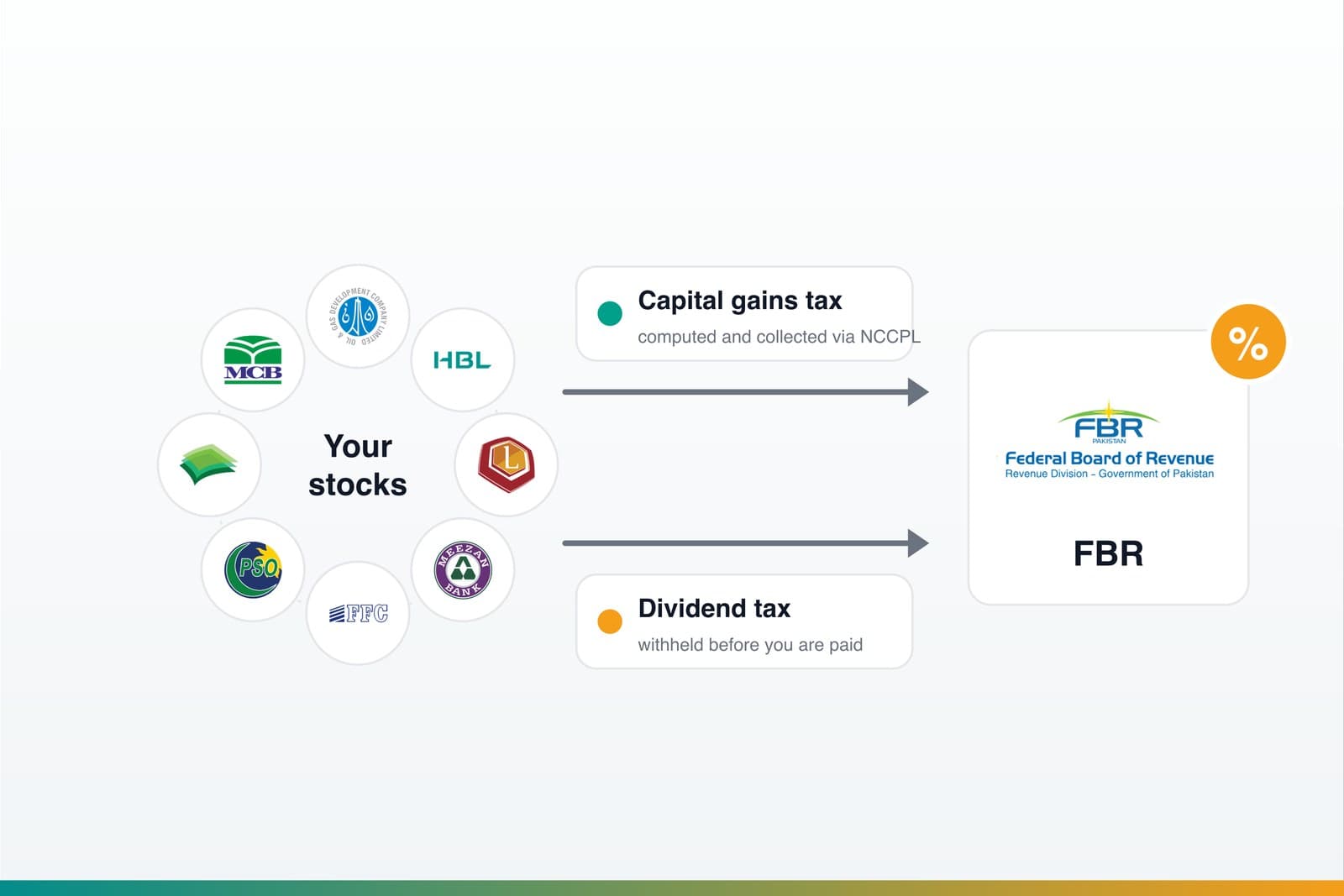
Capital Gains Tax & Dividend Tax on PSX Stocks (Pakistan)
A plain-English guide to how capital gains tax (CGT) and dividend tax work on Pakistan Stock Exchange shares - filer vs non-filer rates, how holding period and acquisition date matter, how NCCPL collects CGT, and what you still have to declare.
Read guide
How to Start Investing in the Pakistan Stock Exchange as a Beginner
A complete beginner guide to investing in the Pakistan Stock Exchange: account setup, brokers, PSX concepts, research, risk management, portfolio tracking and daily market routines.
Read guide
What Is the Minimum Amount Needed to Start Investing in PSX?
Understand how much money a beginner may need to start investing in the Pakistan Stock Exchange, including account requirements, share prices, charges and practical starting ranges.
Read guide