
Provident Fund Calculator
TWO HANDS
You put in, your employer matches, the fund grows it
Shares are worked on basic salary, not gross pay.
You
deducted from salary
Rs 10,000 a month
Your employer
added on top
Rs 10,000 a month
IN 25 YEARS
Rs 61,760,467
Every Rs 1 you put in comes back as about Rs 5.2.
- YouRs 1.18 crore (19%)
- Your employerRs 1.18 crore (19%)
- Fund profitRs 3.82 crore (62%)
Your basic in the final year: Rs 984,973 a month.
HOW IT GROWS
Your raises and the fund's profit do the growing
THE TAX CHECK
Your employer's share is tax-free
In a recognised fund, employer contributions up to the lower of 10% of salary or Rs 150,000 a year are tax-free, and the balance you receive is excluded from income.
About Rs 8,104,447 over the years goes above the limit and is taxed as your income that year. See the income tax calculator.
In 7 years the profit credited is more than a third of that year's salary; interest above that is income under rule 3(b).
PART-WAY THROUGH?
Add what is already in, and inflation
Pair this with your gratuity in the gratuity calculator, and plan the rest in the retirement calculator.
- You
- Your employer
- Fund profit
Profit is credited as a steady monthly equivalent of the yearly rate. Real funds credit once a year on the average balance, so actual results differ slightly.
How the provident fund calculator works
A provident fund is a retirement savings pool. Every month a fixed percentage of your basic salary is deducted and paid in, your employer adds its share, and the fund credits profit on the whole balance. The calculator runs this month by month, adds your increment every twelve months, and keeps three running totals so you can see how much of the final balance is your own money, your employer's money and profit.
- S
- monthly basic salary that month, rising by the yearly increment
- e, r
- your and your employer's contribution as a share of basic
- i
- monthly profit rate = (1 + yearly profit rate)^(1/12) − 1
Real funds credit profit once a year on the average balance, so actual results can differ a little. The pattern is the same: the employer share is free money that also compounds, and the profit share grows fastest in the last decade.
A worked example
With a Rs 100,000 basic salary, 10% from you and 10% from your employer, a 10% yearly increment and a 10% profit rate, the fund reaches Rs 61,760,467 after 25 years. You contribute Rs 11,801,647, your employer Rs 11,801,647, and profit adds Rs 38,157,172, which is 62% of the balance. If your salary stayed flat the same plan reaches Rs 24,666,498.
| Fund profit rate | Balance after 25 years | Profit share of balance |
|---|---|---|
| 8% | Rs 49.6M | 52% |
| 10% | Rs 61.8M | 62% |
| 12% | Rs 78M | 70% |
| 14% | Rs 99.6M | 76% |
The profit rate is the biggest single lever, which is why it is worth asking your trustees what the fund has credited over the last few years and where it invests.
Your employer's share is the other reason a provident fund beats saving the same money alone: in this example it adds Rs 11,801,647 on top of your Rs 11,801,647, a 100% return on your own contributions before any profit. Under rule 2(d) of the recognition rules, the employer can recover only its own contributions and the profit on them, and only if you are dismissed for misconduct or leave voluntarily early; your own contributions stay yours. Check your fund's rules before you resign.
Pakistan tax rules for a recognised provident fund
Part I of the Sixth Schedule to the Income Tax Ordinance, 2001 sets the rules for a recognised provident fund. As read in the summaries we could access:
- Employer contributions: anything above the lower of one-tenth of salary or Rs 150,000 a year is treated as the employee's income (rule 3(a)). The one-tenth limit is the one that bites for most people, while the rupee cap bites when basic salary is above Rs 125,000 a month. At Rs 250,000 a month, Rs 150,000 of a 10% employer share is above the limit.
- Employer match: the employer's contribution in a year may not exceed the employee's (rule 2(c)).
- Profit: interest credited above one-third of salary, or above a rate the Federal Government notifies, is treated as income (rule 3(b)). We could not confirm the current notified rate, so ask your trustees.
- Payout: the accumulated balance is excluded from total income (rule 4), and rules 5 and 6 cover tax deducted at source on some payouts.
If your employer excess is taxable, the income tax calculator shows what it costs at your slab. For the voluntary side of retirement saving, with its own yearly tax credit, see the VPS pension calculator.
Getting more from your provident fund
- Take the full match. If your fund lets you choose a higher percentage, the employer match is the best return you will get, but check the limit above for high salaries.
- Watch the trustees' investments. A fund held mostly in government securities tracks interest rates, so profit falls when the State Bank cuts. Compare the credited profit with inflation, not only with a bank account.
- Do not cash out when you change jobs. The balance can usually be transferred to your next employer's recognised fund, which keeps it compounding and keeps it excluded from income under rule 4.
- Plan for the gap. A fund plus gratuity rarely covers a full retirement. Put the balance into the lump sum box of the retirement calculator to see what you still need.
Sources and assumptions
Rules checked October 31, 2026. The fund profit rate is an assumption you control; the current notified profit-rate exemption could not be confirmed.
- FBR: Income Tax Ordinance, 2001, amended up to June 30, 2026 (Second Schedule Part I clause 13; Sixth Schedule)
- Pakistan Revenue: summary of Part I of the Sixth Schedule (recognised provident funds)
- M. Safdar & Co., Labour Laws of Pakistan (February 2026), Standing Order 12
- Calculation: month-end contributions, profit credited monthly at the monthly equivalent of the yearly rate, salary increment applied every 12 months
Your fund's trust deed and rules decide the real contributions and profit. Results are estimates for information and planning only, not tax, legal or investment advice. Check your own case with a tax adviser, your broker or the official source before acting.
FAQ
Provident Fund Calculator: common questions
How is a provident fund balance calculated?+
Each month you and your employer each pay a fixed percentage of your basic salary into the fund, and the fund credits profit on the balance. With a Rs 100,000 basic salary, 10% from each side, a 10% yearly increment and a 10% fund profit, the balance after 25 years is about Rs 61,760,467.
What percentage do employees and employers contribute to a provident fund in Pakistan?+
There is no single legal percentage. Most funds use 8.33% (one month's basic salary a year) or 10% of basic, and the employer usually matches the employee. Your fund's trust deed and rules set the rate. In a recognised fund the employer's contribution in a year may not exceed the employee's.
Is the employer's contribution to a provident fund taxable?+
Up to a limit it is not. Under Part I of the Sixth Schedule to the Income Tax Ordinance, 2001, employer contributions to a recognised provident fund above the lower of one-tenth of salary or Rs 150,000 a year are treated as the employee's income. For example, at a Rs 250,000 monthly basic the limit is Rs 150,000 a year, so a 10% employer share of Rs 300,000 has Rs 150,000 above it.
Is the profit on my provident fund taxable?+
Interest or profit credited to your balance above one-third of your salary in a year, or above a rate that the Federal Government notifies, is treated as income under rule 3(b) of Part I of the Sixth Schedule. We could not confirm the current notified rate, so the calculator only flags years where profit exceeds one-third of salary. Ask your fund trustees how your fund's profit is treated.
Is the money I receive from the provident fund at retirement taxed?+
The accumulated balance of a recognised provident fund is excluded from total income under rule 4 of Part I of the Sixth Schedule, including when it moves to a new employer's recognised fund. Other rules cover cases where tax is deducted at source on a payout, for example if the fund is not recognised or the payment falls outside the permitted cases, so confirm with the trustees before you withdraw early.
Provident fund or gratuity: which do I get?+
Under Standing Order 12, no gratuity is payable for the period an employer's provident fund has existed, where the worker contributes to it and the employer's contribution is not less than the worker's. If the employer contributes less than you do, gratuity is still due. Some employers pay gratuity in addition under their own policy. Check your appointment letter, and use the gratuity calculator to see what the other benefit would add.
Can I take money out of my provident fund before retiring?+
Under the recognition rules, the balance is payable when you leave the employer, and no part is payable before that except as the fund's rules and the Schedule allow. Many funds permit loans or limited advances, but the terms are set in your fund's rules, so read them before you plan around early access.
Keep going
Related tools
Retirement Calculator
The savings you need to retire, and the monthly investment that gets you there.
Gratuity Calculator
Gratuity from your last drawn salary and years of service, with the tax-free limit.
VPS Pension Calculator
Voluntary Pension System growth, the yearly tax credit, and the pension at retirement.
PSX guides
Learn the ideas behind the numbers
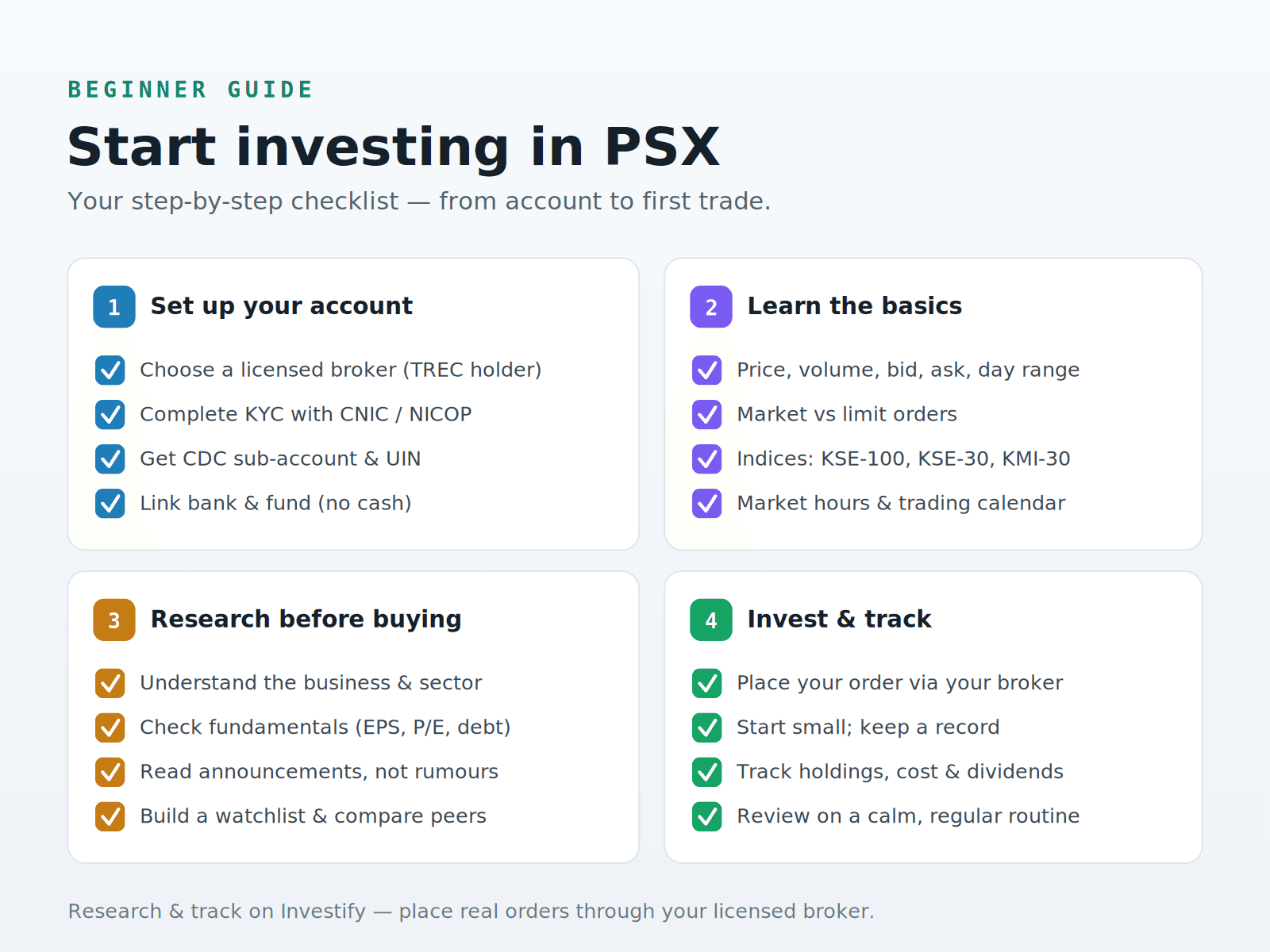
How to Start Investing in the Pakistan Stock Exchange as a Beginner
A complete beginner guide to investing in the Pakistan Stock Exchange: account setup, brokers, PSX concepts, research, risk management, portfolio tracking and daily market routines.
Read guide
What Is the Minimum Amount Needed to Start Investing in PSX?
Understand how much money a beginner may need to start investing in the Pakistan Stock Exchange, including account requirements, share prices, charges and practical starting ranges.
Read guide
Dividend Stocks vs Growth Stocks on PSX
A beginner-friendly PSX guide comparing dividend stocks and growth stocks, including risks, investor fit, sectors, interest rates and market cycles.
Read guide