
Graham Number Calculator
THE STOCK
Would Benjamin Graham buy it?
Loading the latest figure...
Loading the latest figure...
Graham's number is √(22.5 × EPS × book value): the most a careful investor should pay, at 15× earnings and 1.5× book.
FFC GRAHAM NUMBER
Loading the latest PSX figures for FFC...
Graham set his limits for the US market of the 1960s and 70s, when interest rates were far lower than in Pakistan today. Treat them as a yardstick, not a rule.
The Graham number, explained
Graham's defensive investor wanted a stock that was cheap on two measures at once: against its earnings and against its assets. His rule of thumb was a price no higher than 15 times earnings and 1.5 times book value, with some give between the two: a stock with a lower P/E could be allowed a higher P/B, as long as P/E × P/B stayed within 22.5. Setting that product equal to 22.5 and solving for the price gives a single number.
- EPS
- earnings per share for the latest full year (must be positive)
- BVPS
- book value per share: equity divided by shares outstanding (must be positive)
- 22.5
- 15 × 1.5, Graham's limits for P/E and P/B
P/E is price ÷ EPS and P/B is price ÷ BVPS, so P/E × P/B = price² ÷ (EPS × BVPS). When that equals 22.5, the price is exactly the Graham number. Any price below it passes the combined test, any price above it fails.
Graham's growth formula, and using a Pakistani yield
Graham also gave a quick way to value a company that is expected to grow. It starts from a P/E of 8.5 for a business with no growth and adds two points of P/E for each percent of yearly growth expected over the next 7 to 10 years. The later version scales the result by how today's bond yields compare with the 4.4% high-grade corporate yield he used when he first wrote it down.
- g
- expected yearly earnings growth over 7 to 10 years, in percent (8 for 8%)
- Y
- today's yield on high-grade bonds, in percent
- 4.4
- the AAA corporate yield the formula was calibrated to
The Pakistan substitution. Graham's Y is the AAA corporate bond yield, and Pakistan has no deep market of AAA corporate bonds to read it from. We use the 10-year PIBcut-off yield, 12.85% at the State Bank's October 7, 2026 auction, as a local high-grade yield. It is a risk-free government yield, not a corporate yield, and it carries Pakistan's inflation, so it is much higher than 4.4%. The effect is that the formula's multiple of earnings is multiplied by 4.4 ÷ 12.85 = 0.34, which brings it into the range PSX stocks actually trade at. It is an open judgement call, so Y is editable and the formula is best read as one more yardstick rather than a precise value.
A worked example
A company earns Rs 20.00 per share on a book value of Rs 120.00 per share, with 8% expected growth, and trades at Rs 150.00. Its P/E is 7.5 and its P/B is 1.25, so P/E × P/B is 9.4, inside the 22.5 limit.
| Measure | Working | Value per share |
|---|---|---|
| Graham number | √(22.5 × 20 × 120) | Rs 232.38 |
| Growth formula, Y = 12.85% | 20 × (8.5 + 2 × 8) × 4.4 ÷ 12.85 | Rs 167.78 |
| Growth formula, Graham's own Y = 4.4% | 20 × (8.5 + 2 × 8) × 4.4 ÷ 4.4 | Rs 490.00 |
At Rs 150.00 the price is below the Graham number of Rs 232.38 and below the growth-formula value of Rs 167.78. The two methods weigh things differently: the Graham number leans on book value, the growth formula only on earnings and growth, so when they disagree, ask which one fits the business. The last row shows how much the choice of Y matters: using Graham's own 4.4% would multiply the growth-formula value by 2.9.
What this model misses
- One year of earnings. Graham averaged earnings over several years to smooth out cycles. A single strong year in oil, cement or fertiliser flatters EPS and the Graham number. Enter a normal-year EPS to be fair to cyclical companies.
- Book value is accounting, not market value. Land, plant and mines are carried at historical cost less depreciation, so in a high-inflation economy book value can understate what assets would cost today. Asset-light businesses with strong brands or technology look expensive on P/B even when they are not.
- Fixed limits from another era. The 15 and 1.5 were set for the US market of the 1960s and 70s. Interest rates in Pakistan are far higher, which is why you can change the limits under More options.
- No quality or debt check. A cheap company can be cheap for a reason: weak margins, heavy borrowing, or earnings that never arrive as cash. Look at the balance sheet before trusting a pass.
- Banks and financials. Banks have no current ratio and carry high leverage by design. Use the P/B and P/E checks and judge the rest on its own terms.
Using it with other tools
Graham values are a quick first filter. Follow up with the P/E ratio calculator to see what multiple the price implies, the intrinsic value (DCF) calculator to model growth over time, and the dividend discount model for steady payers such as FFC. To see two stocks' P/E and P/B side by side, use the stock comparison.
Sources and assumptions
Rates checked October 31, 2026: 10-year PIB cut-off yield 12.85% (State Bank auction, October 7, 2026), used as the local high-grade yield.
- Benjamin Graham, The Intelligent Investor (revised edition, 1973): the defensive investor's limits of 15 times earnings, 1.5 times book value and 22.5 combined
- Benjamin Graham, Security Analysis (1962 edition) and later writing: the growth formula and its bond-yield adjustment, as widely cited
- State Bank of Pakistan, PIB auction results (latest result when checked: 10-year cut-off yield 12.85%, auction held October 7, 2026)
- EPS, book value per share, dividend, current ratio and price: Investify PSX data, with the reporting period shown beside each number
A Graham value is a screening yardstick from a different era and market, not a price target or a recommendation to buy or sell. Results are estimates for information and planning only, not tax, legal or investment advice. Check your own case with a tax adviser, your broker or the official source before acting.
FAQ
Graham Number Calculator: common questions
What is the Graham number?+
The Graham number is the highest price Benjamin Graham's defensive investor should pay for a share, based on two things: earnings per share and book value per share. It equals the square root of 22.5 × EPS × BVPS. A share trading below it passes Graham's combined test, and one trading above it fails.
Why 22.5?+
Graham said a defensive investor should pay no more than about 15 times earnings and 1.5 times book value, and that a higher figure for one could be balanced by a lower figure for the other as long as P/E multiplied by P/B stayed under 22.5 (15 × 1.5). Setting P/E × P/B equal to 22.5 and solving for the price gives the square root formula.
Why is there no Graham number for my stock?+
The formula takes a square root of EPS times book value, so both must be positive. A company that lost money in the latest year, or that has negative shareholders' equity, has no Graham number. The growth formula also needs positive EPS.
What is Graham's growth formula and what is Y?+
The formula is value = EPS × (8.5 + 2g) × 4.4 ÷ Y. The 8.5 is the fair P/E of a company with no growth, g is the growth you expect over the next 7 to 10 years, and Y is the current yield on high-grade corporate bonds. The 4.4 is the yield Graham calibrated to. Pakistan has no deep AAA corporate bond market, so this calculator uses the 10-year PIB yield (12.85% at the State Bank's October 7, 2026 auction) as a local stand-in. You can edit Y.
Do Graham's rules work on the Pakistan Stock Exchange?+
As a screen, yes: they quickly separate stocks priced cheaply against earnings and assets from richly priced ones. As a verdict, no. Graham's numbers came from a different market and era, so treat them as one yardstick next to the DCF and dividend models.
Can a stock above its Graham number still be a good investment?+
Yes. Companies that earn very high returns on a small asset base, such as some consumer and technology companies, can trade well above 1.5 times book value for good reason. The Graham number is built for asset-heavy, steady businesses. A stock above it is not automatically expensive, it just fails this particular test.
Why does the checklist say some data is missing?+
The checks use the latest reported dividend and current ratio. Some companies, especially banks, do not report a current ratio because they do not have a conventional current and non-current split. A check with no data is marked as such rather than passed or failed.
Keep going
Related tools
Intrinsic Value (DCF) Calculator
A discounted earnings or cash-flow value per share, with margin of safety.
P/E Ratio & Fair Price Calculator
P/E, earnings yield, PEG and the price a target P/E implies.
Compare PSX Stocks
Two to four PSX stocks side by side: price, returns, valuation, dividends and profitability.
PSX guides
Learn the ideas behind the numbers
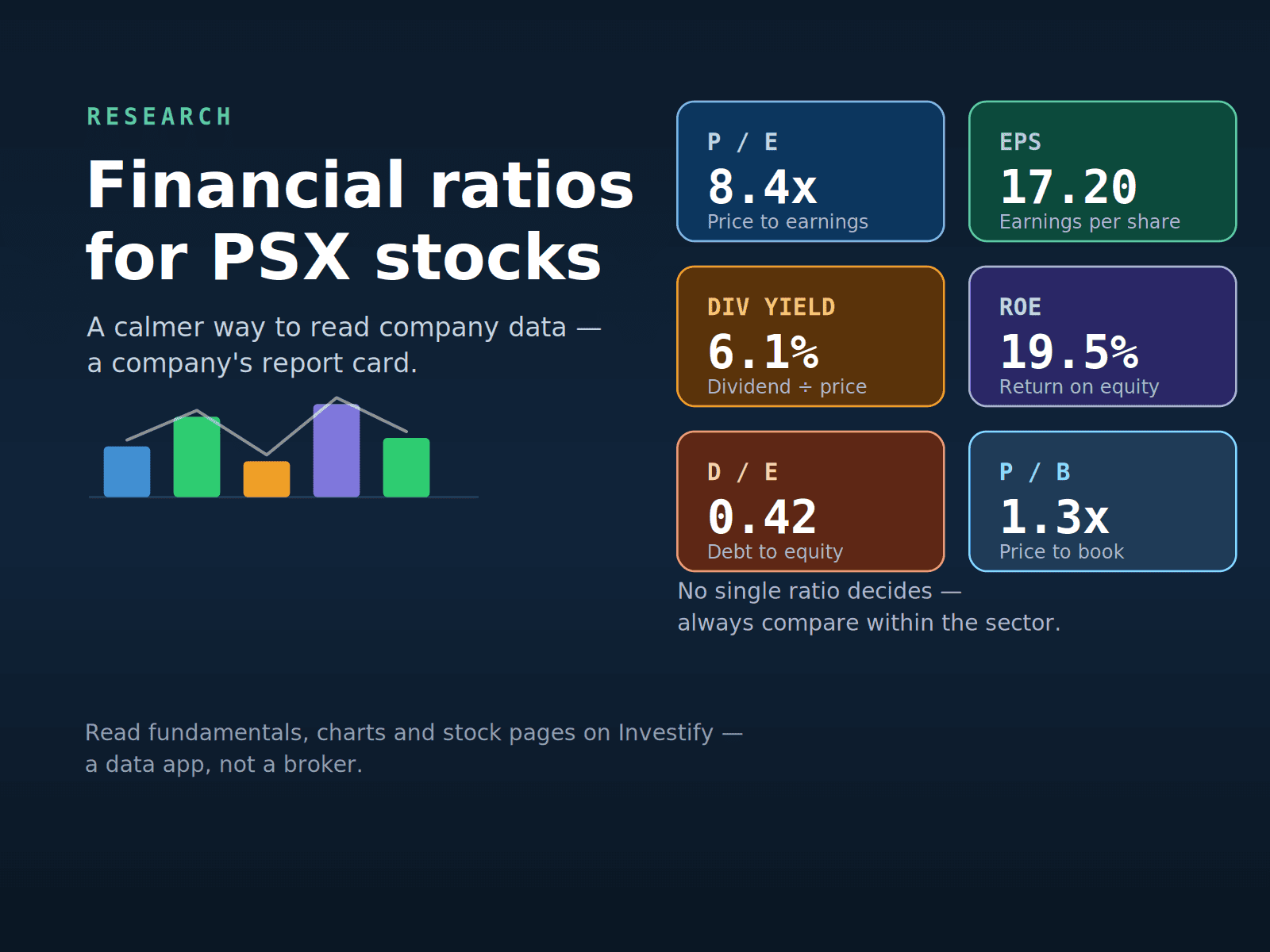
Beginner-Friendly Financial Ratios for PSX Stocks
A simple guide to key financial ratios for Pakistan Stock Exchange stocks, including EPS, P/E, dividend yield, book value, ROE, margins, debt ratios and how beginners should read them.
Read guide
How to Research PSX Companies Before Buying Shares
A practical PSX company research checklist for beginners: read stock pages, fundamentals, charts, technicals, announcements, annual reports and market news before buying.
Read guide
Dividend Stocks vs Growth Stocks on PSX
A beginner-friendly PSX guide comparing dividend stocks and growth stocks, including risks, investor fit, sectors, interest rates and market cycles.
Read guide