
Emergency Fund Calculator
THE SAFETY NET
If your income stopped, how long could you last?
Only what you must keep paying: rent, bills, groceries, school fees, loan instalments, insurance, transport.
My income is
3 to 6 months suggested: A steady salary and an employer who pays gratuity or notice means a shorter gap if you lose the job.
Months of cover
1 lakh
IF YOUR INCOME STOPPED TODAY
1.3months
Your Rs 1 lakh covers that much of the 4 months to aim for (Rs 320,000).
Rs 2.2 lakh
still to save
9 months
at Rs 25,000 a month
BUILD IT
Save more, get there sooner
On the way you deposit Rs 225,000 and earn Rs 14,722 of profit before tax.
WHERE TO KEEP IT
Safe, and reachable in a day or two
A savings account is instant but pays least; a money market fund usually pays more and returns money in a day or two; short-term National Savings certificates pay a fixed rate (check the early-encashment terms). Never shares. Profit is taxed: see the fixed deposit calculator.
ITEM BY ITEM
Not sure of the total? List it
Replaces the single figure with the lines below.
- Your emergency savings
- Target fund
Once the fund is full, see your wider picture in the net worth calculator and plan the next goal with the goal planner.
How the emergency fund calculator works
An emergency fund is money set aside for the months when income stops: a job loss, a business slowdown, a medical bill or a family emergency. The calculator sizes it as your monthly essential expenses multiplied by the months of cover your situation calls for, then shows how long it takes to reach that amount from what you have saved and what you can add each month.
- Target
- monthly essential expenses × months of cover
- i
- monthly return = (1 + yearly return)^(1/12) − 1
- D
- amount you save at the end of each month
The calculator counts months until the balance first reaches the target, including the interest earned on the way. Because the cushion is small, interest matters less than the monthly amount: the saving rate is what builds the fund.
How many months of cover do you need?
| Your situation | Months of cover | Why |
|---|---|---|
| Stable salaried job | 3 to 6 months | A steady salary and an employer who pays gratuity or notice means a shorter gap if you lose the job. |
| One income or a family depends on you | 6 months | No second salary to fall back on, so the cushion has to carry the whole household. |
| Self-employed or freelancer | 9 to 12 months | Income arrives late or unevenly and dries up in a bad quarter, so a longer cushion is the norm. |
These ranges are common planning guidance, not a rule. Add a month or two if you have dependents, a large loan instalment or health costs, or if your industry is going through layoffs. In the calculator the suggestion uses 4, 6 and 10 months, and you can pick your own.
A worked example
Suppose essential expenses are Rs 80,000 a month, you already have Rs 100,000 set aside and you save Rs 25,000 a month at 10% a year before tax.
| Situation | Target | Time to reach it | Interest earned |
|---|---|---|---|
| Stable salaried job | Rs 320,000 | 9 months | Rs 14,722 |
| One income or a family depends on you | Rs 480,000 | 1 year 2 months | Rs 30,494 |
| Self-employed or freelancer | Rs 800,000 | 2 years 1 month | Rs 85,593 |
A longer cushion takes much longer to build at the same saving rate, which is why many people start with a one-month starter fund, then grow it. Saving Rs 40,000 a month instead of Rs 25,000 gets the stable-job cushion done in 6 months instead of 9 months.
Build it in stages
A six-month target can feel out of reach, so build it in stages. With the same Rs 80,000 of essentials, Rs 100,000 saved and Rs 25,000 a month, the milestones fall like this:
| Milestone | Amount | Time from now |
|---|---|---|
| 1 month of expenses | Rs 80,000 | Already there |
| 3 months of expenses | Rs 240,000 | 6 months |
| 6 months of expenses | Rs 480,000 | 1 year 2 months |
The first month of cover covers the most common emergencies, such as a car repair or a short gap between jobs. Reaching it quickly lets you start investing for the long term while you finish the rest. If you also carry credit card debt, clear it alongside the starter fund, because card interest is higher than anything a savings account pays.
Where to keep an emergency fund
An emergency fund has three jobs: be there, be quick to reach and not lose value. That rules out shares and anything you could only sell at a loss.
- Savings account: instant access and the lowest return. Good for the first month or two. National Savings lists 10% on its savings account.
- Money market fund: usually a higher return than a savings account, not guaranteed, and money comes back in a day or two. Read the fund's documents first.
- Short-term National Savings certificates: a fixed rate for 3, 6 or 12 months (11.12%, 11.5% and 11.72% per the October 21, 2026 revision as reported). Check early-encashment terms.
Profit on all of these is taxed. Compare after-tax returns in the fixed deposit calculator and the National Savings calculator. When the fund is full, see where you stand overall with the net worth calculator.
Common mistakes
- Counting investments as the emergency fund. A falling market can cut it exactly when you need it.
- Using total spending instead of essentials, which makes the target look impossible and discourages saving.
- Forgetting that costs rise: refresh your essentials figure every year, especially rent and school fees.
- Treating the fund as spendable. Define what an emergency is before you need to decide, and refill the fund after you use it.
Sources and assumptions
Savings rates checked October 31, 2026 (National Savings revision of October 21, 2026, as reported). The return is an assumption you control.
- Calculation: target = monthly essentials × months of cover; balance grows by the monthly equivalent of the yearly return with each deposit added at month end
- Central Directorate of National Savings, profit rates
- State Bank of Pakistan, Monetary Policy Statement (October 2026)
Returns are before tax and are not guaranteed. Results are estimates for information and planning only, not tax, legal or investment advice. Check your own case with a tax adviser, your broker or the official source before acting.
FAQ
Emergency Fund Calculator: common questions
How many months of expenses should an emergency fund cover in Pakistan?+
Three to six months if you have a stable salaried job, about six months if you are the only earner or a family depends on your income, and nine to twelve months if you are self-employed or a freelancer. The less predictable your income and the harder it would be to find work quickly, the longer the cushion should be.
What counts as an essential expense?+
Only the costs you would have to keep paying if your income stopped: rent or home costs, utilities, groceries, school fees, loan instalments, insurance and medical, and transport. Leave out holidays, dining out, shopping and savings. The item by item card lets you enter these one by one.
Where should I keep my emergency fund?+
Somewhere you can reach within a day or two and where the value will not fall in a bad week. The usual options are a savings account, a money market fund and short-term National Savings certificates. National Savings lists a 10% savings account rate and 11.72% on the 12-month short-term certificate (media reports of the October 21, 2026 revision, official site not reachable at review time). Do not keep it in shares.
Is a money market fund safe for an emergency fund?+
Money market funds invest in short-term government securities and bank deposits and aim for stable value, but they are not guaranteed like a bank deposit, and redemption can take a day or two. Read the fund's offering document and decide whether you are comfortable with that. A savings account is simpler and instant, at a lower return.
How long will it take me to build the fund?+
It depends on your target and how much you save. With Rs 80,000 of monthly essentials, a stable job (a 4-month cushion of Rs 320,000), Rs 100,000 already saved and Rs 25,000 a month at 10%, you get there in 9 months. Saving Rs 40,000 a month instead takes 6 months.
Should I build an emergency fund before I invest in the stock market?+
Most advisers say yes, at least a starter fund of one to three months. Shares can fall exactly when you need cash, and selling at a loss to pay a bill defeats the purpose of investing. Build the starter fund, then split your savings between completing the fund and investing.
Should I include my loan instalments?+
Yes. Loan instalments are a bill you must keep paying even if you lose your income, so they belong in essential expenses. A large instalment is also a reason to aim for the higher end of the months of cover.
Keep going
Related tools
Net Worth Calculator
Everything you own minus everything you owe, with an asset mix breakdown.
Goal Planner
The monthly investment that reaches a goal: Hajj, a wedding, a car, a home or education.
Bank Term Deposit Calculator
Profit on bank term deposits and savings accounts, monthly or at maturity, after tax.
PSX guides
Learn the ideas behind the numbers
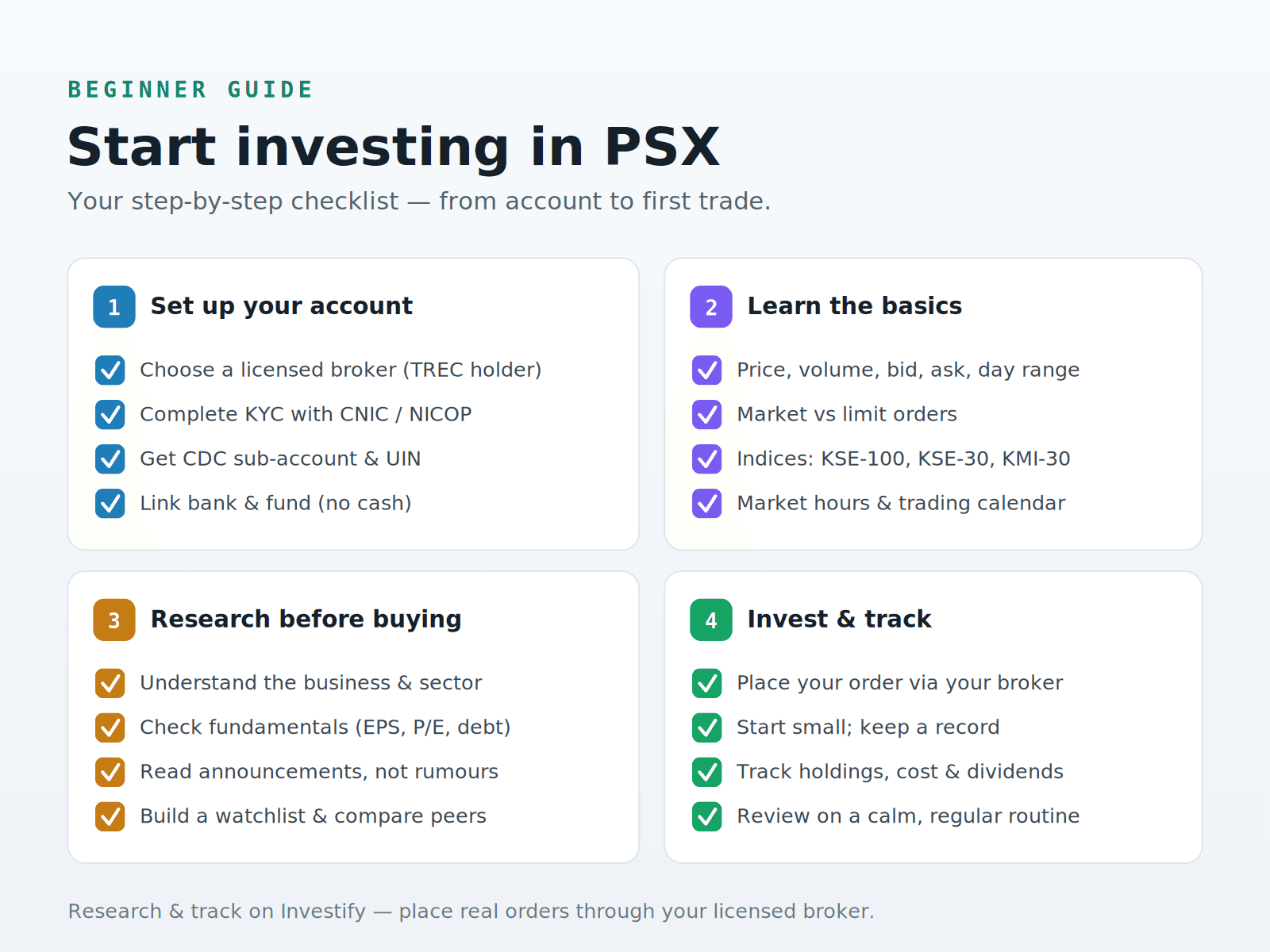
How to Start Investing in the Pakistan Stock Exchange as a Beginner
A complete beginner guide to investing in the Pakistan Stock Exchange: account setup, brokers, PSX concepts, research, risk management, portfolio tracking and daily market routines.
Read guide
What Is the Minimum Amount Needed to Start Investing in PSX?
Understand how much money a beginner may need to start investing in the Pakistan Stock Exchange, including account requirements, share prices, charges and practical starting ranges.
Read guide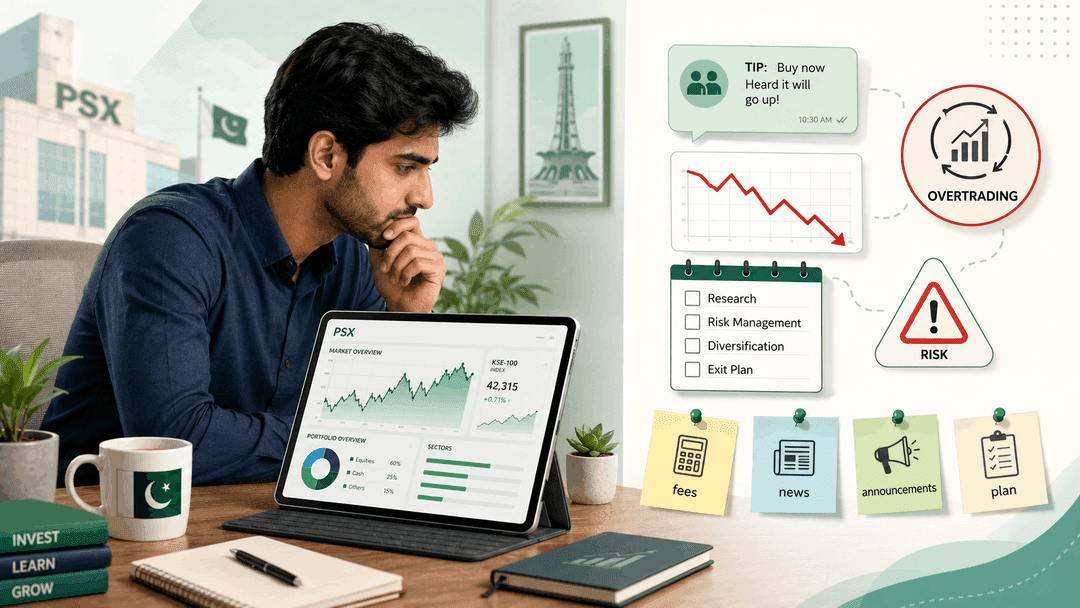
Common Mistakes Beginners Make in the Pakistan Stock Exchange
A practical guide to common PSX beginner mistakes, including chasing tips, overtrading, ignoring risk, skipping research and not tracking portfolio decisions.
Read guide