
Right Shares Calculator
THE RIGHT ISSUE
Your company is offering you new shares
No stock selected. Enter the price yourself.
1 new share for every 4 held.
LETTER OF RIGHT
1 for 4
Each right is worth
Rs 80.00
The share should open ex-right near Rs 180.00 (-10% from Rs 200.00), the theoretical ex-right price.
Doing nothing costs you Rs 20,000
Subscribe or sell the letters and your total stays about the same. Let them lapse and their value is gone.
YOUR THREE CHOICES
Today you hold Rs 200,000. After the issue:
Subscribe
Pay for every new share
Rs 200,000
Same as today
- 1,250 shares
- You pay Rs 25,000
Sell the letters
Take cash for your rights
Rs 200,000
Same as today
- 1,000 shares
- You get Rs 20,000
Do nothing
The rights lapse
Rs 180,000
-Rs 20,000 (-10%)
- 1,000 shares
Shares valued at the theoretical ex-right price, plus cash received, less cash paid. The real ex-right price can differ.
SPLIT IT
Short of cash? Sell 139 letters, take 111 shares
The money from the letters you sell pays for the shares you keep, so you add little or no cash of your own.
250 subscribed, 0 sold
You pay Rs 25,000 and get Rs 0: net -Rs 25,000 in cash. You end with Rs 200,000 (same as today).
YOUR NEW AVERAGE COST
What did you pay for your shares?
Leave at 0 to skip.
New shares bought at Rs 100.00 pull your average toward the subscription price.
Fractions of a right are not allotted: the company combines them, sells them on the PSX and pays the proceeds to the shareholders entitled. See how bonus shares differ in the bonus shares calculator. Price at 50% below the market.
How a right issue works
In a right issue the company raises money from its own shareholders. Each shareholder is offered new shares in proportion to what they hold, usually at a price below the market price. A "25% right" means 25 new shares for every 100 held. The offer comes as a letter of right, one for each new share you may buy. You can subscribe to it, sell it, or let it lapse.
Because new shares are issued at a discount, the share is worth less per share once the issue is done, even though the company has more money. The calculator finds that new price, the theoretical ex-right price (TERP), and from it the value of each right.
- N
- shares you hold (use 100 for the ratio)
- R
- new shares offered per 100 held, for example 25
- P cum
- market price before the stock goes ex-right
- P sub
- subscription price per new share
A worked example
You hold 1,000 shares at Rs 200.00. The company offers a 25% right at Rs 100.00. You are entitled to 250 right shares, and subscribing to all of them costs Rs 25,000. TERP is Rs 180.00, so each letter of right is worth Rs 80.00.
| Your choice | Shares after | Cash in or out | Total value | Against today |
|---|---|---|---|---|
| Subscribe to all | 1,250 | -Rs 25,000 | Rs 200,000 | Rs 0 |
| Sell the letters (after 0.18% costs) | 1,000 | +Rs 19,964 | Rs 199,964 | -Rs 36 |
| Do nothing | 1,000 | Rs 0 | Rs 180,000 | -Rs 20,000 |
| Subscribe to 40%, sell the rest | 1,100 | +Rs 1,978 | Rs 199,978 | -Rs 22 |
Subscribing or selling keeps your wealth about where it was, because the price drop on your old shares is made up by the new shares you buy or the cash you sell the rights for. Doing nothing is the only choice that loses money. The small gap on selling is brokerage and charges.
Subscribe, sell or let it lapse
- Subscribe. You pay the subscription price for each new share through your broker or CDC participant before the closing date in the notice. You hold more shares afterwards, and your average cost per share moves toward the subscription price. Enter your buy price in the new average cost card to see it.
- Sell the letters of right. After the book closure the unpaid rights are credited to your CDC account, and the PSX opens a trading window for them. They trade as their own security with their own symbol, usually the company's code plus a suffix such as R, which the notice gives. You sell them through your broker like any share, and the brokerage calculator shows the charges. The price moves with the market, so it can differ from the theoretical value, and once a letter is paid for it can no longer be traded.
- Do nothing. The rights lapse at the closing date and you receive nothing for them. The calculator shows what that costs.
Dates matter: to receive the rights you must own the shares before the ex-right date, in the same way as for a dividend (see the dividend calculator). The ex-right and book closure dates are in the company's right issue notice on the PSX website.
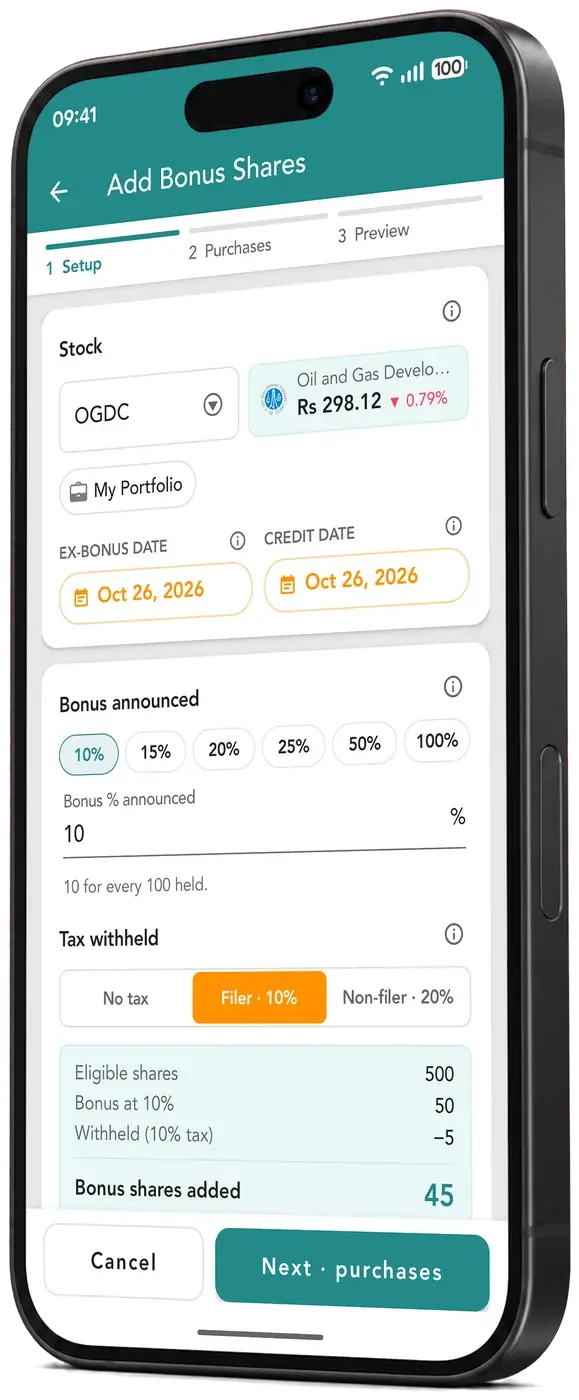
Right issue or bonus issue
| Right shares | Bonus shares | |
|---|---|---|
| Do you pay? | Yes, the subscription price | No cash for the shares |
| Effect on the share price | Falls to about the TERP | Falls in proportion to the new shares |
| Your total value, if you take part | About unchanged | About unchanged, less tax |
| Tax at the time | No bonus-share tax | 10% filer, 20% non-filer, withheld by the company |
| If you ignore it | You lose the value of the rights | The shares are credited anyway |
The bonus shares calculator covers the tax and the adjusted price. If the subscription price is above the market price, as in Rs 250.00 against Rs 200.00, the right has no value and subscribing would cost you Rs 12,500 against the market. Whether a sale of letters of right is a taxable gain is worth checking with your broker or a tax adviser.
Common mistakes
- Treating 25% as 25 shares. It is 25 new shares per 100 held, so 1,000 shares earn 250 rights.
- Using today's price after the ex-date. Enter the price before the stock goes ex-right. After it, the market price already reflects the issue.
- Forgetting the premium. The subscription price is the full amount per share, premium included.
- Missing the deadline. Subscription and the trading window for letters both close on dates in the notice. A right not used or sold by then lapses.
To work out what your average cost becomes after buying more shares, see the stock average calculator.
Sources and assumptions
Trading costs checked October 31, 2026 against the PSX schedule of charges.
- Pakistan Stock Exchange, company announcements, book closure and letter of right notices
- PSX filing, S.G. Power right issue schedule and offer letter (August 2026): book closure, credit of unpaid rights, trading window, fractional rights
- Securities and Exchange Commission of Pakistan, Companies Act 2017 and the Companies (Further Issue of Shares) Regulations, 2020
- Central Depository Company of Pakistan, how letters of right are credited and subscribed
- Method: TERP is the weighted average price; outcomes assume the share trades at TERP after the issue
Results are estimates for information and planning only, not tax, legal or investment advice. Check your own case with a tax adviser, your broker or the official source before acting.
FAQ
Right Shares Calculator: common questions
What is the theoretical ex-right price (TERP)?+
TERP is the price the share should trade at once the new shares exist: the weighted average of the old shares at the market price and the new shares at the subscription price. With 100 shares at Rs 200.00 and 25 new shares at Rs 100.00, TERP is Rs 180.00. The actual price depends on the market, so treat TERP as a guide.
How do I calculate the value of a right?+
The value of one letter of right is the TERP minus the subscription price: Rs 180.00 less Rs 100.00 is Rs 80.00. Per share you hold it is the market price minus the TERP, Rs 200.00 less Rs 180.00 is Rs 20.00. If the subscription price is at or above the market price, the right is worth nothing.
Should I subscribe, sell my rights or ignore them?+
Before costs, subscribing and selling leave your total wealth about the same: subscribing means you pay cash for extra shares, selling means you take cash and keep the shares you have. Ignoring the rights loses their value, Rs 20,000 in the example. The right choice depends on whether you want a bigger holding at the subscription price and have the cash. This is general information, not investment advice.
What happens if I do nothing?+
The rights lapse after the last date in the company's notice. You keep your original shares, which trade at the lower ex-right price, and you receive nothing for the rights. In the example that is a loss of Rs 20,000, 10% of the holding.
How many right shares will I get?+
Multiply your shares by the right percentage and round down. A 25% right on 1,000 shares gives 250 right shares. On 1,010 shares the entitlement is 252.5, so you get 252. Fractional rights are not allotted: under the Companies (Further Issue of Shares) Regulations 2020 the company consolidates them, sells them on the PSX and pays the proceeds to the shareholders entitled, about Rs 40 for the half right here at the theoretical value of a letter, which the calculator counts as cash.
Can I sell my letters of right on the PSX?+
Yes. Shortly after the book closure the unpaid rights are credited to your CDC account in book-entry form, and the PSX opens a trading window for them. They trade as their own security with their own symbol, usually the company's code plus a suffix, for example LSEFSLR for the unpaid rights of LSE Financial Services. The window closes before the last payment date, and once the subscription is paid the letter can no longer be traded. Selling the letters is how a shareholder who does not want to put in more cash realises the value of a right.
What does '25% right at Rs 20 including premium' mean?+
It means 25 new shares for every 100 held, at Rs 20 each. The Rs 20 usually covers the face value (Rs 10 for most companies) plus a premium. Enter the full Rs 20 as the subscription price, since that is what you pay per new share.
Keep going
Related tools
Bonus Shares & Stock Split Calculator
New share count, adjusted price and average cost after a bonus issue or a split.
Stock Average Price Calculator
Your average cost after several buys, and how many shares bring it down to a target.
Dividend Income Calculator
Dividend income from your PSX shares after withholding tax, per payout and per year.
PSX guides
Learn the ideas behind the numbers

PSX Company Announcements Explained: Results, Dividends, Board Meetings, Book Closure, Rights and Bonus Issues
Learn what PSX company announcements mean - results, dividends, book closure, bonus shares and rights issues - and how to read them in Investify.
Read guide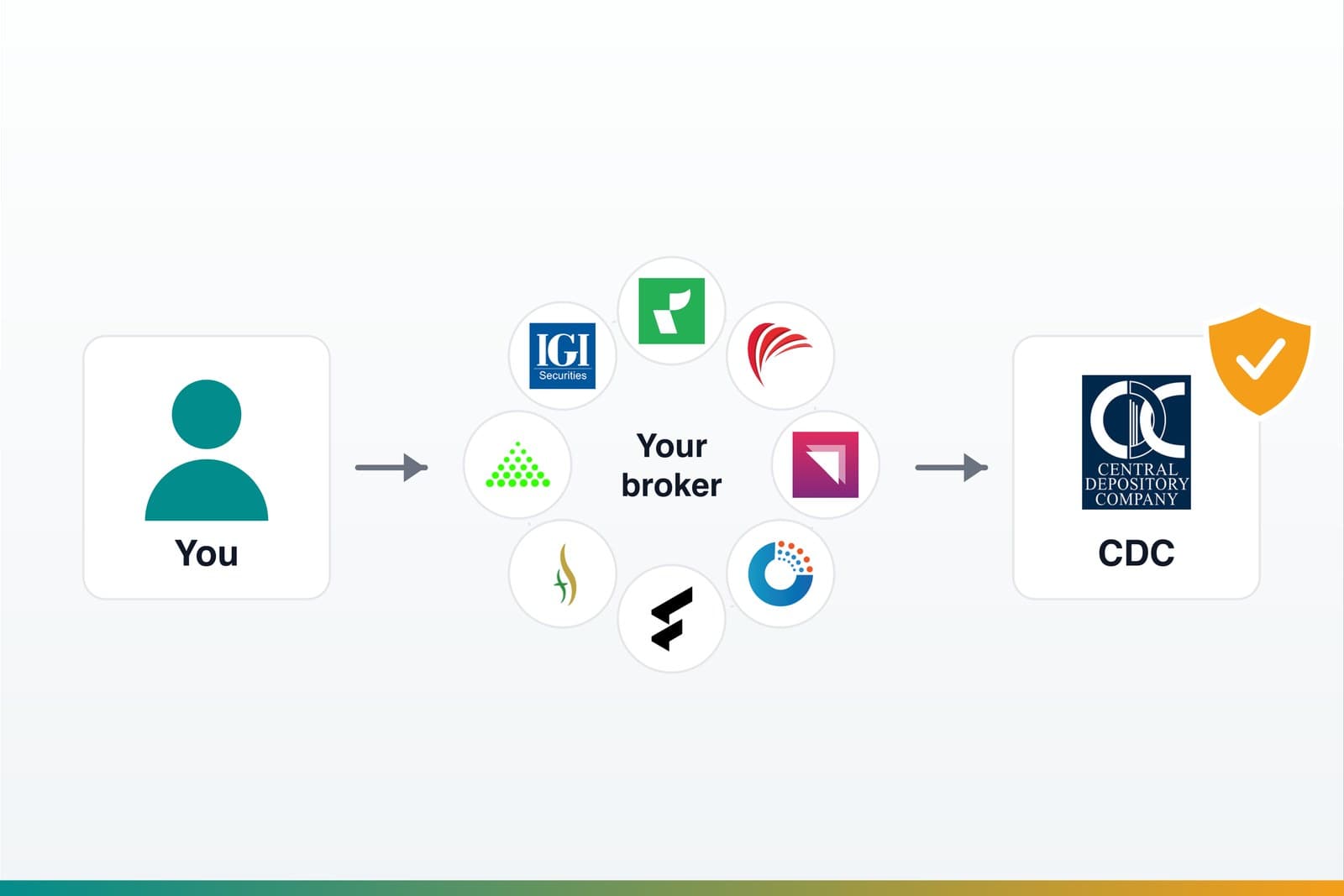
CDC Account Explained: Sub-Account vs Investor Account in Pakistan
What a CDC account actually is, the difference between a broker sub-account and a direct CDC Investor Account (IAS), how to check your shares yourself, and what happens to your shares if your broker shuts down.
Read guide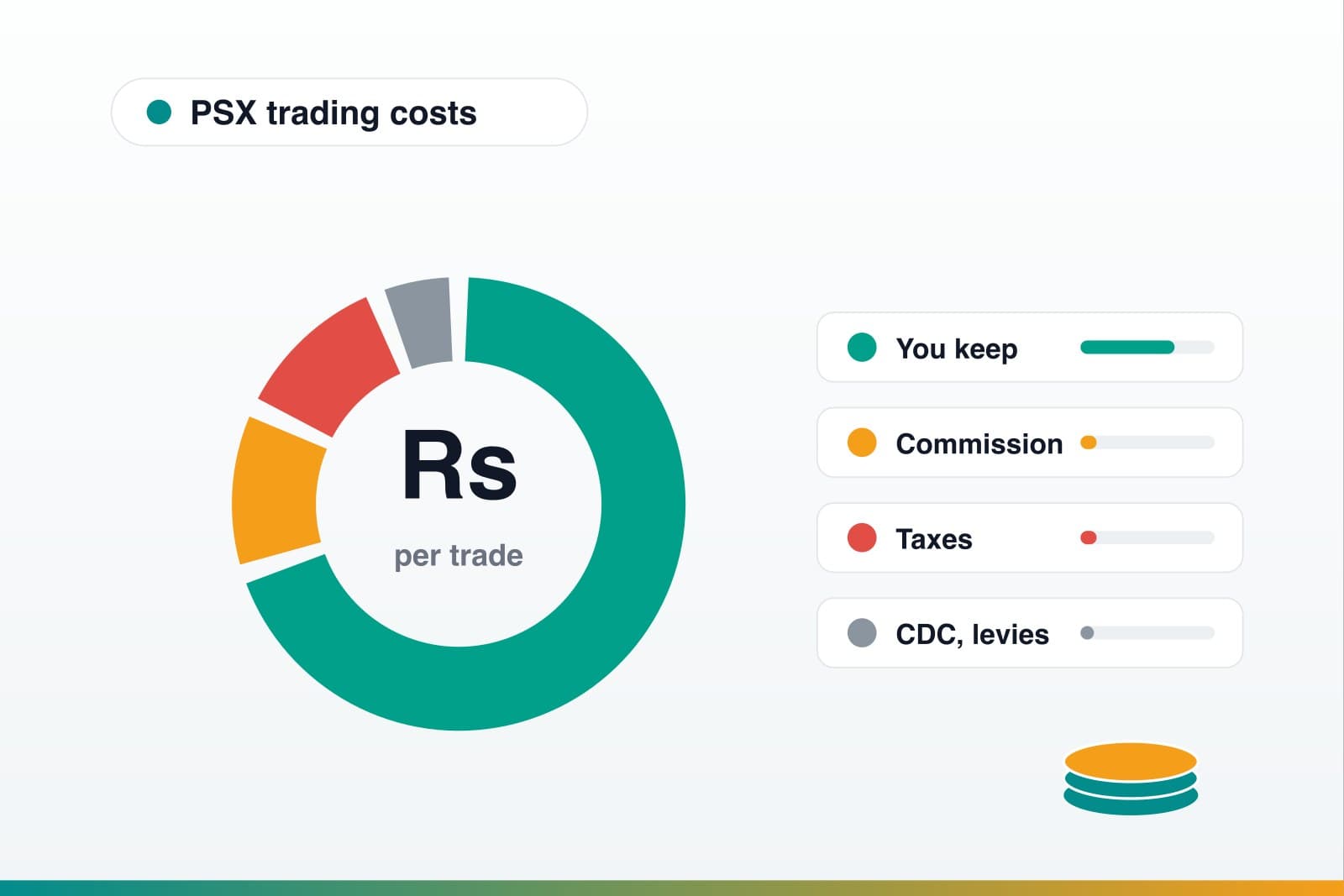
PSX Trading Fees & Charges: What a Trade Actually Costs in Pakistan
Every fee on a PSX trade explained - brokerage commission structures, sales tax on commission, CDC and NCCPL charges, regulatory levies and taxes - with a worked example of a full Rs 100,000 buy-and-sell round trip.
Read guide