
Dividend Tax Calculator
YOUR DIVIDEND
The tax taken before it reaches you
DIVIDEND WARRANT
Your shares
Pay the shareholder
Eight thousand five hundred rupees only
Rs 8,500
THE ATL ON THIS DIVIDEND
Being on the list saves you Rs 1,500
For this payer, dividend tax is 15% on the Active Taxpayers List and 30% off it. Your status on the day it is paid decides.
WHO PAYS DECIDES THE RATE
The same Rs 10,000 from each kind of payer
Tax on the ATL. Tap a payer to use it.
CHECK YOUR STATEMENT
Expected tax: Rs 1,500
Dividend tax under section 150 is a final tax: the payer deducts it before the money reaches you, and you owe nothing more on that dividend. Bonus shares are taxed separately at 10% on the ATL and 20% off it.
How tax on dividends works
When a PSX company pays a cash dividend, it deducts income tax before the money leaves its account. This is withholding tax under section 150 of the Income Tax Ordinance, and for individuals it is a final tax: what you receive is yours, and you owe nothing more on that dividend. The rate depends on two things, who pays the dividend and whether you are a filer.
- Gross dividend
- dividend per share × the number of shares you held on the record date
- Rate
- from the table below, by payer type and filer status
You are a filer if you are on the FBR Active Taxpayers List (ATL) when the dividend is paid. Check it on the FBR website before a payout date, because the rate applied to you follows the list on the day.
Rates by payer type, tax year 2027
The same dividend of Rs 100,000, taxed under each rule:
| Payer | Filer | Non-filer | Tax on Rs 100,000 (filer) | Tax on Rs 100,000 (non-filer) |
|---|---|---|---|---|
| Listed company (most PSX stocks) | 15% | 30% | Rs 15,000 | Rs 30,000 |
| Independent power producer (pass-through) | 7.5% | 15% | Rs 7,500 | Rs 15,000 |
| REIT scheme | 15% | 30% | Rs 15,000 | Rs 30,000 |
| Mutual fund, equity income share | 15% | 30% | Rs 15,000 | Rs 30,000 |
| Mutual fund, debt income share | 25% | 50% | Rs 25,000 | Rs 50,000 |
| Mutual fund earning 50% or more from profit on debt | 25% | 50% | Rs 25,000 | Rs 50,000 |
| Company paying no tax (exempt, losses or credits) | 25% | 50% | Rs 25,000 | Rs 50,000 |
Almost every stock on the PSX falls in the first row. A company that pays no tax itself (because of exemptions, losses or tax credits) deducts the higher 25% rate from dividends.
A worked example
You hold 1,000 shares of an ordinary listed company that declares a dividend of Rs 10 a share. The gross dividend is Rs 10,000.
| Filer | Non-filer | |
|---|---|---|
| Rate | 15% | 30% |
| Tax withheld | Rs 1,500 | Rs 3,000 |
| You receive | Rs 8,500 | Rs 7,000 |
The filer keeps Rs 1,500 more from the same dividend. For a portfolio paying Rs 200,000 a year in dividends the gap is Rs 30,000. Use the dividend calculator to project your dividend income.
What tax does to dividend yield
The yield quoted for a stock is before tax, so the yield you actually earn is lower. On an ordinary listed company, a filer keeps 85% of every dividend rupee and a non-filer keeps 70%.
| Quoted dividend yield | Yield after tax, filer | Yield after tax, non-filer |
|---|---|---|
| 4% | 3.4% | 2.8% |
| 8% | 6.8% | 5.6% |
| 12% | 10.2% | 8.4% |
Keep this in mind when you compare dividend stocks with other income: profit on a bank deposit, for example, is also taxed at source, at a different rate (the fixed deposit calculator shows it). Compare the after-tax figures, not the headline ones. A payer type with a higher rate, such as a debt-heavy mutual fund at 25% for filers, gives up a bigger slice before the income reaches you. The dividend yield calculator gives the after-tax yield for any PSX stock.
Tax on bonus shares
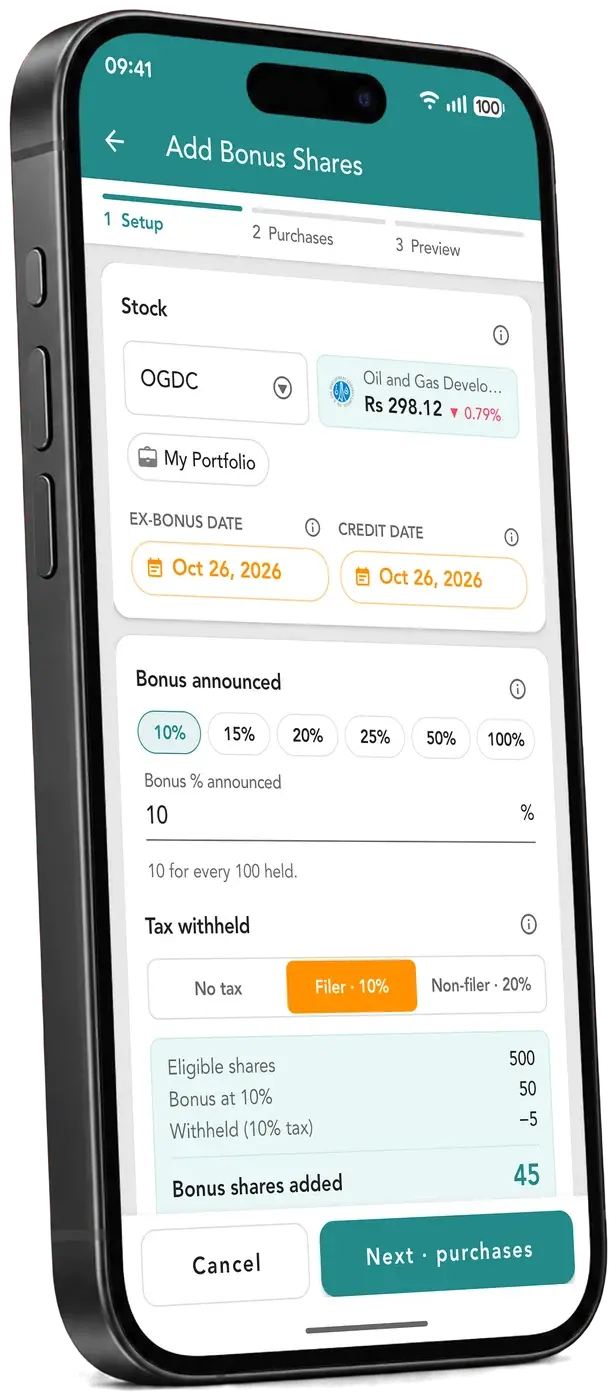
A bonus issue gives you extra shares at no cost, but the shares are not tax-free. Under section 236Z the company must collect tax of 10% of the bonus shares' value for filers and 20% for non-filers, again a final tax. The Ordinance values the shares at the day-end price on the first day of book closure. By then the share already trades ex-bonus, so this calculator values them at the ex-bonus price, the same basis as the bonus shares calculator, which also takes the actual closing price.
Example: you hold 1,000 shares and the company declares a 20% bonus while the share trades at Rs 100. You are due 200 bonus shares and the price adjusts to Rs 83.33, so they are worth Rs 16,667. A filer pays Rs 1,667 (the equivalent of 20 shares withheld), a non-filer Rs 3,333. The company collects it either by holding back some of the bonus shares or by taking cash, deposits it with FBR within 15 days of the book closure and can sell withheld shares to recover the tax, so the shares credited to your CDC account can be fewer than announced. Fractions of a share are not issued.
What to check on your statement
- Your filer status on the day of payment. The Check your statement card compares the tax shown on your statement with the expected figure.
- The payer type. A power company, a REIT and a mutual fund each use a different rate from an ordinary company.
- The book closure. Only shareholders on the company's books at the book closure receive the dividend, so check the dates in the announcement.
If the shares are Shariah-compliant, you may also want to give part of the dividend to charity: see the dividend purification calculator. When you sell shares rather than collect dividends, the capital gains tax calculator applies instead.
Sources and assumptions
Rates checked October 31, 2026.
- FBR Withholding Tax Rates Card, tax year 2027
- KPMG Taseer Hadi & Co., A Brief of Finance Act 2026
- Federal Board of Revenue: Active Taxpayers List
- FBR, Income Tax Ordinance 2001 (amended up to June 30, 2026)
- Section 150 (dividends) and section 236Z (bonus shares) of the Income Tax Ordinance, 2001
Your broker or the payer's statement shows the rate actually applied. Results are estimates for information and planning only, not tax, legal or investment advice. Check your own case with a tax adviser, your broker or the official source before acting.
FAQ
Dividend Tax Calculator: common questions
How much tax is deducted on dividends in Pakistan?+
On a dividend from an ordinary listed company, 15% is deducted if you are a filer and 30% if you are not. The company deducts it before paying you, so a Rs 10,000 dividend reaches a filer as Rs 8,500. Other payers have their own rates: independent power producers 7.5% for filers, and mutual funds 15% to 25%.
Is dividend tax different for non-filers?+
Yes. The rate for a non-filer is double the filer rate for every payer type: 30% instead of 15% on most PSX stocks, 15% instead of 7.5% for independent power producers, and up to 50% for some mutual fund dividends. Being on the Active Taxpayers List (ATL) when the dividend is paid is what counts.
Why is the tax rate lower for some companies?+
Independent power producers pay a lower withholding rate of 7.5% (filers), because the rate card treats their dividends differently. The calculator lets you pick the payer type. The company's dividend announcement and your broker or CDC statement show which rate was actually applied.
Is the tax on dividends final?+
Yes. Tax on dividends under section 150 is a final tax: it is deducted at source, you cannot claim it back against other income, and you owe nothing more on that dividend. It does not affect the tax slab on your salary or business income.
What is the tax on bonus shares?+
Bonus shares are taxed under section 236Z at 10% of their value for filers and 20% for non-filers. The value is the day-end price on the first day of book closure, when the share already trades ex-bonus. For 1,000 shares with a 20% bonus at Rs 100 a share, the 200 bonus shares are worth Rs 16,667 at the ex-bonus price of Rs 83.33, and a filer pays Rs 1,667. It is a final tax collected by the company.
How does a company collect tax on bonus shares?+
The company deducts it before the bonus reaches your CDC account, either by withholding enough of the bonus shares to cover the tax (the tax divided by the ex-bonus price, rounded up to whole shares) or by collecting the amount in cash. It deposits the tax with FBR within 15 days of the book closure and can sell withheld shares to recover it. The book closure announcement and your CDC statement show which route it used.
What dividend tax do mutual funds pay out?+
It depends on the fund's income. A fund's equity income share is taxed at 15% for filers, its debt income share at 25%, and a fund earning 50% or more of its income from profit on debt at 25%. Non-filers pay double. The fund house applies the right rate and shows it in your statement.
What if more tax was deducted than I expected?+
First check your status on the FBR Active Taxpayers List and ask your broker or the company's share registrar which payer type and filer status they used. If you are a filer and were taxed as a non-filer, ask them to correct the record for future payments, and ask a tax adviser about claiming a refund for the excess.
Keep going
Related tools
Dividend Income Calculator
Dividend income from your PSX shares after withholding tax, per payout and per year.
Capital Gains Tax Calculator for PSX Shares
CGT on listed shares and mutual funds for filers and non-filers, by purchase date and holding period.
Dividend Yield Calculator
Dividend yield and yield on cost for any PSX stock, from the latest annual payout.
PSX guides
Learn the ideas behind the numbers
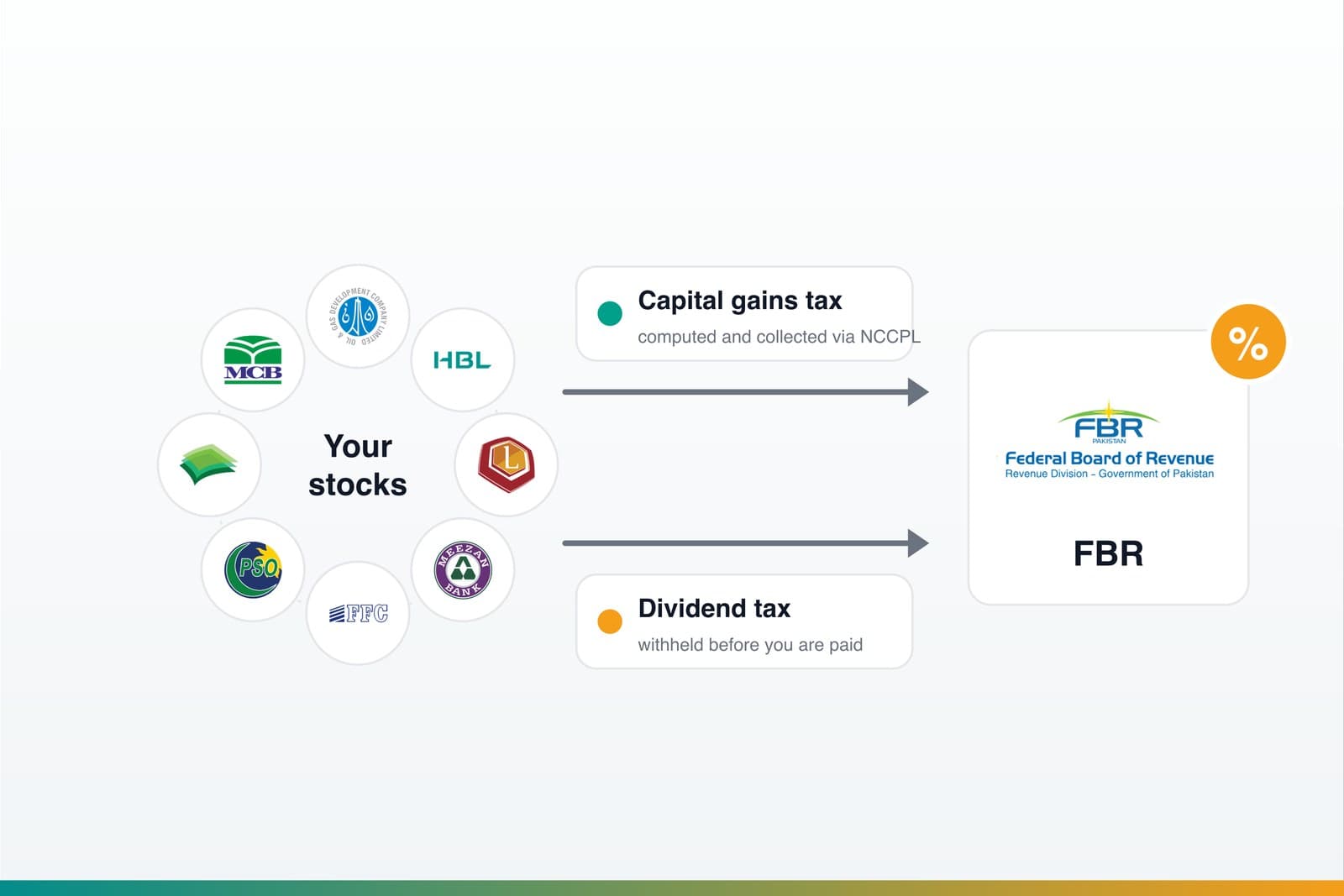
Capital Gains Tax & Dividend Tax on PSX Stocks (Pakistan)
A plain-English guide to how capital gains tax (CGT) and dividend tax work on Pakistan Stock Exchange shares - filer vs non-filer rates, how holding period and acquisition date matter, how NCCPL collects CGT, and what you still have to declare.
Read guide
Dividend Stocks vs Growth Stocks on PSX
A beginner-friendly PSX guide comparing dividend stocks and growth stocks, including risks, investor fit, sectors, interest rates and market cycles.
Read guide
PSX Company Announcements Explained: Results, Dividends, Board Meetings, Book Closure, Rights and Bonus Issues
Learn what PSX company announcements mean - results, dividends, book closure, bonus shares and rights issues - and how to read them in Investify.
Read guide