
Compound Interest Calculator
YOUR SNOWBALL
Start with a lump sum and let it roll
Profit is added
11% added monthly works like 11.57% a year. Pakistani savings accounts usually add profit monthly.
AFTER 10 YEARS
Rs 2,989,150
Rs 1,000,000 grows 2.99× (29.89 lakh)
Compounding adds Rs 889,150 over simple interest
- Your moneyRs 1,000,000
- Interest on your moneyRs 1,100,000
- Interest on interestRs 889,150
HOW OFTEN IT COMPOUNDS
Monthly beats yearly by Rs 149,729
The more often profit is added, the sooner it earns profit too. The gap is real but small: one percent more rate adds Rs 311,237.
Bars start from the yearly figure so the differences show.
WHAT GROWS IT MOST
Time does the heavy lifting
+Rs 2,178,838
if you leave it 5 more years (15 years in all)
+Rs 311,237
at 12% instead of 11%
6.3 years
for your money to double at this rate
63%
of the interest comes in the second half of the 10 years
- Your money
- Interest
Pakistani banks quote a profit rate on savings accounts, usually paid monthly, and Islamic banks call it profit rather than interest. The maths is the same. Between compounding dates the balance grows smoothly.
How the compound interest calculator works
Compound interest means you earn interest on your interest. Each time interest is added, the balance is a little larger, so the next payment is calculated on more. The calculator takes your starting amount, the nominal yearly rate, how often interest is added and the years, and grows the balance one month at a time. Regular deposits are added when you say they are made, so the year-by-year table shows deposits, interest and balance for every year.
- P
- starting amount
- r
- nominal annual rate (11% is 0.11)
- n
- times interest is added per year (12 for monthly)
- t
- years
The balance on every compounding date matches this formula exactly. Between compounding dates the calculator lets the balance grow smoothly rather than waiting for the next payment, which only matters for a deposit that lands part-way through a period, and only slightly.
Simple vs compound interest
Simple interest pays only on the original amount. Compound interest pays on the amount plus everything earned so far. The table shows Rs 100,000 at 12% a year, so you can see how the two paths separate.
| After | Simple interest | Compounded yearly | Compounded monthly |
|---|---|---|---|
| 1 year | Rs 112,000 | Rs 112,000 | Rs 112,683 |
| 5 years | Rs 160,000 | Rs 176,234 | Rs 181,670 |
| 10 years | Rs 220,000 | Rs 310,585 | Rs 330,039 |
| 20 years | Rs 340,000 | Rs 964,629 | Rs 1,089,255 |
| 30 years | Rs 460,000 | Rs 2,995,992 | Rs 3,594,964 |
After 30 years, simple interest has turned Rs 100,000 into Rs 460,000 while monthly compounding has made it Rs 3,594,964, about 8 times as much. That gap is the reason long holding periods matter, and why the rule of 72 is such a handy shortcut.
Why the compounding frequency matters
The same nominal rate pays more when interest is added more often, because interest starts earning sooner. This is why banks quote an effective annual rate (APY) next to the headline rate. Here is a nominal 12% on Rs 100,000 for one year.
| Compounding | Effective annual rate | Balance after 1 year |
|---|---|---|
| Yearly | 12% | Rs 112,000 |
| Half-yearly | 12.36% | Rs 112,360 |
| Quarterly | 12.551% | Rs 112,551 |
| Monthly | 12.683% | Rs 112,683 |
| Daily | 12.747% | Rs 112,747 |
A worked example with monthly deposits
Rs 1,000,000 at 11% compounded monthly for 10 years grows to Rs 2,989,150, so Rs 1,989,150 of the total is interest. Add Rs 25,000 at the end of every month and you put in Rs 4,000,000 but finish with Rs 8,414,103, of which Rs 4,414,103 is interest.
Working backwards under More options, the same Rs 1,000,000 takes 6 years and 4 months to double at 11% compounded monthly, and turning it into Rs 5,000,000 in 10 years would need a rate near 16.2%. That second figure is a useful reality check: unless policy rates are very high, a bank deposit will not pay that, so reaching the target needs more time, regular deposits or a riskier asset. For monthly investing in funds or shares, use the SIP calculator, and for one amount invested once, the lumpsum calculator. To measure the yearly rate a past investment really earned, use the CAGR calculator.
Profit rates, banks and Islamic accounts in Pakistan
- Banks quote a profit rate. A savings account advertises an annual rate, usually worked out on the daily balance and credited monthly. Choose monthly compounding to match, and compare accounts on the effective rate.
- Islamic banks call it profit, not interest. The return is shared under a Shariah-compliant contract rather than charged as interest, but the statement shows the same thing: a rate and a payout schedule.
- Tax reduces what you keep. Profit on deposits is subject to withholding tax, and the rate depends on whether you are on the Active Taxpayers List. Subtract tax from the rate before you compare with other options, or see the fixed deposit calculator and the National Savings calculator.
- Rates change. Deposit rates follow the State Bank policy rate. A rate that is high today may not be available when a term deposit matures.
Tips
- Compare accounts on the effective annual rate, not the headline rate.
- Starting early matters: the final years of compounding add the most.
- Regular deposits made at the start of a period earn slightly more than those at the end.
- Check the return against inflation: turn on Show today's money under More options to see the balance in today's rupees, or compare with history in the inflation calculator.
Sources and assumptions
- Calculation: balance = P × (1 + r/n)^(n×t); effective rate = (1 + r/n)^n − 1; deposits added month by month
- Solve for: bisection on the rate (0 to 1,000%) or on the number of months (up to 100 years)
- State Bank of Pakistan: policy rate and banking profit rates
- National Savings: scheme profit rates
- Federal Board of Revenue: tax on profit on debt
Results are estimates for information and planning only, not tax, legal or investment advice. Check your own case with a tax adviser, your broker or the official source before acting.
FAQ
Compound Interest Calculator: common questions
What is the compound interest formula?+
Balance = P × (1 + r/n)^(n×t), where P is the starting amount, r the nominal yearly rate as a decimal, n the number of times interest is added each year and t the years. With regular deposits, the calculator applies the same growth month by month and adds each deposit when it is made. When the deposits and the compounding use the same period (monthly deposits with monthly compounding, or yearly deposits with yearly compounding) the result matches the annuity formulas exactly. When they differ, for example monthly deposits with yearly compounding, the balance grows smoothly between compounding dates, so the answer is marginally lower than a bank that credits simple interest on each deposit until the next compounding date: Rs 25,000 a month for 10 years at 11% compounded yearly gives Rs 5,264,758 here and Rs 5,269,523 the bank way, a gap of 0.09%.
What is the difference between simple and compound interest?+
Simple interest is paid only on the original amount: Rs 100,000 at 12% earns Rs 12,000 every year. Compound interest is also paid on interest already earned, so the yearly amount keeps growing. Over 10 years the simple version reaches Rs 220,000 while yearly compounding reaches Rs 310,585, and the gap widens every year.
What is the effective annual rate (APY)?+
It is the single yearly rate that gives the same result as your nominal rate with its compounding. A nominal 12% compounded monthly is an effective 12.68% a year, because each month's interest starts earning interest. Always compare accounts on their effective rate, not the headline rate.
How often does compounding matter?+
More frequent compounding pays slightly more, but with diminishing returns. At a nominal 12%, yearly compounding gives 12%, quarterly 12.55%, monthly 12.68% and daily 12.75%. The jump from yearly to monthly is much bigger than from monthly to daily.
Do Pakistani banks pay compound interest?+
Savings accounts in Pakistan quote an annual profit rate and commonly work it out on the daily balance and credit it monthly, so the effective return is a little above the headline rate when you leave profit in the account. Term deposits may pay profit monthly, quarterly or at maturity. Check your bank's schedule of charges for the exact method, then choose the matching frequency in the calculator.
Is Islamic bank profit calculated the same way?+
Islamic banks call the return profit rather than interest and share it under a Shariah-compliant contract such as mudarabah, but the arithmetic you see on a statement is the same: a quoted annual rate, credited periodically. The calculator works for either, because it only needs the rate and how often it is paid.
How do I find the rate or time needed to reach a target?+
Open More options and use Work it backwards. Enter a target balance and the calculator searches for the rate or the number of months that reaches it with your starting amount, deposits and compounding. For example, Rs 1,000,000 at 11% compounded monthly takes 6 years and 4 months to double, and growing Rs 1,000,000 to Rs 5,000,000 in 10 years needs about 16.2% compounded monthly.
Keep going
Related tools
SIP Calculator
What a fixed monthly investment in PSX stocks or mutual funds can grow to, with yearly step-up.
Rule of 72 Calculator
How many years it takes money to double, quickly and exactly.
Bank Term Deposit Calculator
Profit on bank term deposits and savings accounts, monthly or at maturity, after tax.
PSX guides
Learn the ideas behind the numbers

How to Start Investing in the Pakistan Stock Exchange as a Beginner
A complete beginner guide to investing in the Pakistan Stock Exchange: account setup, brokers, PSX concepts, research, risk management, portfolio tracking and daily market routines.
Read guide
What Is the Minimum Amount Needed to Start Investing in PSX?
Understand how much money a beginner may need to start investing in the Pakistan Stock Exchange, including account requirements, share prices, charges and practical starting ranges.
Read guide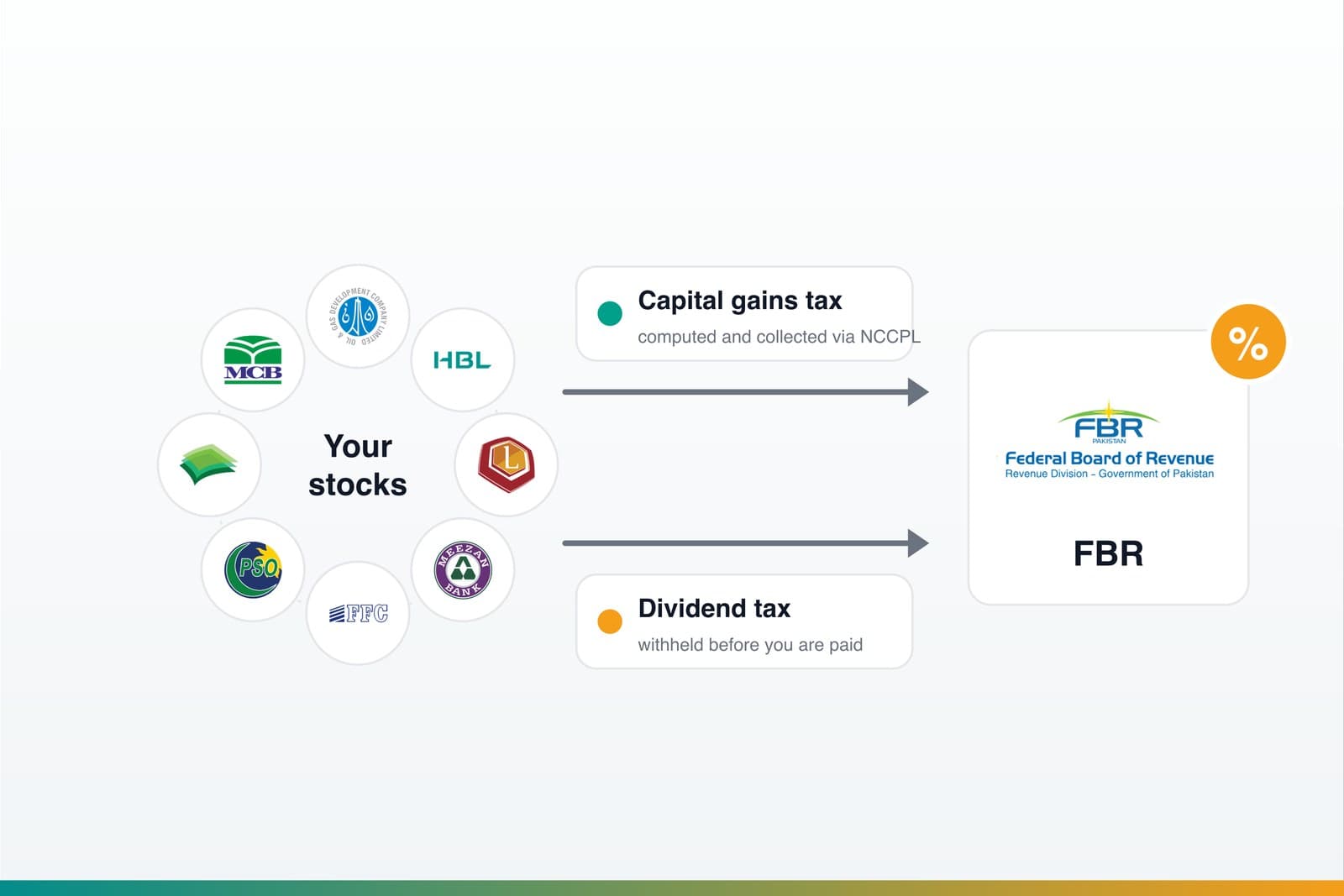
Capital Gains Tax & Dividend Tax on PSX Stocks (Pakistan)
A plain-English guide to how capital gains tax (CGT) and dividend tax work on Pakistan Stock Exchange shares - filer vs non-filer rates, how holding period and acquisition date matter, how NCCPL collects CGT, and what you still have to declare.
Read guide