Up to 10% of your basic pay is tax-free when it is paid as a medical allowance and your employer gives no free treatment or reimbursement. Ask HR to show it on your payslip.
Salary Income Tax Calculator 2026-27
TAX YEAR 2026-27
YOUR MONTHLY PAYSLIP
After income tax, tax year 2026-27
You take home
Rs 187,000
+Rs 500 a month in hand vs last year
OUT OF EVERY RS 100 YOU EARN
Rs 6.50 goes to tax. Rs 93.50 is yours.
That is about Rs 427 a day.
PAY LESS TAX, LEGALLY
Seven ways the tax law lets you keep more
YOU COULD SAVE
About Rs 91,062 a year
That is with the example amounts on the cards below. Switch on the ones that apply to you and change the amounts to yours.
If your employer runs a recognised provident fund, its contribution for you is tax-free up to 10% of your salary or Rs 150,000 a year, whichever is lower. Part of your package paid into it stays out of tax, and the fund pays it out under its rules, usually when you leave.
Pay into an approved Voluntary Pension System fund and get your average tax rate back on it, on up to 20% of your taxable income. The money stays yours and grows for retirement: see the VPS calculator.
Markup you pay on a loan from a bank or another approved lender to build or buy your house (land up to 2,500 sq ft, or a flat up to 2,000 sq ft) earns your average tax rate back, on up to 30% of your taxable income. Once you claim it for one home, you cannot claim it for another for 15 tax years.
Zakat paid under the Zakat and Ushr Ordinance, such as the zakat your bank deducts in Ramadan, comes off your taxable income. Keep the bank's certificate. Work out the amount with the zakat calculator.
Give to a charity approved by FBR and get your average tax rate back on it, on up to 30% of your taxable income. Pay by bank transfer or crossed cheque, not cash, and keep the receipt.
If your taxable income is under Rs 1,500,000 a year, 5% of the tuition fees you pay comes off it, up to Rs 60,000 per child and a quarter of your income. You claim it in your tax return, not through your employer.
Stay on the Active Taxpayers List
Your employer deducts tax on your salary either way. If you are not on FBR's Active Taxpayers List, the tax deducted from your bank profit and dividends doubles.
On Rs 1,000,000 of bank profit that is Rs 200,000 of tax instead of Rs 400,000. The 0.8% tax on cash withdrawals also applies only to people who are not on the list.
Pension, donation and home loan credits are worth your average tax rate on the amount, so they save more as your salary grows; together they can take off at most 80% of the tax. Each card shows what it is worth on top of the others you have switched on. Take-home on the payslip is pay after income tax: the pension, markup and donations you pay come out of it, and a provident fund share goes to the fund.
CHECK YOUR PAYSLIP
On your salary alone your employer should deduct about Rs 13,000 a month. If you gave HR receipts for pension, donations or home loan markup, it can be a little lower.
How your Rs 2,400,000 of taxable income is taxed
| Income slab | Rate | Your income in slab | Tax |
|---|---|---|---|
| Up to Rs 600,000 | 0% | Rs 600,000 | Rs 0 |
| Rs 600,001 to Rs 1,200,000 | 1% | Rs 600,000 | Rs 6,000 |
| Rs 1,200,001 to Rs 2,200,000 | 11% | Rs 1,000,000 | Rs 110,000 |
| Rs 2,200,001 to Rs 3,200,000 | 20% | Rs 200,000 | Rs 40,000 |
| Rs 3,200,001 to Rs 4,100,000 | 25% | Rs 0 | Rs 0 |
| Rs 4,100,001 to Rs 5,600,000 | 29% | Rs 0 | Rs 0 |
| Rs 5,600,001 to Rs 7,000,000 | 32% | Rs 0 | Rs 0 |
| Above Rs 7,000,000 | 35% | Rs 0 | Rs 0 |
| Slab tax on Rs 2,400,000 | Rs 2,400,000 | Rs 156,000 | |
| Tax payable | Rs 156,000 | ||
For a resident individual whose salary is the main income. Your employer deducts tax every month at your average rate for the year (section 149), so a single month can differ a little from these figures, mostly when a bonus is paid. School fees are claimed in your tax return. Pension, donation and home loan credits can be given by your employer if you hand in the receipts; otherwise you claim them in your return.
How salary tax is worked out in Pakistan
Pakistan taxes salary in slabs. Your taxable income for the year is your salary plus any bonus, less allowances that are exempt and less zakat you paid. The tax is a fixed amount for the slabs below yours plus a percentage of the part of your income that falls in your slab. Only the rupees inside a slab are taxed at that slab's rate, so moving into a higher slab never taxes the money you earned below it more heavily.
- Fixed
- tax on the income up to the start of your slab
- Rate
- the percentage for your slab
- Start
- the lowest income in your slab
Monthly tax is the yearly figure divided by 12. Your employer deducts it from each salary under section 149 at your average rate for the year, then you file a return on the FBR's IRIS portal to reconcile it. Take-home pay is your salary less that tax. The calculator also reports your effective rate (tax as a share of income) and your marginal rate (the rate on your next rupee), which is the number that matters when you weigh a raise or a bonus.
A worked example
For a salary of Rs 200,000 a month (Rs 2,400,000 a year), the tax year 2027 slab starts at Rs 2,200,000 with Rs 116,000 fixed and a 20% rate. The yearly tax is Rs 116,000 + 20% of Rs 200,000 = Rs 156,000, or Rs 13,000 a month, leaving Rs 187,000. In tax year 2026 the same salary paid Rs 13,500 a month because that slab was taxed at 23%. A yearly bonus of Rs 400,000 on top would add Rs 80,000 of tax, a marginal rate of 20%.
Salary tax slabs for tax year 2027 (2026-27)
The Finance Act 2026 lowered the rates above Rs 2,200,000 of taxable income and split the old top slab into three, so the highest earners benefit most. The first three slabs did not change. These are the slabs for salaried individuals, applied to taxable income for the year.
| Taxable income (tax year 2027) | Tax |
|---|---|
| Up to Rs 600,000 | Nil |
| Rs 600,001 to Rs 1,200,000 | 1% of the excess over Rs 600,000 |
| Rs 1,200,001 to Rs 2,200,000 | Rs 6,000 + 11% of the excess over Rs 1,200,000 |
| Rs 2,200,001 to Rs 3,200,000 | Rs 116,000 + 20% of the excess over Rs 2,200,000 |
| Rs 3,200,001 to Rs 4,100,000 | Rs 316,000 + 25% of the excess over Rs 3,200,000 |
| Rs 4,100,001 to Rs 5,600,000 | Rs 541,000 + 29% of the excess over Rs 4,100,000 |
| Rs 5,600,001 to Rs 7,000,000 | Rs 976,000 + 32% of the excess over Rs 5,600,000 |
| Above Rs 7,000,000 | Rs 1,424,000 + 35% of the excess over Rs 7,000,000 |
For comparison, the slabs for tax year 2026 (July 1, 2025 to June 30, 2026) were:
| Taxable income (tax year 2026) | Tax |
|---|---|
| Up to Rs 600,000 | Nil |
| Rs 600,001 to Rs 1,200,000 | 1% of the excess over Rs 600,000 |
| Rs 1,200,001 to Rs 2,200,000 | Rs 6,000 + 11% of the excess over Rs 1,200,000 |
| Rs 2,200,001 to Rs 3,200,000 | Rs 116,000 + 23% of the excess over Rs 2,200,000 |
| Rs 3,200,001 to Rs 4,100,000 | Rs 346,000 + 30% of the excess over Rs 3,200,000 |
| Above Rs 4,100,000 | Rs 616,000 + 35% of the excess over Rs 4,100,000 |
Tax year 2026 also carried a 9% surcharge on the tax of salaried people with taxable income above Rs 10,000,000. That surcharge is gone for salaried individuals from tax year 2027, which is why the saving at the top is large: at Rs 1,000,000 a month the yearly tax falls from Rs 3,685,290 to Rs 3,174,000.
Income tax on common monthly salaries
This table is worked out by the same engine as the calculator above, for a salaried person with no bonus, no exempt allowance and no other income. "Saving" is how much less you pay each month under the Finance Act 2026 than you did in tax year 2026.
| Monthly salary | Yearly salary | Monthly tax, 2027 | Monthly tax, 2026 | Saving a month | Effective rate, 2027 |
|---|---|---|---|---|---|
| Rs 50,000 | Rs 600,000 | Rs 0 | Rs 0 | Rs 0 | 0% |
| Rs 75,000 | Rs 900,000 | Rs 250 | Rs 250 | Rs 0 | 0.3% |
| Rs 100,000 | Rs 1,200,000 | Rs 500 | Rs 500 | Rs 0 | 0.5% |
| Rs 150,000 | Rs 1,800,000 | Rs 6,000 | Rs 6,000 | Rs 0 | 4% |
| Rs 200,000 | Rs 2,400,000 | Rs 13,000 | Rs 13,500 | Rs 500 | 6.5% |
| Rs 250,000 | Rs 3,000,000 | Rs 23,000 | Rs 25,000 | Rs 2,000 | 9.2% |
| Rs 300,000 | Rs 3,600,000 | Rs 34,667 | Rs 38,833 | Rs 4,167 | 11.6% |
| Rs 400,000 | Rs 4,800,000 | Rs 62,000 | Rs 71,750 | Rs 9,750 | 15.5% |
| Rs 500,000 | Rs 6,000,000 | Rs 92,000 | Rs 106,750 | Rs 14,750 | 18.4% |
| Rs 750,000 | Rs 9,000,000 | Rs 177,000 | Rs 194,250 | Rs 17,250 | 23.6% |
| Rs 1,000,000 | Rs 12,000,000 | Rs 264,500 | Rs 307,108 | Rs 42,608 | 26.5% |
Two patterns stand out. Anyone earning up to Rs 50,000 a month pays nothing, and up to about Rs 183,000 a month the tax is identical in both years because the budget left the lower slabs alone. Above that, every slab got cheaper, and the monthly saving grows quickly. The Rs 1,000,000 row in tax year 2026 includes the surcharge.
Seven legal ways to pay less tax on salary
- Medical allowance. Salary includes most allowances, bonuses and perquisites. A medical allowance is exempt up to 10% of your basic pay when your contract provides no free treatment or reimbursement (Second Schedule, Part I, clause (139)). On Rs 200,000 a month with a basic of Rs 133,000, that saves Rs 31,920 a year.
- Provident fund, employer share. Your employer's contribution to a recognised provident fund counts as salary only above 10% of your salary or Rs 150,000 a year, whichever is lower (Sixth Schedule, Part I, rule 3). Moving Rs 150,000 of a Rs 200,000 a month package into the fund saves Rs 30,000 a year, and the fund pays it to you when you leave.
- Zakat. Zakat paid under the Zakat and Ushr Ordinance is a deductible allowance, so it reduces taxable income rupee for rupee. Use the zakat calculator for the amount.
- Pension contributions. Money you put into a Voluntary Pension System account earns a tax credit worth your average tax rate times the contribution, up to 20% of taxable income. The VPS pension calculator shows the credit and what the account grows to.
- Donations. Gifts to approved recipients (government education boards, universities, hospitals, approved non-profits) earn a credit on the same average-rate basis, up to 30% of taxable income. Pay by crossed cheque or bank transfer and keep the receipt, because the employer needs documentary evidence to apply it in your monthly deduction.
- Home loan markup. Markup paid on a loan to build or buy your house (land up to 2,500 sq ft, or a flat up to 2,000 sq ft) earns a credit at your average rate, up to 30% of taxable income (section 63A). Rs 600,000 of markup on a Rs 200,000 a month salary saves Rs 39,000 a year. After a claim you cannot claim it for another house for 15 tax years.
- Children's school fees. If your taxable income is under Rs 1,500,000, 5% of the tuition fees you pay comes off it, up to Rs 60,000 per child and 25% of your income (section 60D). You claim it in your return, because the employer ignores it when deducting tax.
Some reliefs that are still widely repeated no longer apply: deduction for profit on a house loan (section 60C) (omitted by the Finance Act 2022; since the Finance Act 2025 the markup earns a credit under section 63A instead); credit for buying new shares or life insurance (section 62) (omitted by the Finance Act 2022); credit for health insurance premiums (section 62A) (omitted by the Finance Act 2022); 25% tax reduction for full-time teachers and researchers (ended after tax year 2025); tax reduction for senior citizens on salary (omitted by the Finance Act 2014; only pension income has an age relief). Gratuity, provident fund and pension payouts have their own rules; see the gratuity calculator and the provident fund calculator.
When salary is not your only income
The salaried slabs are cheaper than the slabs for business people, but you only get them if salary is more than 75% of your taxable income. Take a salary of Rs 2,400,000 a year. You can earn up to Rs 799,999 of other income, such as rent or business profit, and stay on the salaried slabs: with Rs 799,999 of other income your tax on Rs 3,199,999 is Rs 316,000. At Rs 800,000, salary is exactly 75% and no longer enough, the non-salaried slabs apply to the whole Rs 3,200,000, and the tax jumps to Rs 650,000.
This cliff is built into the law, so it pays to check it before you take on side income. Add other income under More options and the calculator warns you when it applies. For landlords see the rental income tax calculator, and for business or freelance income the business income tax calculator.
Filing your return
Salaried individuals file electronically on the FBR's IRIS portal. The return for tax year 2027 is due on September 30 after the tax year ends, so by September 30, 2027, unless the FBR extends the date. Use your payslips or the employer's annual salary certificate for the tax deducted, add credits and other income, and pay any balance or claim a refund of excess deduction.
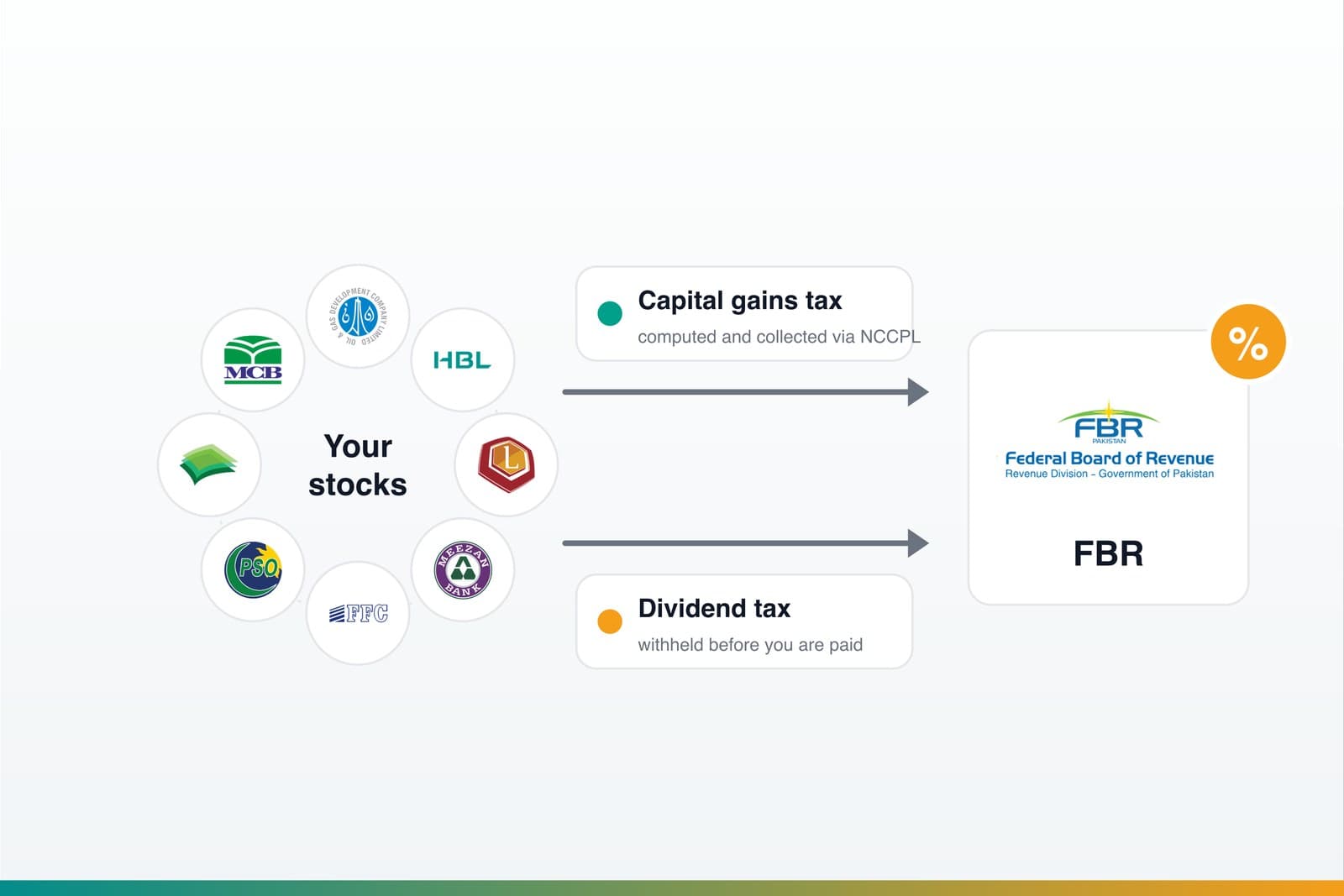
Filing every year keeps you on the Active Taxpayers List. Being off it doubles the withholding tax on many payments, including dividends (30% instead of 15% on most shares) and the profit you earn on bank deposits. If you invest on the PSX, see the capital gains tax calculator and the dividend tax calculator.
Sources and assumptions
Rates and reliefs checked November 1, 2026 against the Income Tax Ordinance as amended up to June 30, 2026, the Finance Act 2026 and FBR's tax year 2027 rate card.
- FBR, Income Tax Ordinance, 2001 (amended up to June 30, 2026)
- FBR, Finance Act 2026
- FBR Withholding Tax Rates Card, tax year 2027
- KPMG Taseer Hadi & Co., A Brief of Finance Act 2026
- FBR IRIS e-filing portal
- FBR Circular No. 01 of 2025-26 (Income Tax)
- Method: slab tax on taxable income, surcharge, then credits, as set out in the Income Tax Ordinance, 2001 (sections 4AB, 60, 60D, 61, 63, 63A, 65 and 149, Second Schedule clause 139, Sixth Schedule rule 3)
Results are estimates for information and planning only, not tax, legal or investment advice. Check your own case with a tax adviser, your broker or the official source before acting.
FAQ
Salary Income Tax Calculator 2026-27: common questions
How much income tax will I pay on a Rs 100,000 monthly salary?+
A salary of Rs 100,000 a month is Rs 1,200,000 a year. The first Rs 600,000 is tax free and the next Rs 600,000 is taxed at 1%, so the yearly tax is Rs 6,000, which is Rs 500 a month. The tax is the same in tax year 2026 and tax year 2027.
How is monthly salary tax calculated in Pakistan?+
Your employer adds up your expected taxable salary for the tax year, finds the tax on it from the slab table, divides by your average rate, and deducts that share from every payment (section 149 of the Income Tax Ordinance). The monthly figure is roughly the yearly tax divided by 12, adjusted if you receive a bonus or the tax already deducted is above or below plan.
What are the income tax slabs for salaried persons in 2026-27?+
Tax year 2027 (July 1, 2026 to June 30, 2027) has eight slabs: Up to Rs 600,000: Nil; Rs 600,001 to Rs 1,200,000: 1% of the excess over Rs 600,000; Rs 1,200,001 to Rs 2,200,000: Rs 6,000 + 11% of the excess over Rs 1,200,000; Rs 2,200,001 to Rs 3,200,000: Rs 116,000 + 20% of the excess over Rs 2,200,000; Rs 3,200,001 to Rs 4,100,000: Rs 316,000 + 25% of the excess over Rs 3,200,000; Rs 4,100,001 to Rs 5,600,000: Rs 541,000 + 29% of the excess over Rs 4,100,000; Rs 5,600,001 to Rs 7,000,000: Rs 976,000 + 32% of the excess over Rs 5,600,000; Above Rs 7,000,000: Rs 1,424,000 + 35% of the excess over Rs 7,000,000.
Do salaried people pay a surcharge in 2026-27?+
No. The Finance Act 2026 exempts salaried individuals from the section 4AB surcharge from tax year 2027. In tax year 2026 salaried people with taxable income above Rs 10,000,000 paid a 9% surcharge on their tax. Business individuals and AOPs still pay 10%.
Who counts as a salaried individual?+
An individual whose income from salary is more than 75% of their taxable income. If you also earn rent, business profit or other income and salary falls to 75% or less of the total, the higher non-salaried slabs apply to all of your income. Add other income under More options to see where that happens for you.
Which allowances are exempt from income tax?+
Most allowances are taxable salary. The common exception is the medical allowance, exempt up to 10% of basic pay when your contract gives no free medical treatment or reimbursement (Second Schedule, Part I, clause (139)). Free treatment or reimbursed medical bills are also exempt when the hospital's NTN is given and the employer certifies the bills. Ask HR which parts of your package are exempt and enter that amount in the calculator.
How can a salaried person pay less tax legally in 2026-27?+
Seven ways are in the law for tax year 2027. A medical allowance up to 10% of basic pay is tax-free when your employer gives no free treatment. An employer's provident fund contribution is tax-free up to 10% of salary or Rs 150,000 a year, whichever is lower. Pension (VPS) contributions, donations to approved charities and the markup on a home loan each earn a credit at your average tax rate, capped at 20%, 30% and 30% of taxable income. Zakat comes off taxable income, and so does 5% of children's tuition fees (up to Rs 60,000 per child and 25% of income) if your taxable income is under Rs 1,500,000. On Rs 200,000 a month, the medical allowance alone saves Rs 31,920 a year.
Are health insurance, home loan interest and the teachers' rebate still deductible?+
Not as they were. Deduction for profit on a house loan (section 60C): omitted by the Finance Act 2022; since the Finance Act 2025 the markup earns a credit under section 63A instead. Credit for buying new shares or life insurance (section 62): omitted by the Finance Act 2022. Credit for health insurance premiums (section 62A): omitted by the Finance Act 2022. 25% tax reduction for full-time teachers and researchers: ended after tax year 2025. Tax reduction for senior citizens on salary: omitted by the Finance Act 2014; only pension income has an age relief. The home loan relief now works as a credit under section 63A, worth your average tax rate on the markup you pay.
When is the income tax return due for tax year 2027?+
Individuals file by September 30 after the tax year ends, so September 30, 2027 for tax year 2027 unless the FBR extends it. Salaried people file online on the FBR's IRIS portal. Filing keeps you on the Active Taxpayers List, which matters because non-filers pay double withholding tax on many payments.

Keep going
Related tools
Business & Freelancer Income Tax Calculator
Tax for non-salaried individuals, sole proprietors, AOPs and freelancers under the 2026-27 slabs.
Gratuity Calculator
Gratuity from your last drawn salary and years of service, with the tax-free limit.
Provident Fund Calculator
Your provident fund balance at retirement from your and your employer's contributions.
VPS Pension Calculator
Voluntary Pension System growth, the yearly tax credit, and the pension at retirement.
Zakat Calculator
Zakat on cash, gold, silver, shares, mutual funds and business stock, with today's nisab.
PSX guides
Learn the ideas behind the numbers

Capital Gains Tax & Dividend Tax on PSX Stocks (Pakistan)
A plain-English guide to how capital gains tax (CGT) and dividend tax work on Pakistan Stock Exchange shares - filer vs non-filer rates, how holding period and acquisition date matter, how NCCPL collects CGT, and what you still have to declare.
Read guide
How to Start Investing in the Pakistan Stock Exchange as a Beginner
A complete beginner guide to investing in the Pakistan Stock Exchange: account setup, brokers, PSX concepts, research, risk management, portfolio tracking and daily market routines.
Read guide
What Is the Minimum Amount Needed to Start Investing in PSX?
Understand how much money a beginner may need to start investing in the Pakistan Stock Exchange, including account requirements, share prices, charges and practical starting ranges.
Read guide