
Net Worth Calculator
OWN AND OWE
Put everything on the scale
The amounts are examples. Use today's values, not what you paid.
WHAT I OWN
5 lakh
10 lakh
Worth Rs 1,886,040 at the live rate of November 3, 2026. Set your own rate under More assets and debts.
1.5 crore
WHAT I OWE
50 lakh
2 lakh
MY NET WORTH
Rs 13,186,040
You own Rs 1.84 crore and owe Rs 52 lakh.
−Rs 18.14 lakh
liquid net worth
28%
of what you own is owed
WHAT YOU OWN
82% of it is property
- PropertyRs 1.5 crore
- GoldRs 18.86 lakh
- PSX sharesRs 10 lakh
- Cash and bankRs 5 lakh
Liquid (cash, shares, funds, savings certificates and gold): Rs 33.86 lakh. Liquid net worth subtracts every debt, the home loan too, so read it as a stress test.
NEXT STEPS
Make the scale tip further your way
- Calculate your zakatYour cash, gold, shares and savings may be zakatable. Check them against the nisab.
- Check your emergency fundYou hold Rs 3,386,040 in liquid assets. See how many months of expenses a safety cushion should cover.
- Plan for retirementMost of your wealth is property, which pays no monthly income. See how much liquid savings your retirement needs.
How the net worth calculator works
Net worth is a snapshot of your balance sheet on one day. The calculator adds your assets, adds your liabilities, and subtracts. It then shows three views that a single number hides: how much of your wealth is liquid, how heavily it is borrowed against, and what it is made of.
- Net worth
- total assets − total liabilities
- Liquid net worth
- (cash + shares + funds + savings certificates + gold) − total liabilities
- Debt-to-asset ratio
- total liabilities ÷ total assets
Value every asset at what it would fetch today, not what you paid, and every debt at what you would owe if you cleared it today. PSX shares are in your Investify portfolio, and the gold calculator shows the live rate that the gold field here uses.
A worked example
A household owns cash of Rs 750,000, shares of Rs 2.5 million, mutual funds of Rs 1.2 million, gold worth Rs 2.4 million, a home worth Rs 18 million and a car worth Rs 2.2 million. It owes Rs 6.5 million on the home loan, Rs 900,000 on the car and Rs 120,000 on credit cards. Total assets are Rs 27,050,000 and total liabilities Rs 7,520,000, so net worth is Rs 19,530,000.
| Measure | Value |
|---|---|
| Net worth | Rs 19,530,000 |
| Liquid assets | Rs 6,850,000 |
| Liquid net worth | -Rs 670,000 |
| Debt-to-asset ratio | 27.8% |
| Asset mix: Property | 67% |
| Asset mix: PSX shares | 9% |
| Asset mix: Gold | 9% |
| Asset mix: Other | 15% |
The net worth looks comfortable, yet liquid net worth is negative because the loans are larger than the cash, shares, funds and gold. The home loan is counted in full even though the house it is secured on is not in the liquid figure, so this view is deliberately strict: wealthy on paper, tight in an emergency. Seeing both numbers is the point.
Reading your asset mix
The mix bar shows what your wealth is made of, one colour for each kind of asset; the table above folds the smaller ones into "Other". A mix that is over 70% property is common in Pakistan, and it means little of your wealth produces monthly income or can be sold quickly. A mix that is mostly shares carries more day-to-day swings. There is no single right split; the useful question is whether it matches when you will need the money.
- Short-term needs (under three years): cash and savings certificates. Size them with the emergency fund calculator.
- Long-term goals (retirement, children's education): shares, funds and a pension account. The retirement calculator shows how much.
- Religious obligations: cash, gold, silver, shares held for trade and savings above the nisab may attract zakat. See the zakat calculator.
Putting a value on Pakistani assets
- Gold: tolas × the rate per tola × purity. Jewellery usually sells for less than the bullion value because of making charges and deductions, so use a jeweller's buy-back quote if you want a cautious figure. The calculator prefills the live 24K rate (22K gold uses the live 22K quote) and lets you replace it.
- PSX shares: the market value at the latest close, for every holding in your CDC account and sub-accounts. Your portfolio on Investify adds it up for you.
- National Savings and bonds: the face value plus profit you have earned and could encash today, before any early-encashment deduction.
- Property: a realistic resale price from recent sales near you, not the government valuation and not the asking price. Count only your ownership share.
- Provident fund and gratuity: not cash today, but a real asset. If you want to count them, enter the fund balance under "Other assets" in More assets and debts. The provident fund calculator and the gratuity calculator show what each is heading for.
Common mistakes
- Valuing property at the purchase price. Use a realistic current resale value, after any costs of sale you expect.
- Forgetting informal debts: money owed to family, committee (BC) instalments you still owe, pending bills and tax.
- Counting a business at what you hope it is worth. Use a conservative number, or leave it out of the liquid figure, as the calculator does.
- Mixing assets that belong to the family with your own. Count only your share.
- Ignoring the trend. One reading means little; comparing the same list every year shows whether your net worth is growing faster than inflation.
Sources and assumptions
Gold rates are read live from the Investify market feed (cached up to 10 minutes). Every other value is yours.
- Calculation: assets minus liabilities; gold = tolas × the rate per tola for the karat (22K from its own quote, otherwise 24K rate × karat ÷ 24); one tola = 11.6638 grams
- Liquid net worth = cash, shares, funds, savings certificates and gold, minus all debts
Net worth is only as accurate as the values you enter. Results are estimates for information and planning only, not tax, legal or investment advice. Check your own case with a tax adviser, your broker or the official source before acting.
FAQ
Net Worth Calculator: common questions
What is net worth and how do I calculate it?+
Net worth is everything you own minus everything you owe. Add up the current market value of your assets (cash, shares, funds, gold, property, vehicles, business and money owed to you), add up your debts (home loan, car loan, credit cards, personal loans), and subtract. A positive number means you own more than you owe.
Should I include my house and car in my net worth?+
Yes, at what they would sell for today, and include the loan against them as a liability. Many people also track liquid net worth, which leaves out property and vehicles because they are hard to turn into cash without selling the home you live in or the car you use.
What is liquid net worth?+
Liquid net worth is what you could reach quickly: cash, PSX shares, mutual funds, savings certificates and gold, minus your debts. In this calculator it leaves out property, vehicles, business, money owed to you and other assets. On the example above, assets of Rs 27,050,000 give a net worth of Rs 19,530,000 but a liquid net worth of -Rs 670,000. Two things make that figure harsh: every debt is subtracted, including a home loan secured on a house the figure leaves out, and VPS balances count as liquid although that money is locked until retirement age. Treat it as a stress test, not as a measure of your wealth.
How is gold valued in the net worth calculator?+
Gold is valued as tolas × the rate per tola × purity. The rate is the live 24K price per tola. 22K gold uses the live 22K quote when there is one (it normally sits at 22/24 of the 24K price, as on the gold calculator), and 21K gold is priced at 21/24 of the 24K rate. One tola is 11.66 grams. You can overwrite the rate with your own, for example a sarafa quote for your jewellery.
What is the debt-to-asset ratio?+
It is your total liabilities divided by your total assets. On the example above it is 27.8%. There is no official benchmark; as a rule of thumb, a low ratio means your wealth is mostly your own, while a ratio above 50% means debts are carrying a large share of your assets and leave less room if prices fall.
How often should I check my net worth?+
Once or twice a year is enough for most people, for example at the start of the tax year in July or after a big change such as a bonus, a property sale or a new loan. Weekly checks mostly track market noise. The share link keeps your numbers in the web address, so you can bookmark last year's result and compare.
Is my data saved or shared?+
The calculation runs in your browser, and Investify does not save your figures to an account or database. They are kept in the page address, which is how the Share button works, so anyone you send the link to can see them.
Keep going
Related tools
Zakat Calculator
Zakat on cash, gold, silver, shares, mutual funds and business stock, with today's nisab.
Emergency Fund Calculator
How big your safety cushion should be and how long it takes to build.
Retirement Calculator
The savings you need to retire, and the monthly investment that gets you there.
PSX guides
Learn the ideas behind the numbers
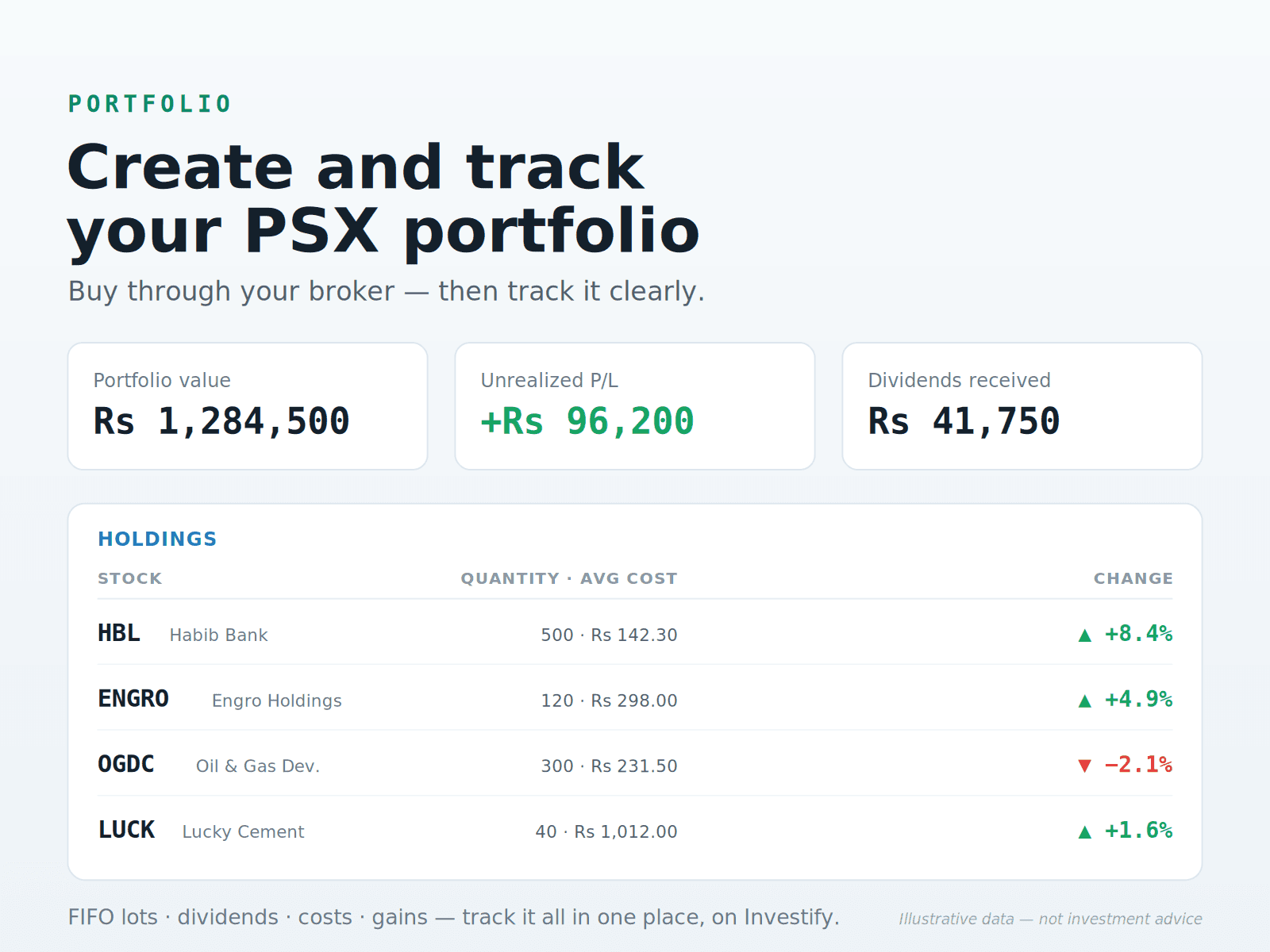
How to Create and Track a PSX Stock Portfolio
Learn how to create a PSX stock portfolio through a licensed broker and track it with FIFO, dividends, costs and corporate actions.
Read guide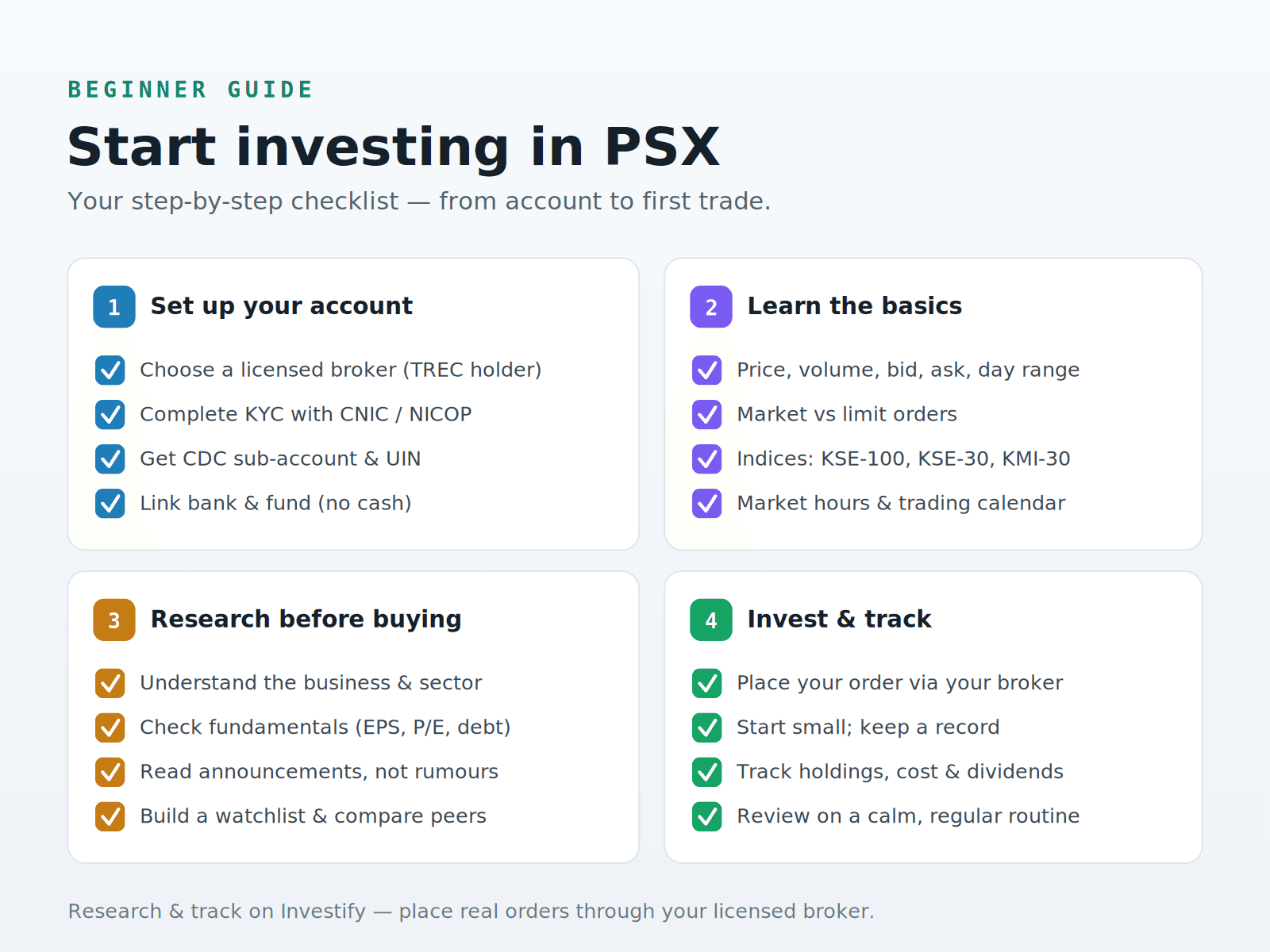
How to Start Investing in the Pakistan Stock Exchange as a Beginner
A complete beginner guide to investing in the Pakistan Stock Exchange: account setup, brokers, PSX concepts, research, risk management, portfolio tracking and daily market routines.
Read guide
Dividend Stocks vs Growth Stocks on PSX
A beginner-friendly PSX guide comparing dividend stocks and growth stocks, including risks, investor fit, sectors, interest rates and market cycles.
Read guide