
Goal Planner
YOUR GOAL
What are you saving for?
Example: the government scheme's 40 to 42 day package for Hajj 2027 was announced at about Rs 1.2 million, and the shorter 20 to 22 day package at Rs 1.3 million. Private packages cost more. Confirm current figures with the Ministry of Religious Affairs.
HAJJ IN 5 YEARS
Rs 20,752a month
Rs 12 lakh today will cost about Rs 16.83 lakh by then. That is about Rs 692 a day.
The goal by then
Rs 1,683,062
You put in
Rs 1,245,120
Growth does the rest
Rs 437,942
WHAT IF THE RETURN IS DIFFERENT
Where you keep it changes the monthly
Tap a row to use it. Higher returns come with bigger swings.
PRICES MOVE THE GOALPOST
+40% by the time you get there
If the price stood still you would need Rs 14,796 a month. Rising prices add Rs 5,956 a month.
ALREADY STARTED?
Money you have and raises you expect
- Your savings
- Goal cost (rising with inflation)
Invested at the start of each month, with the return compounding yearly. Returns are not guaranteed. Already investing monthly? Check the plan in the SIP calculator.
How the goal planner works
A goal has two moving parts. Its cost keeps rising with inflation, and your savings keep growing with your investment return. The planner first raises today's cost to what it will be when you need it, then finds the smallest monthly investment, rounded up to a whole rupee, that grows to that amount, counting any money you already have and any yearly step-up.
- Cost
- what the goal costs today
- i
- yearly inflation of the goal's price
- n
- years until you need it
- P
- monthly investment
- j
- monthly return = (1 + annual return)^(1/12) − 1
The second formula is the level-instalment case. With savings already in hand or a step-up, the planner solves the same month-by-month engine used by the SIP calculator, so the answer is exact for every option.
A worked example: Hajj
Take a Hajj goal of Rs 1,200,000 in today's rupees, needed in 5 years. At 7% inflation it will cost about Rs 1,683,062. Investing at 12% a year, you need about Rs 20,752 a month: you put in Rs 1,245,120 and the investment adds Rs 437,942. Leaving inflation out would have suggested only Rs 14,796 a month, a shortfall you would only discover when it was too late.
The return you assume matters as well. Here is the same goal at different returns:
| Expected return | Monthly investment needed |
|---|---|
| 8% a year | Rs 22,926 |
| 10% a year | Rs 21,810 |
| 12% a year | Rs 20,752 |
| 15% a year | Rs 19,270 |
| 18% a year | Rs 17,904 |
The example goals at a glance
These are the presets in the planner, at 7% inflation and 12% return. They are examples in today's rupees, not quotes, so replace each with your own figure.
| Goal | Cost today | Years | Cost then | Monthly needed |
|---|---|---|---|---|
| Hajj | Rs 1,200,000 | 5 | Rs 1,683,062 | Rs 20,752 |
| Umrah | Rs 300,000 | 2 | Rs 343,470 | Rs 12,691 |
| Wedding | Rs 2,500,000 | 4 | Rs 3,276,990 | Rs 53,708 |
| Child's university | Rs 4,000,000 | 10 | Rs 7,868,605 | Rs 35,123 |
| Car | Rs 4,000,000 | 3 | Rs 4,900,172 | Rs 113,748 |
| Home down payment | Rs 5,000,000 | 7 | Rs 8,028,907 | Rs 62,336 |
| Emergency fund | Rs 600,000 | 2 | Rs 686,940 | Rs 25,382 |
Saving for Hajj, Umrah and other Pakistani goals
- Hajj. The government scheme and private operators price packages differently, and prices have risen over the years. Reports on the multi-year Hajj policy for 2027 to 2030 also described choosing a preferred year by paying part of the estimated cost at registration. Check the Ministry of Religious Affairs for the current rules and amounts, then use the Hajj preset as a starting point.
- Umrah. Prices depend on the season, hotel distance and length of stay, and rise sharply in Ramadan. Use a quote from an operator you trust.
- Education. A 10-year plan for a four-year degree at Rs 4,000,000 today needs about Rs 35,123 a month in this example. University fees often rise faster than general inflation, so consider a higher inflation figure.
- Home. A down payment is only part of the cost. Include registration, taxes and furnishing. See the home loan calculator.
- Emergency fund. Build this first and keep it low-risk. The emergency fund calculator helps size it.
Match the investment to the time
| Time to goal | What usually fits | Planning return |
|---|---|---|
| Under 3 years | Deposits, National Savings, money market or income funds | About 11 to 12% |
| 3 to 7 years | A mix of income and equity-oriented funds | About 11 to 13% |
| More than 7 years | Equity funds or PSX shares, shifting to safer assets as the goal nears | 12 to 15%, with large swings |
These are planning ranges, not promises: the short-term range is anchored on the 12% State Bank policy rate that deposits and income funds follow, less about a point for fees. Moving money to a safer place in the last year or two protects what you have built. Compare what returns have actually been using the CAGR calculator and the inflation calculator.
Common mistakes
- Planning with today's price. The goal will cost more when you reach it.
- Assuming an equity return for a goal that is only a year or two away.
- Starting late. Time does much of the work, so the same goal costs far more each month if you wait.
- Mixing several goals in one pot. Give each goal its own plan so you know whether it is on track.
Sources and assumptions
Goal examples checked October 31, 2026. Every cost is an editable example, not a quote.
- Calculation: future cost = cost today × (1 + inflation)^years; monthly amount = the instalment that grows to it, invested at the start of each month (same engine as the SIP calculator)
- Hajj example: Ministry of Religious Affairs and Interfaith Harmony, Hajj 2027 government scheme packages (Rs 1.2 million and Rs 1.3 million, as announced)
- Umrah example: operator packages advertised for 2026 and 2027 (roughly Rs 220,000 to Rs 300,000 per person for 7 to 10 nights outside Ramadan)
- Pakistan Bureau of Statistics: Consumer Price Index, for inflation history
- State Bank of Pakistan: policy rate, which drives deposit and income fund returns
Results are estimates for information and planning only, not tax, legal or investment advice. Check your own case with a tax adviser, your broker or the official source before acting.
FAQ
Goal Planner: common questions
How much should I invest each month to reach a goal?+
Work out what the goal will cost when you need it, not today, then find the monthly amount that grows to that figure. For example, a Rs 1,200,000 goal in 5 years at 7% inflation will cost about Rs 1,683,062, and reaching it at 12% a year takes about Rs 20,752 a month. Enter your own cost, years and return above to get the amount for your goal.
Why does the calculator add inflation to my goal?+
Prices rise, so a goal that costs Rs 1,200,000 today costs more in five years. Ignoring that would leave you short: the same Hajj example needs Rs 14,796 a month with no inflation but Rs 20,752 with 7% inflation. The 7% is an assumption (the FY2026 average was 7.05%, and the latest reading is 10.3% for September 2026), so change it to match the goal. Education, property and travel costs can rise faster than general inflation.
What return should I assume for a short-term goal?+
The shorter the goal, the more cautious you should be, because a market fall just before you need the money cannot be recovered. For goals under three years, income funds, deposits or National Savings at around 11 to 12% (near the 12% policy rate, less fees) are a safer planning figure than equity returns. For goals ten years or more away, a higher figure of 12 to 15% for equity-heavy investing may be reasonable, as long as you accept the swings.
How much money do I need to save for Hajj?+
Government scheme packages have recently been announced at about Rs 1.2 million (40 to 42 days) and Rs 1.3 million (20 to 22 days), and private packages cost more. These are announcements, so confirm the current figure with the Ministry of Religious Affairs. Start from the Hajj preset, set your own cost, and the calculator adds inflation and works out the monthly amount.
Can I save for a goal in a mutual fund or on the PSX?+
Yes, and many people do, but match the investment to the time. Money needed within a few years belongs in low-risk options such as an income or money market fund, a deposit or National Savings. Equity funds and PSX shares suit goals more than five to seven years away. Shariah-compliant savers can choose Islamic funds and Islamic bank accounts. Check fees, taxes and redemption terms before you commit.
What if I already have some money saved for the goal?+
Add it under Already started, in money already saved. It keeps growing at your return and lowers the monthly amount. In the Hajj example, starting with Rs 300,000 cuts the monthly amount from Rs 20,752 to Rs 14,234.
Does a yearly step-up help?+
Yes. A step-up lets you start with a smaller amount and raise it as your income grows. In the Hajj example, stepping up 10% a year starts at Rs 17,366 a month instead of Rs 20,752. Set it under Already started to match your usual salary increment.
Keep going
Related tools
SIP Calculator
What a fixed monthly investment in PSX stocks or mutual funds can grow to, with yearly step-up.
Retirement Calculator
The savings you need to retire, and the monthly investment that gets you there.
Inflation Calculator Pakistan
What rupees from any year are worth today, from Pakistan's CPI history.
Compound Interest Calculator
Compounding daily, monthly, quarterly, half-yearly or yearly, with regular additions.
XIRR Calculator
Annualised return on irregular buys, sells and dividends, on their actual dates.
PSX guides
Learn the ideas behind the numbers
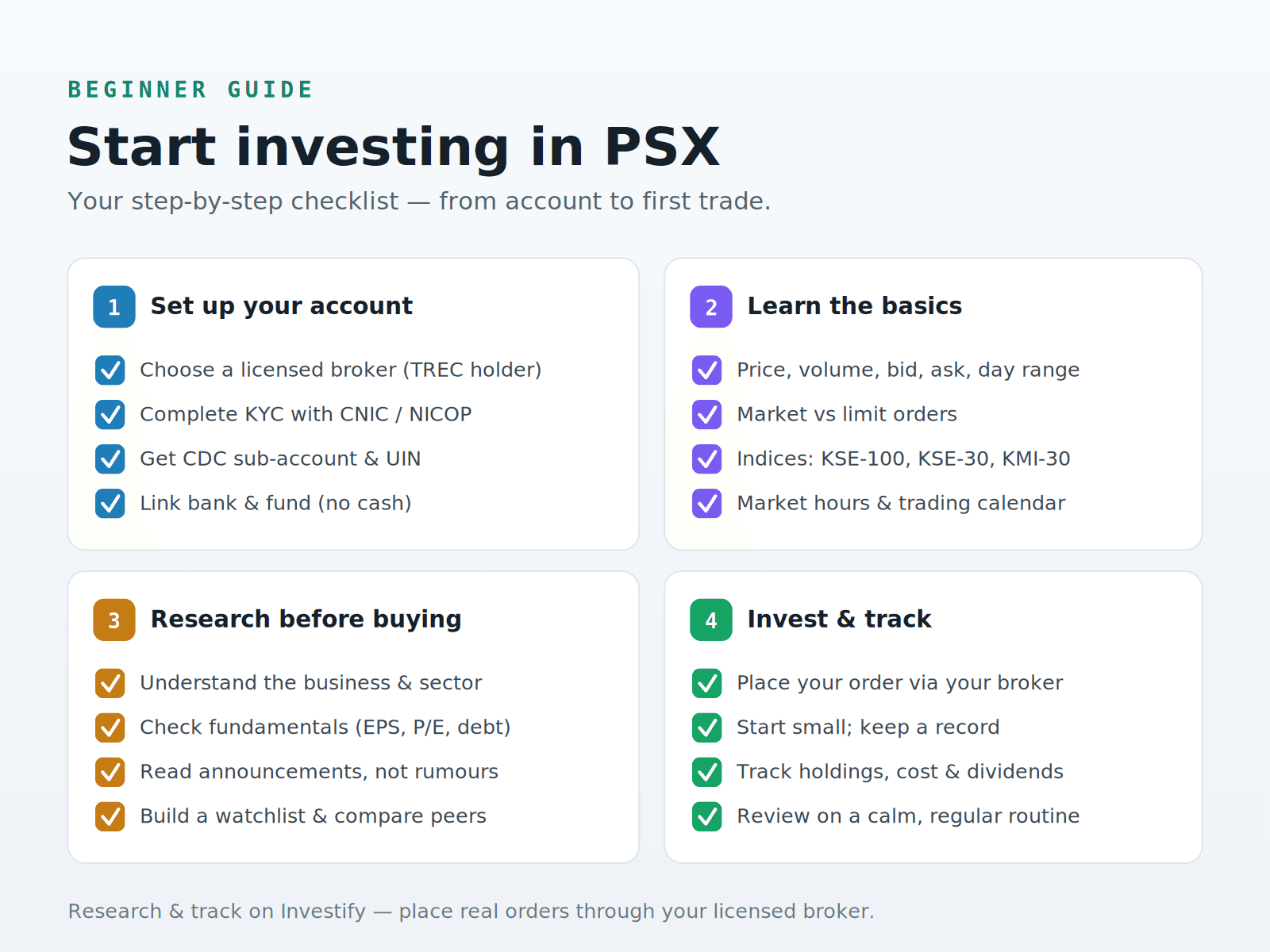
How to Start Investing in the Pakistan Stock Exchange as a Beginner
A complete beginner guide to investing in the Pakistan Stock Exchange: account setup, brokers, PSX concepts, research, risk management, portfolio tracking and daily market routines.
Read guide
What Is the Minimum Amount Needed to Start Investing in PSX?
Understand how much money a beginner may need to start investing in the Pakistan Stock Exchange, including account requirements, share prices, charges and practical starting ranges.
Read guide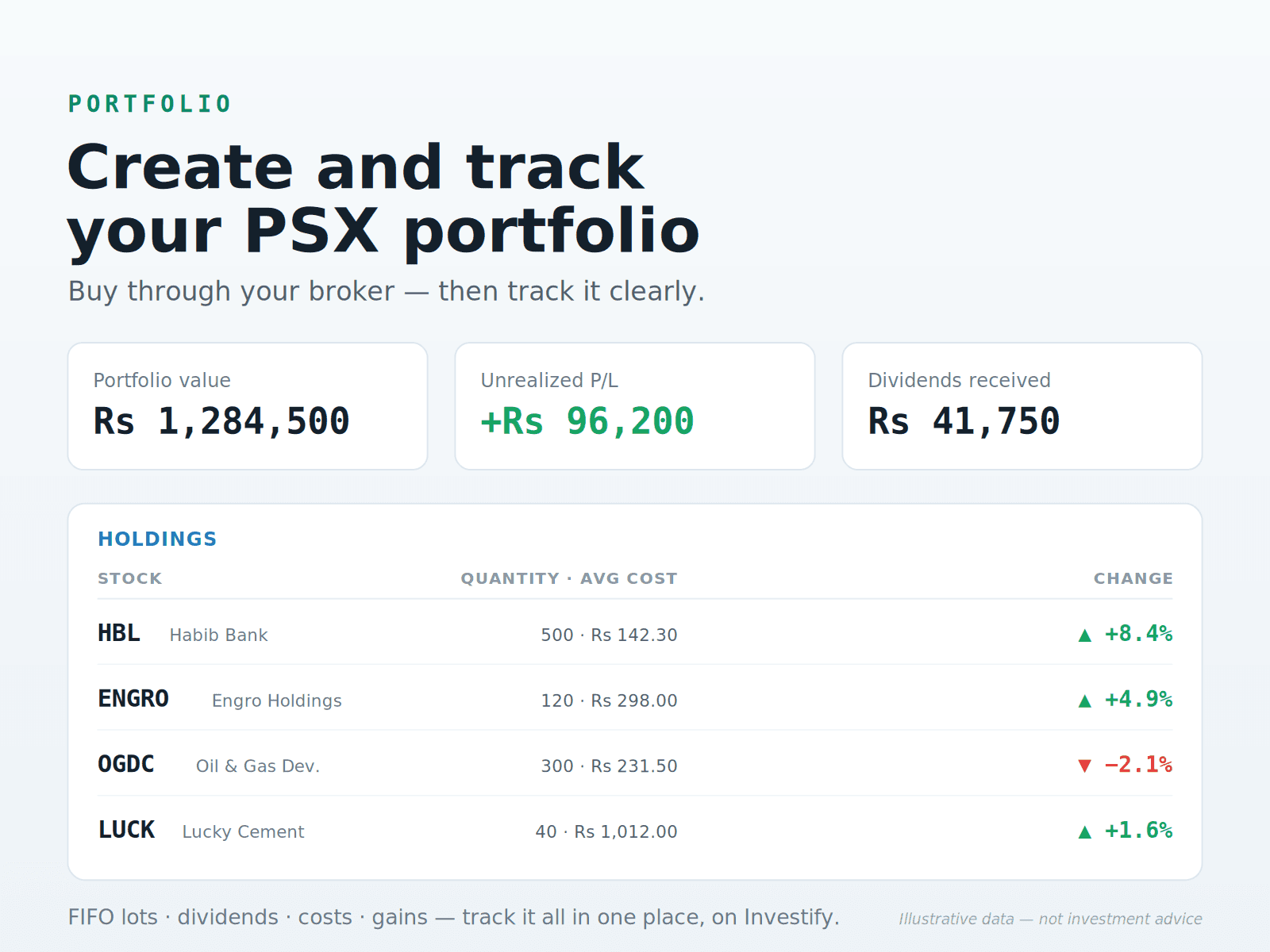
How to Create and Track a PSX Stock Portfolio
Learn how to create a PSX stock portfolio through a licensed broker and track it with FIFO, dividends, costs and corporate actions.
Read guide