
T-Bill Calculator
THE TREASURY BILL
Pay a little less today, get the full amount back
For
Latest 3 months cut-off, SBP auction of October 28, 2026.
AUCTION SLIP
3 months treasury bill, 91 days at 12.43%
Net profit
Rs 26,333
10.99% a year after tax, compounded.
Rs 97.00 buys Rs 100 back in 91 days
Day 0: pay the price. Day 91: the State Bank pays the face value.
WHICH LENGTH
6 months pays most a year at today's cut-offs
The same Rs 1,000,000 in each, after 15% tax. Tap one to use it.
A longer bill locks the money for longer. A shorter one lets you reinvest sooner, at whatever the yield is then.
Want longer than 12 months, or a bank?
ROLL IT OVER
Buy again each time it matures
Price, profit and yield by length
| Length | Cut-off | Price per Rs 100 | Face value | Net profit | Net yield |
|---|---|---|---|---|---|
| 1 month (28 days) | 12.1055% | 99.0799 | Rs 1,009,286 | Rs 7,893 | 10.79% |
| 3 months (91 days) | 12.4261% | 96.9951 | Rs 1,030,980 | Rs 26,333 | 10.99% |
| 6 months (182 days) | 12.65% | 94.0666 | Rs 1,063,077 | Rs 53,615 | 11.04% |
| 12 months (364 days) | 12.89% | 88.6095 | Rs 1,128,547 | Rs 109,265 | 10.96% |
Cut-off yields from the SBP auction of October 28, 2026; the next auction sets new ones. Withholding tax is the tax year 2027 rate for individuals on government securities, applied to the discount.
How T-bill pricing works
A Market Treasury Bill (MTB) pays no coupon. The government sells it for less than its face value and repays the face value on the maturity date, so your profit is the discount. The State Bank auctions four tenors: 1 month (28 days), 3 months (91 days), 6 months (182 days) and 12 months (364 days). At each auction it announces a cut-off yield, and bids at or below it are accepted. A competitive bid may be filled at a different yield from the cut-off, and a non-competitive bid is filled at the weighted average yield of the accepted bids, which is a little below the cut-off.
Profit = face value − price paid
- Price
- what you pay for each Rs 100 of face value
- y
- the annual yield, as a decimal (12.4261% is 0.124261)
- days
- days from purchase to maturity: 28, 91, 182 or 364
The yield is a simple annual rate on a 365-day year, so the profit on a 91-day bill is 91 ÷ 365 of the yearly yield. The calculator also converts that to a compounded rate (what you would earn if you rolled over at the same yield all year), so bills of different lengths can be compared with each other and with National Savings and bank deposits.
A worked example
Rs 1,000,000 in a 3-month bill at the October 28, 2026 cut-off of 12.4261% buys a face value of Rs 1,030,980 at Rs 96.9951 per Rs 100. The discount is Rs 30,980. A filer pays Rs 4,647 withholding tax (15%) and keeps Rs 26,333 after 91 days, a net return of 10.56% a year, or 10.99% compounded.
Working the other way, if you want exactly Rs 1,000,000 at maturity from a 12-month bill, you pay Rs 886,095 today.
| Rs 1,000,000 invested | Cut-off | Price per Rs 100 | Net profit, filer | Net profit, non-filer | Net yield, filer |
|---|---|---|---|---|---|
| 1 month (28 days) | 12.1055% | 99.0799 | Rs 7,893 | Rs 6,500 | 10.79% |
| 3 months (91 days) | 12.4261% | 96.9951 | Rs 26,333 | Rs 21,686 | 10.99% |
| 6 months (182 days) | 12.65% | 94.0666 | Rs 53,615 | Rs 44,154 | 11.04% |
| 12 months (364 days) | 12.89% | 88.6095 | Rs 109,265 | Rs 89,983 | 10.96% |
The 12-month bill pays the highest yield, but a 1-month bill rolled over keeps your money flexible. If yields stay where they are, buying four 3-month bills in a row (364 days) turns Rs 1,000,000 into about Rs 1,109,567 after tax, against Rs 1,109,265 from one 12-month bill.
Tax on T-bill profit
The discount is profit on debt. For individuals in tax year 2027, withholding tax on government securities is 15% for filers and 30% for non-filers. Companies and associations of persons pay 20% and 40%. For an individual, the tax withheld is final up to Rs 5 millionof profit in the year, with a minimum-tax regime above that. If you roll a bill over, the discount on each bill is taxed when it matures, which is why the calculator reinvests the after-tax proceeds.
Bank deposits are taxed higher (20% for filers), so the tax gap adds to the yield gap in favour of bills. See where this income falls in your return with the income tax calculator.
How individuals buy T-bills in Pakistan
- Through a bank. A bank that deals in government securities can open an Investor Portfolio Securities (IPS) account for you and place your bid at the State Bank auction. Ask for a non-competitive bid, which is filled at the auction's weighted average yield, a little below the cut-off, and avoids guessing it.
- Through a broker. Brokers that deal in government securities can bid for you and hold the securities in your account.
- Through a fund. Money market and income mutual funds hold T-bills for you, with daily liquidity but fund-level costs and their own tax treatment. The lump sum calculator shows what a fund could grow to.
- From overseas. Overseas Pakistanis can use a Roshan Digital Account, read the Roshan Digital Account guide, and ask their bank which government securities it offers.
Minimum amounts, fees and bidding deadlines differ between banks and brokers, so confirm them before you plan around a figure. The State Bank holds bill auctions regularly, roughly every two weeks, and publishes the calendar and the results on its website.
Rolling over, and common mistakes
- Rollover compounds, but only if yields hold. Each rollover buys at the yield of that day. Use the roll it over card to test a lower yield for later bills.
- Price and yield move in opposite directions. A higher yield means a lower price per Rs 100. If you sell before maturity, you get the market price of that day.
- Compare after tax, not before. A bill at 12.65% gives a filer about 10.75% a year after tax.
- Check real returns. Compare the net yield with price rises using the inflation calculator.
- Longer maturities. For multi-year government paper with a coupon, use the PIB calculator.
Sources and assumptions
T-bill yields from the SBP auction of October 28, 2026. Withholding tax rates for tax year 2027 (July 1, 2026 to June 30, 2027).
- SBP, Market Treasury Bills auction results (latest)
- State Bank of Pakistan, Monetary Policy Statement (October 2026)
- FBR Withholding Tax Rates Card, tax year 2027
- KPMG Taseer Hadi & Co., A Brief of Finance Act 2026
- Pricing: price = 100 ÷ (1 + yield × days ÷ 365), actual days over a 365-day year, with 28, 91, 182 and 364 days for the four tenors
Each auction sets new cut-off yields, and a competitive bid may be filled at a different yield from the cut-off. Banks and brokers add their own minimums and fees. Results are estimates for information and planning only, not tax, legal or investment advice. Check your own case with a tax adviser, your broker or the official source before acting.
FAQ
T-Bill Calculator: common questions
How is the price of a T-bill calculated in Pakistan?+
A Market Treasury Bill is sold at a discount and repaid at face value. The price per Rs 100 of face value is 100 ÷ (1 + yield × days ÷ 365), using the auction yield and the number of days to maturity (28, 91, 182 or 364). At the October 28, 2026 cut-off of 12.4261%, a 91-day bill costs Rs 96.9951 per Rs 100. Your profit is the difference between face value and what you paid.
What are the current T-bill yields in Pakistan?+
At the State Bank auction of October 28, 2026, the cut-off yields were 12.1055% for 1 month, 12.4261% for 3 months, 12.65% for 6 months and 12.89% for 12 months. A new auction sets new yields, so the calculator lets you type any yield.
How much profit does Rs 1 million earn in a 6-month T-bill?+
At the 12.65% cut-off, Rs 1,000,000 buys a 182-day bill with a face value of Rs 1,063,077. The discount is Rs 63,077. After 15% withholding tax a filer keeps Rs 53,615, and a non-filer, taxed at 30%, keeps Rs 44,154.
How is T-bill profit taxed?+
The discount is profit on debt. For individuals, withholding tax is 15% for filers and 30% for non-filers in tax year 2027. Companies and associations of persons pay 20% and 40%. For an individual it is a final tax up to Rs 5 million of profit in the year. When you roll a bill over, each maturity is taxed separately.
Can an individual buy treasury bills in Pakistan?+
Yes. Individuals normally buy through a bank or a broker, which opens an Investor Portfolio Securities (IPS) account for them and places a bid at the State Bank auction. A non-competitive bid is filled at the weighted average yield of the auction for that tenor, a little below the cut-off, so you do not have to guess a yield. That is the simplest route, and this calculator starts from the cut-off, so for a non-competitive bid it slightly understates the price and overstates the yield. Minimum amounts, fees and the bidding deadline are set by the bank or broker, so ask before you apply.
What is the difference between a T-bill and a PIB?+
Treasury bills are short-term (up to 12 months), pay no coupon and are sold at a discount. Pakistan Investment Bonds run for 2 to 30 years and pay a coupon every six months. Both are government securities taxed in the same way for individuals. Use the PIB calculator for bonds.
Are treasury bills risk-free?+
The government pays face value on the maturity date, so credit risk is the sovereign's. If you hold to maturity, the profit is known on the day you buy. If you sell before maturity the price depends on the market yield that day. Rolling over also carries reinvestment risk, because later auctions may pay lower yields.
Does the calculator use a 365-day year?+
Yes. Pakistan quotes bill yields on an actual days over 365 basis, so a 91-day bill earns 91 ÷ 365 of the annual yield. The 12-month bill is 364 days, so its profit is 364 ÷ 365 of a full year at the quoted yield.
Keep going
Related tools
PIB & Bond Yield Calculator
Yield to maturity, price and coupon income on PIBs, sukuk and TFCs.
National Savings (NSS) Profit Calculator
Profit on Behbood, Defence, Regular Income, Special and Short Term certificates after tax.
Bank Term Deposit Calculator
Profit on bank term deposits and savings accounts, monthly or at maturity, after tax.
PSX guides
Learn the ideas behind the numbers
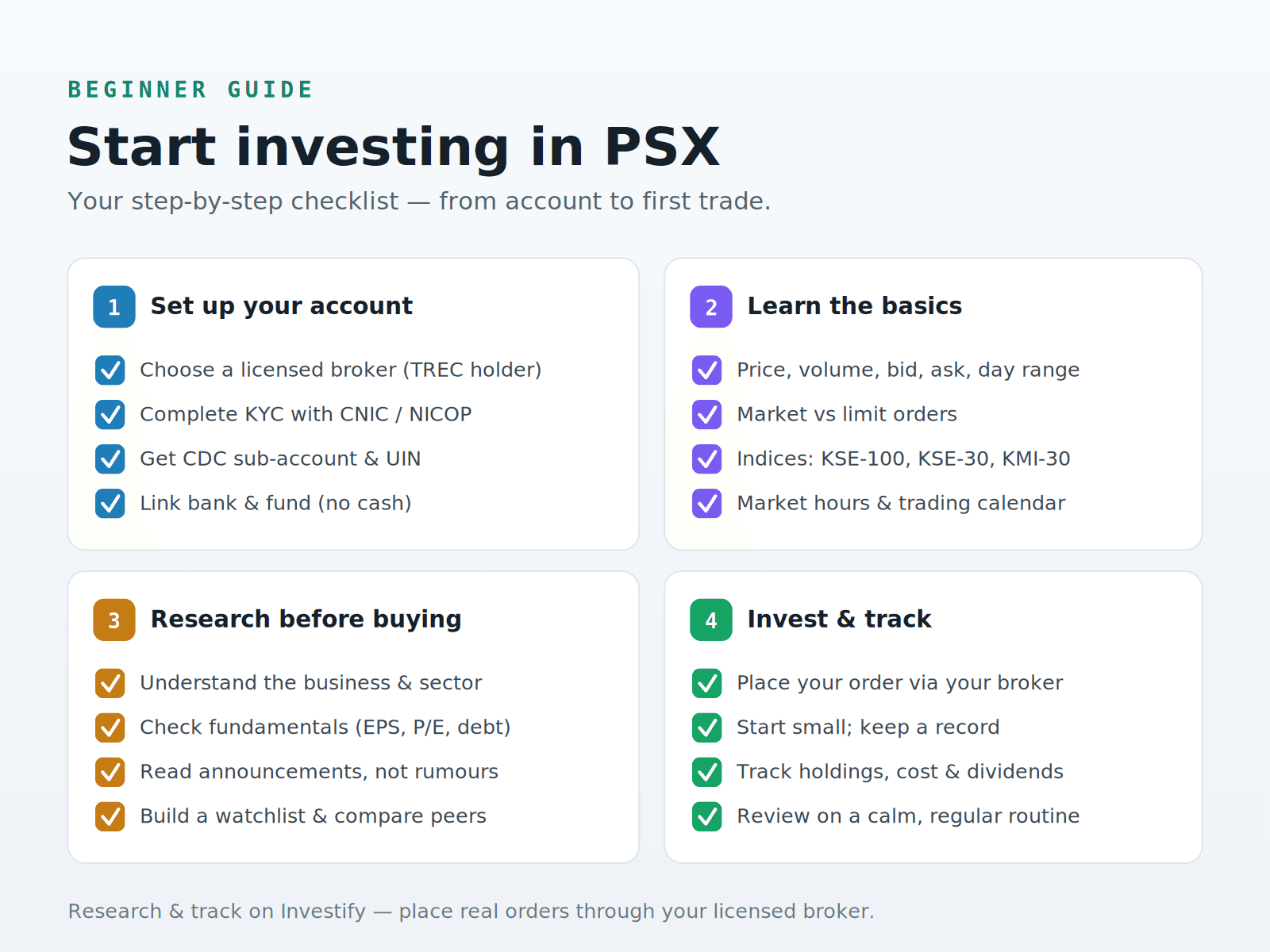
How to Start Investing in the Pakistan Stock Exchange as a Beginner
A complete beginner guide to investing in the Pakistan Stock Exchange: account setup, brokers, PSX concepts, research, risk management, portfolio tracking and daily market routines.
Read guide
Roshan Digital Account: How Overseas Pakistanis Invest in PSX
A step-by-step guide for Non-Resident Pakistanis to invest in PSX through the Roshan Digital Account and Roshan Equity Investment: eligibility, banks, brokers, CDC setup, taxes and repatriation.
Read guide
What Is the Minimum Amount Needed to Start Investing in PSX?
Understand how much money a beginner may need to start investing in the Pakistan Stock Exchange, including account requirements, share prices, charges and practical starting ranges.
Read guide