
PIB & Bond Yield Calculator
THE BOND
A coupon every six months, your money back at the end
The type decides the tax rate on your coupons.
Priced on a coupon date, in whole coupon periods.
Latest PIB cut-off for 5 years, SBP auction of October 7, 2026.
PRICE PER RS 100
Rs 98.56
Pay Rs 985,596 for Rs 10 lakh face value.
At a discount: you get more back than you pay
Rs 53,125
each half-year, after tax
10.78%
coupon on price, after tax
11.01%
yield after tax
HOLD TO MATURITY
Rs 545,654 net profit over 10 coupons
Tax (15%, T-bills, PIBs and other government securities (individuals)) is withheld on the coupons only.
Compare with
IF RATES MOVE
Rates up 1 point, price down about 3.6%
Yields rise 1 point
−Rs 3.49
per Rs 100
Yields fall 1 point
+Rs 3.65
per Rs 100
On average your money comes back in 3.9 years. Longer bonds swing more. Held to maturity the swings do not matter: you get the coupons and the face value.
- Bond price per Rs 100
- Face value (par)
The curve bends: a fall in yields lifts the price more than an equal rise cuts it. Where it crosses par, the yield equals the coupon.
PIB cut-off yields from the SBP auction of October 7, 2026; yields change at every auction. Priced on a coupon date (the clean price, no accrued interest). Tax is withheld on coupons only.
How bond pricing and yield work
A fixed-rate bond is a stream of known cash flows: a coupon every period and the face value at the end. Its price is what those cash flows are worth today when discounted at the market yield. A higher yield discounts them more, so the price falls. A PIB pays coupons twice a year, so the calculator discounts at half the yearly yield over twice as many periods.
- C
- coupon per period, as a percentage of face value (the yearly coupon ÷ 2 for a PIB)
- i
- yield per period (the yearly yield ÷ 2)
- n
- number of coupon periods (years × 2)
Going the other way, the calculator searches for the yield that reproduces the price you enter. Current yield is the coupon divided by the price. Macaulay duration is the average time to receive the cash flows, weighted by their present value, and modified duration divides it by (1 + i) to give the approximate percentage price change for a one point move in yield. The calculator also reprices the bond exactly at yields one point higher and lower.
A worked example
Take a 5-year PIB with a 12.5% coupon, valued at the latest 5-year cut-off yield of 12.8998% (auction of October 7, 2026). The price is Rs 98.5596 per Rs 100, so Rs 1,000,000 of face value costs Rs 985,596. It pays Rs 62,500 every six months before tax, and Rs 53,125 after 15% withholding tax for a filer. Held to maturity the net profit is Rs 545,654: net coupons plus the Rs 14,404 gained as the price pulls up to face value.
Modified duration is 3.62, so if the yield rose one percentage point the price would fall by about Rs 3.49 per Rs 100, and if it fell one point it would rise by about Rs 3.65. As a check, a 10% coupon, 5-year bond at an 8% yield is worth Rs 108.1109.
The table shows the four fixed-rate PIB tenors at the latest cut-offs, for a bond bought at face value with a coupon equal to the cut-off. The longer the bond, the more its price reacts to yield changes.
| PIB tenor | Cut-off yield | Coupon per 6 months on Rs 1,000,000 | After tax, filer | Yield after tax | Modified duration |
|---|---|---|---|---|---|
| 2 years | 12.795% | Rs 63,975 | Rs 54,379 | 10.88% | 1.72 |
| 3 years | 12.746% | Rs 63,730 | Rs 54,171 | 10.83% | 2.43 |
| 5 years | 12.8998% | Rs 64,499 | Rs 54,824 | 10.96% | 3.60 |
| 10 years | 12.85% | Rs 64,250 | Rs 54,613 | 10.92% | 5.54 |
Fixed-rate and floating-rate PIBs
A fixed-rate PIB keeps the same coupon for its whole life, which is what this calculator prices. Its price moves as market yields move, and you know every coupon in advance.
A floating-rate PIB resets its coupon at set intervals against a benchmark tied to treasury bill yields. The coupon you will receive next year is not known today, so the cash flows cannot be listed and a precise yield cannot be computed in advance. Its price stays close to face value because the coupon follows rates up and down. If you want a rough read on a floating bond, enter its current coupon and yield here, and treat the later coupons as estimates that will change at each reset.
Sukuk, TFCs and tax
The same maths prices a sukuk or a term finance certificate (TFC) that pays a fixed profit rate. Pick the bond type so the right withholding tax is used. For individuals in tax year 2027:
| Instrument | Filer | Non-filer |
|---|---|---|
| PIB and other government securities | 15% | 30% |
| Sukuk, yearly return up to Rs 1 million | 10% | 20% |
| Sukuk, yearly return above Rs 1 million | 12.5% | 25% |
| TFC and other corporate profit on debt | 15% | 30% |
Corporate bonds and sukuk carry credit risk that government paper does not, and listed ones can trade thinly, so the price you can sell at may differ from the price the maths gives. Compare your after-tax yield with T-bills, National Savings and bank deposits. To see where the coupons fall in your return, use the income tax calculator.
Reading the results
- Price below 100 is a discount: the yield is above the coupon. Above 100 is a premium: the yield is below the coupon. A 10-year par bond with a 12.5% coupon prices at 100.00 and has a Macaulay duration of 5.97 years.
- Yield to maturity assumes you reinvest coupons at the same yield. If rates fall, you reinvest at less and your realised return is lower.
- Hold to maturity and the price swings do not matter, apart from the opportunity cost. Sell early and you receive the market price of that day.
- Check real returns. Compare the after-tax yield with price rises using the inflation calculator.
Sources and assumptions
PIB cut-off yields from the SBP auction of October 7, 2026. Withholding tax rates for tax year 2027 (July 1, 2026 to June 30, 2027).
- SBP, Pakistan Investment Bonds auction results (latest)
- State Bank of Pakistan, Monetary Policy Statement (October 2026)
- FBR Withholding Tax Rates Card, tax year 2027
- KPMG Taseer Hadi & Co., A Brief of Finance Act 2026
- Pricing: present value of the coupons and face value at the yield per coupon period; yield by bisection; duration from the discounted cash flows
Each auction sets new yields, and the coupon of a bond already in issue is fixed by its terms. Prices here assume settlement on a coupon date and ignore dealer spreads, commissions and accrued interest. Results are estimates for information and planning only, not tax, legal or investment advice. Check your own case with a tax adviser, your broker or the official source before acting.
FAQ
PIB & Bond Yield Calculator: common questions
How do I calculate the yield to maturity of a PIB?+
Yield to maturity (YTM) is the single yearly rate that makes the present value of all remaining coupons and the face value equal to the price. There is no direct formula, so the calculator finds it by repeated bisection. For example, a 5-year bond with a 12.5% coupon priced at Rs 97 per Rs 100 has a YTM of 13.3413%. Choose "Yield from price" and enter the price.
How often do PIBs pay a coupon?+
Fixed-rate Pakistan Investment Bonds pay a coupon every six months at half of the yearly coupon rate. The face value is repaid on the maturity date. Floating-rate PIBs also pay periodically, but the coupon is reset against a T-bill benchmark, so the amount changes.
How much coupon does a Rs 1 million PIB pay?+
At a 12.5% coupon, Rs 1,000,000 face value pays Rs 62,500 every six months before tax. Withholding tax takes 15% for filers (Rs 9,375), leaving Rs 53,125. A non-filer is taxed at 30% and receives Rs 43,750.
How are PIB coupons taxed in Pakistan?+
Coupon income on government securities held by individuals carries withholding tax of 15% for filers and 30% for non-filers in tax year 2027. It is a final tax for individuals up to Rs 5 million of profit in the year. This calculator taxes the coupons only. The tax treatment of a price gain or loss when you sell or redeem depends on your case, so ask a tax adviser.
What is the difference between clean price and accrued interest?+
The clean price is the bond's quoted price without the coupon that has built up since the last payment. When you buy between coupon dates you also pay the seller the accrued interest, and you get it back in the next coupon. This calculator prices the bond on a coupon date, so there is no accrued interest and the price shown is the clean price.
What does duration tell me?+
Duration measures how sensitive a bond's price is to a change in yields. Modified duration of 3.62 means the price falls by about 3.62% if yields rise one percentage point. A 10-year bond bought at par with a 12.5% coupon has a Macaulay duration of 5.97 years, so long bonds move much more than short ones.
How is a sukuk taxed compared with a PIB?+
For individuals, sukuk return is taxed at 10% for filers (20% for non-filers) when the yearly return is up to Rs 1 million, and 12.5% (25%) when it is above. Corporate bonds and TFCs use the general profit-on-debt rate of 15% for filers and 30% for non-filers. The calculator picks the rate from your bond type and coupon.
Why does a bond price fall when yields rise?+
A bond's coupon is fixed. When market yields rise, new bonds pay more, so an older bond must sell for less to give a buyer the same yield. At a 12.9% yield the 5-year example costs Rs 98.56 per Rs 100. At a yield one point higher it costs Rs 95.07, and one point lower, Rs 102.21.
Keep going
Related tools
T-Bill Calculator
Price, yield and profit on Pakistan treasury bills, with the latest auction yields.
National Savings (NSS) Profit Calculator
Profit on Behbood, Defence, Regular Income, Special and Short Term certificates after tax.
Bank Term Deposit Calculator
Profit on bank term deposits and savings accounts, monthly or at maturity, after tax.
PSX guides
Learn the ideas behind the numbers
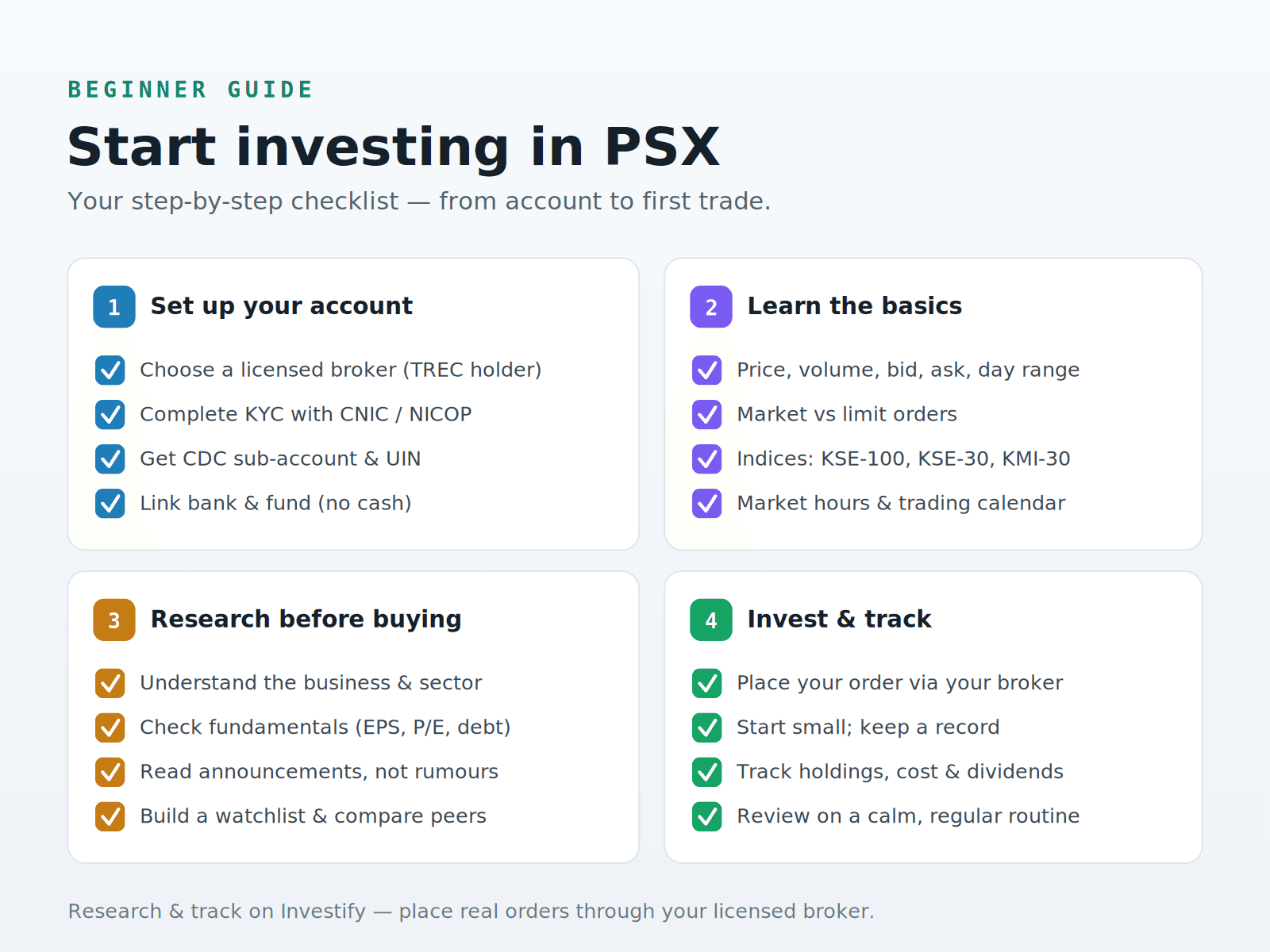
How to Start Investing in the Pakistan Stock Exchange as a Beginner
A complete beginner guide to investing in the Pakistan Stock Exchange: account setup, brokers, PSX concepts, research, risk management, portfolio tracking and daily market routines.
Read guide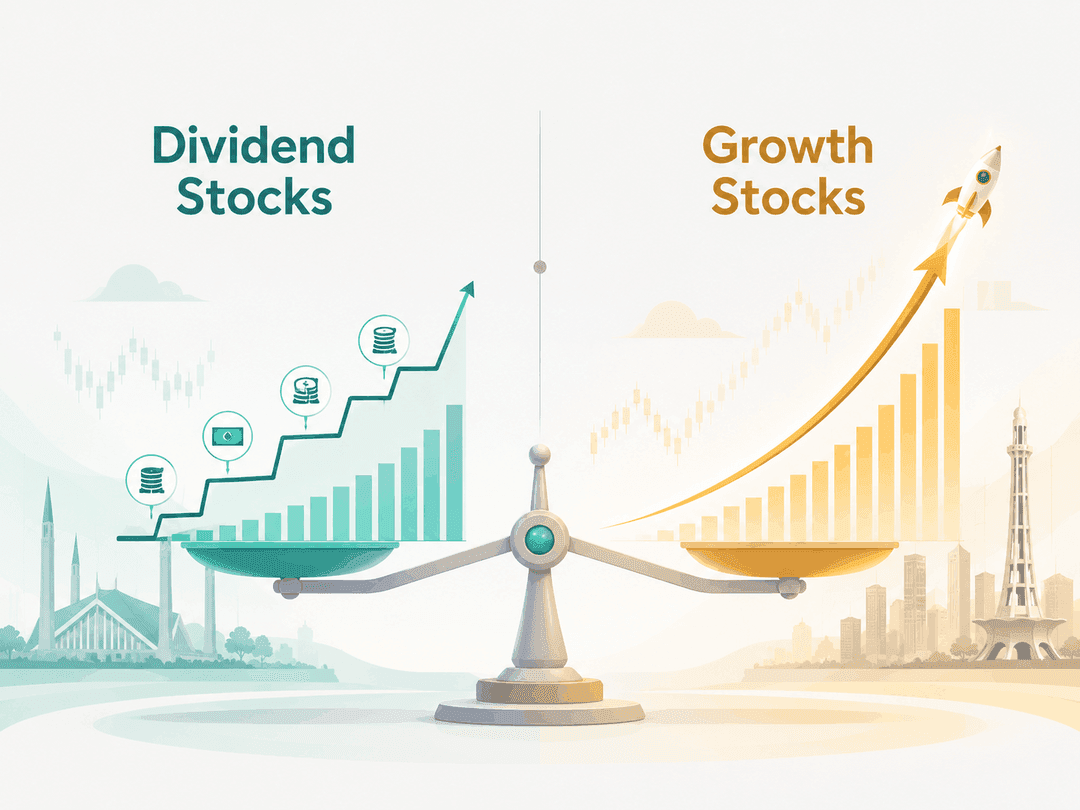
Dividend Stocks vs Growth Stocks on PSX
A beginner-friendly PSX guide comparing dividend stocks and growth stocks, including risks, investor fit, sectors, interest rates and market cycles.
Read guide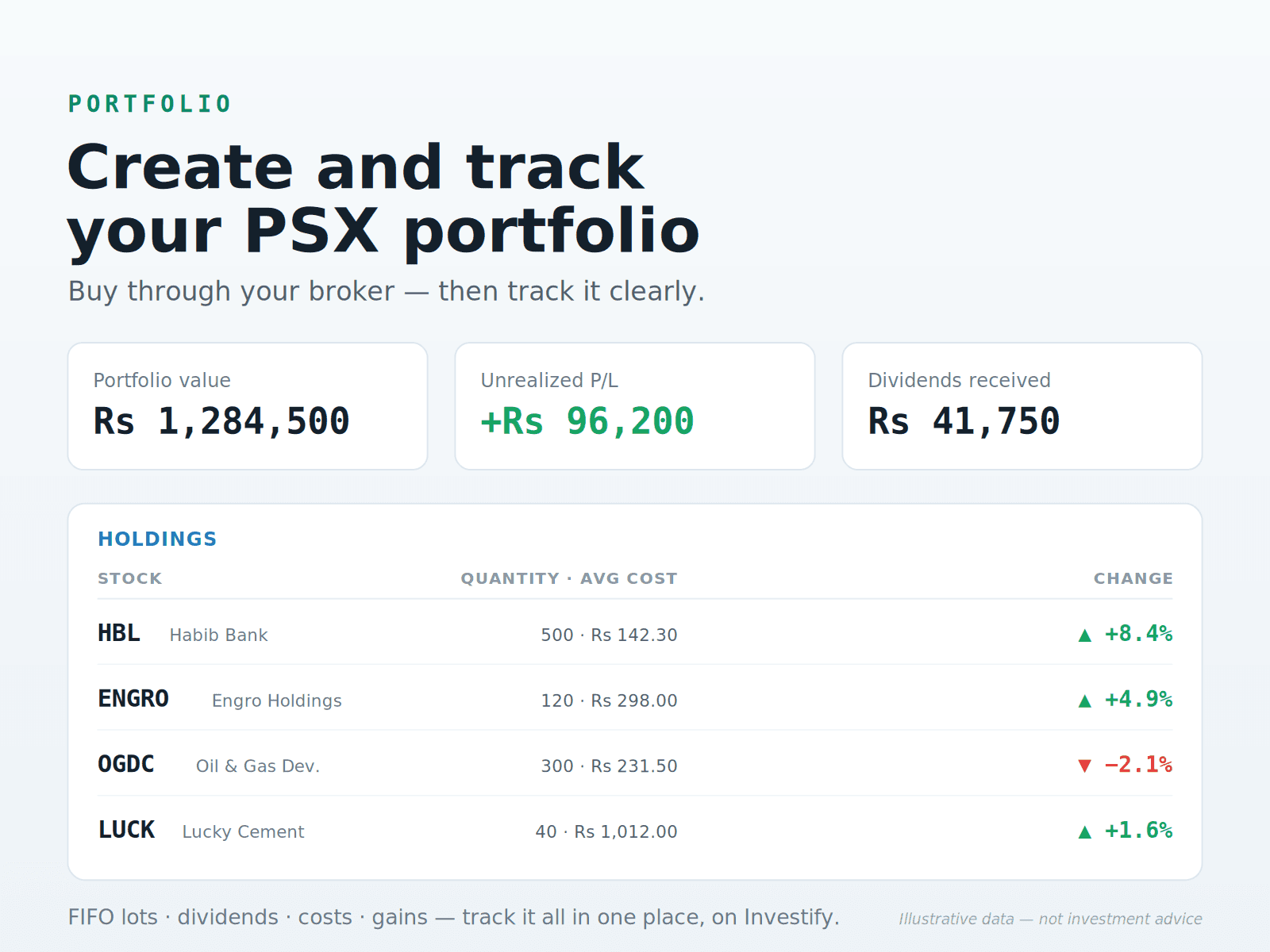
How to Create and Track a PSX Stock Portfolio
Learn how to create a PSX stock portfolio through a licensed broker and track it with FIFO, dividends, costs and corporate actions.
Read guide