
Retirement Calculator
YOUR PLAN
When you stop working, and what you spend
Money you will leave untouched until then: PSX shares, mutual funds, VPS, savings certificates.
Assumes 7% inflation, 12% a year before retirement and 9% after, with the money lasting to age 85. Change them under More options.
TO RETIRE AT 60
Rs 59,377a month
invested from now builds a pot of Rs 18.29 crore by age 60, worth Rs 2.4 crore in today's money.
- Your Rs 100,000 a month costs thenRs 761,226
- The pot equals20 years of spending
EVERY YEAR YOU WAIT
Waiting 5 years makes it 1.3× as much
The same retirement, started later: fewer years to save, and less time for growth to do the work.
Start now, at 30
Rs 59,377
a month in today's rupees
Start at 35
Rs 76,626
a month in today's rupees
Start at 40
Rs 101,100
a month in today's rupees
RETIRE EARLIER OR LATER
Each year of work makes the pot smaller and the saving longer
- Building up (age 30 to 60)
- Drawing down (age 60 onward)
The lines meet at age 60, the day you stop working. Before it you add to the pot; after it the pot pays your expenses, which keep rising with inflation.
Years shown: 30 years of saving and 25 years of retirement. Assumptions, not forecasts.
How the retirement calculator works
The calculator works backwards in four steps. It inflates your monthly spending to the day you retire, subtracts any pension or rental income you expect, finds the lump sum that can pay the rest for the whole retirement, and then works out the monthly investment that builds that lump sum.
- W
- monthly amount to fund at retirement = expenses × (1 + inflation)^years − pension income inflated the same way
- ρ
- real monthly return after retirement = ((1 + return) ÷ (1 + inflation))^(1/12) − 1
- n
- months of retirement = (life expectancy − retirement age) × 12
The last factor, (1 + ρ), reflects that you draw each month's money at the start of the month. Working with the real return keeps the maths honest: your expenses rise with inflation, so what counts is how far your investments beat it. If the two are equal (ρ = 0) the corpus is simply W × n.
Existing savings grow at your before-retirement return until the retirement date. Whatever is still missing, after any gratuity or provident fund lump sums, is the target for a monthly investment. That step uses the same engine as the SIP calculator, including the optional yearly step-up.
A worked example
Take someone aged 30 who spends Rs 100,000 a month today, plans to retire at 60 and wants the money to last until 85. At 7% inflation that spending becomes Rs 761,226 a month in 30 years. Earning 9% after retirement is a real return of 1.87%, so the corpus needed at 60 is Rs 182,939,499, worth Rs 24,032,235 in today's rupees.
With nothing saved so far and a 12% return before retirement, that takes Rs 59,377 invested every month. Raising the monthly amount by 10% each year lets you start with Rs 22,908 instead.
| Change one thing | Corpus at retirement | Invest per month |
|---|---|---|
| Base case: 7% inflation, 12% before, 9% after | Rs 182.9M | Rs 59,377 |
| Inflation 9% instead of 7% | Rs 398M | Rs 129,190 |
| Return after retirement 7% (same as inflation, so a zero real return) | Rs 228.4M | Rs 74,122 |
| Retire at 55 instead of 60 | Rs 150M | Rs 88,135 |
| Retire at 65 instead of 60 | Rs 214.3M | Rs 38,888 |
| Save Rs 5 million already | Rs 182.9M | Rs 10,756 |
| Start at 40 instead of 30 | Rs 93M | Rs 101,100 |
Two levers dominate: how long you give compounding to work, and the gap between your return and inflation. 9% inflation instead of 7% moves both numbers the most: the monthly amount by +118% and the corpus by +118%. Among the changes in your own hands, starting at 40 instead of 30 raises the monthly amount the most (+70%).
Inflation is the real retirement risk in Pakistan
Pakistan's calendar-year CPI inflation averaged about 9.3% between 2000 and 2025, ranging from 2.53% in 2015 to 30.77% in 2023. The State Bank policy rate is 12% (effective October 27, 2026), and the latest monthly CPI reading was 10.3%. A retirement plan built on a calm 5% assumption can be badly short if the decade turns out like 2020 to 2025.
That is why the default here is 7% rather than a lower figure, and why More options makes inflation and both returns editable. Run the plan at 7%, 9% and 11%. If the monthly investment at 11% is out of reach, the safer response is to lengthen the saving period or raise the equity share, not to hope for lower prices.
Pension income and tax
The FBR tax year 2027 rate card taxes pension income at 0% up to Rs 10,000,000 a year, with 5% on the excess for recipients under 70. A typical pension sits far below that, so the plan above works with pre-tax figures. Your investment income in retirement is taxed separately; see the dividend tax calculator and the capital gains tax calculator. Pakistan also offers a tax credit on contributions to a Voluntary Pension System account; the VPS pension calculator shows it.
FIRE and the safe withdrawal rate
The FIRE method skips the year-by-year funding and sets a target of annual expenses ÷ safe withdrawal rate. At 4% that is 25 times your annual spending. On the example above the FIRE number is Rs 228,367,651 at 4% and Rs 260,991,601 at 3.5%, against Rs 182,939,499 for the lifetime method.
The 4% rule was built on US data with modest inflation and a 30-year retirement. In Pakistan, higher and more volatile inflation, rupee depreciation and large equity drawdowns all argue for a lower rate or a bigger corpus, and an early retirement at 45 or 50 needs even more margin because the money must last 40 years or more. The calculator tests this directly: in FIRE mode it simulates your withdrawals and tells you the age at which the money would run out, if it does.
Common mistakes
- Using today's expenses as the target. Without inflation the corpus looks several times smaller than it should.
- Assuming the same return after retirement as before. Safer holdings earn less, and a market fall early in retirement does the most damage.
- Planning to age 70 or 75. Plan to 85 or 90, because outliving the money is the risk that matters.
- Counting the family home as retirement money. It lowers future rent but does not pay the monthly bills.
Sources and assumptions
Inflation and policy-rate context checked October 31, 2026. Return and inflation inputs are assumptions you control.
- Calculation: present value of a growing annuity at the real post-retirement return, each payment at the start of the month; savings grown with the monthly equivalent of the yearly return
- State Bank of Pakistan, Monetary Policy Statement (October 2026)
- World Bank: consumer price inflation, Pakistan (annual %)
- FBR Withholding Tax Rates Card, tax year 2027 (pension income)
Returns and inflation are assumptions, not forecasts. Results are estimates for information and planning only, not tax, legal or investment advice. Check your own case with a tax adviser, your broker or the official source before acting.
FAQ
Retirement Calculator: common questions
How much money do I need to retire in Pakistan?+
It depends on what you spend and how many years you have until you stop working. For example, someone aged 30 who spends Rs 100,000 a month today and retires at 60 will spend about Rs 761,226 a month then at 7% inflation, and needs about Rs 182,939,499 at 60 to fund that until age 85 (Rs 24,032,235 in today's money). Enter your own numbers above for your figure.
How does the calculator work out the corpus?+
It inflates your monthly expenses to the retirement date, subtracts any pension income, and then finds the lump sum that can pay those expenses every month, rising with inflation, until your chosen age. That lump sum is the present value of a growing annuity at the real (after-inflation) return, with each payment made at the start of the month. It then works out the monthly investment that grows your savings to that corpus.
What inflation rate should I use for retirement planning in Pakistan?+
Use a number you can defend and then test a higher one. The default is 7%, close to the 7.05% fiscal 2026 average, but Pakistan's calendar-year CPI averaged 9.3% from 2000 to 2025 and the latest monthly reading is 10.3%. Try 9% as well to see how much the target grows. The same default is used in the lumpsum, goal, compound interest and rule of 72 calculators, so the tools agree.
What is the 4% rule and does it work in Pakistan?+
The 4% rule says you can withdraw 4% of your portfolio in year one, then raise that amount with inflation, and the money should last about 30 years. It was derived from US markets with 2 to 3% inflation. In a higher-inflation economy with a more volatile currency and equity market, a lower rate such as 3 to 3.5%, or a larger corpus, gives more margin. Use the FIRE option under More options to test your own rate.
What is FIRE and how is the FIRE number calculated?+
FIRE stands for financial independence, retire early. The FIRE number is your annual expenses divided by your safe withdrawal rate. At 4% that is 25 times your yearly spending; at 3.5% it is about 28.6 times. Because early retirement means more years of withdrawals, the calculator also tells you whether the corpus lasts to the age you choose.
Is the EOBI pension enough to retire on?+
For most people, no. The EOBI old-age pension follows a formula tied to wages and has a minimum of Rs 11,500 a month, which covers only a small part of a middle-class budget. Treat it as a useful floor and enter it as pension income under More options. The EOBI pension calculator shows what you would get.
Is pension income taxed in Pakistan?+
According to the FBR tax year 2027 rate card, pension income is taxed at 0% up to Rs 10,000,000 a year, with 5% on the excess for recipients under 70. Income from your investments in retirement (dividends, profit on debt, capital gains) has its own rules, so check the relevant tax calculators for your mix.
Should I include my provident fund and gratuity?+
Yes, as lump sums on the retirement date under More options. They reduce the corpus you must build yourself. Estimate them with the gratuity calculator and the provident fund calculator; both are in rupees at the retirement date, so use the future value those tools show.
Keep going
Related tools
VPS Pension Calculator
Voluntary Pension System growth, the yearly tax credit, and the pension at retirement.
Gratuity Calculator
Gratuity from your last drawn salary and years of service, with the tax-free limit.
Provident Fund Calculator
Your provident fund balance at retirement from your and your employer's contributions.
EOBI Pension Calculator
Your EOBI old-age pension, contributions and eligibility.
SIP Calculator
What a fixed monthly investment in PSX stocks or mutual funds can grow to, with yearly step-up.
SWP Calculator
Monthly withdrawals from an investment and how long the money lasts.
PSX guides
Learn the ideas behind the numbers
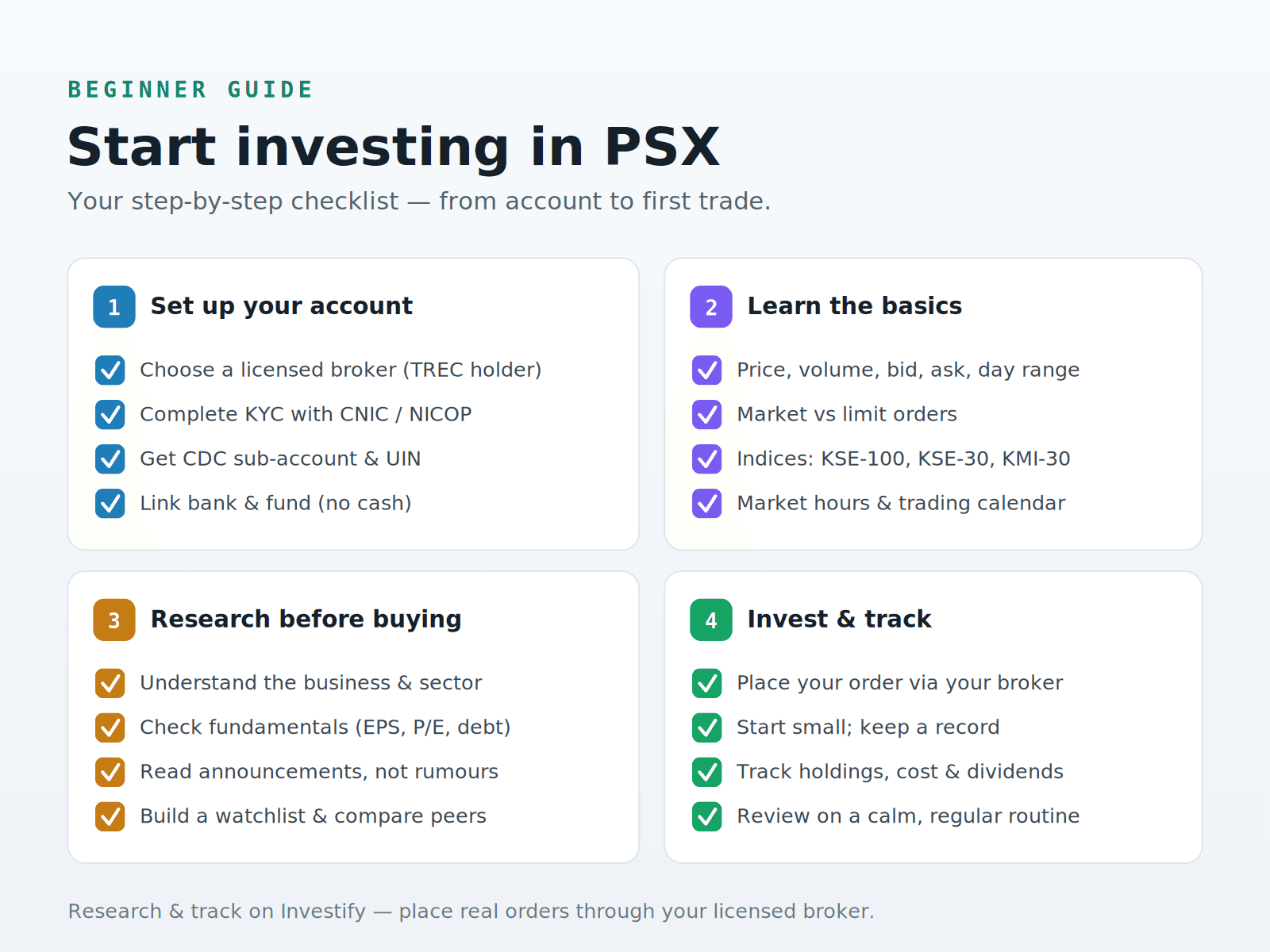
How to Start Investing in the Pakistan Stock Exchange as a Beginner
A complete beginner guide to investing in the Pakistan Stock Exchange: account setup, brokers, PSX concepts, research, risk management, portfolio tracking and daily market routines.
Read guide
What Is the Minimum Amount Needed to Start Investing in PSX?
Understand how much money a beginner may need to start investing in the Pakistan Stock Exchange, including account requirements, share prices, charges and practical starting ranges.
Read guide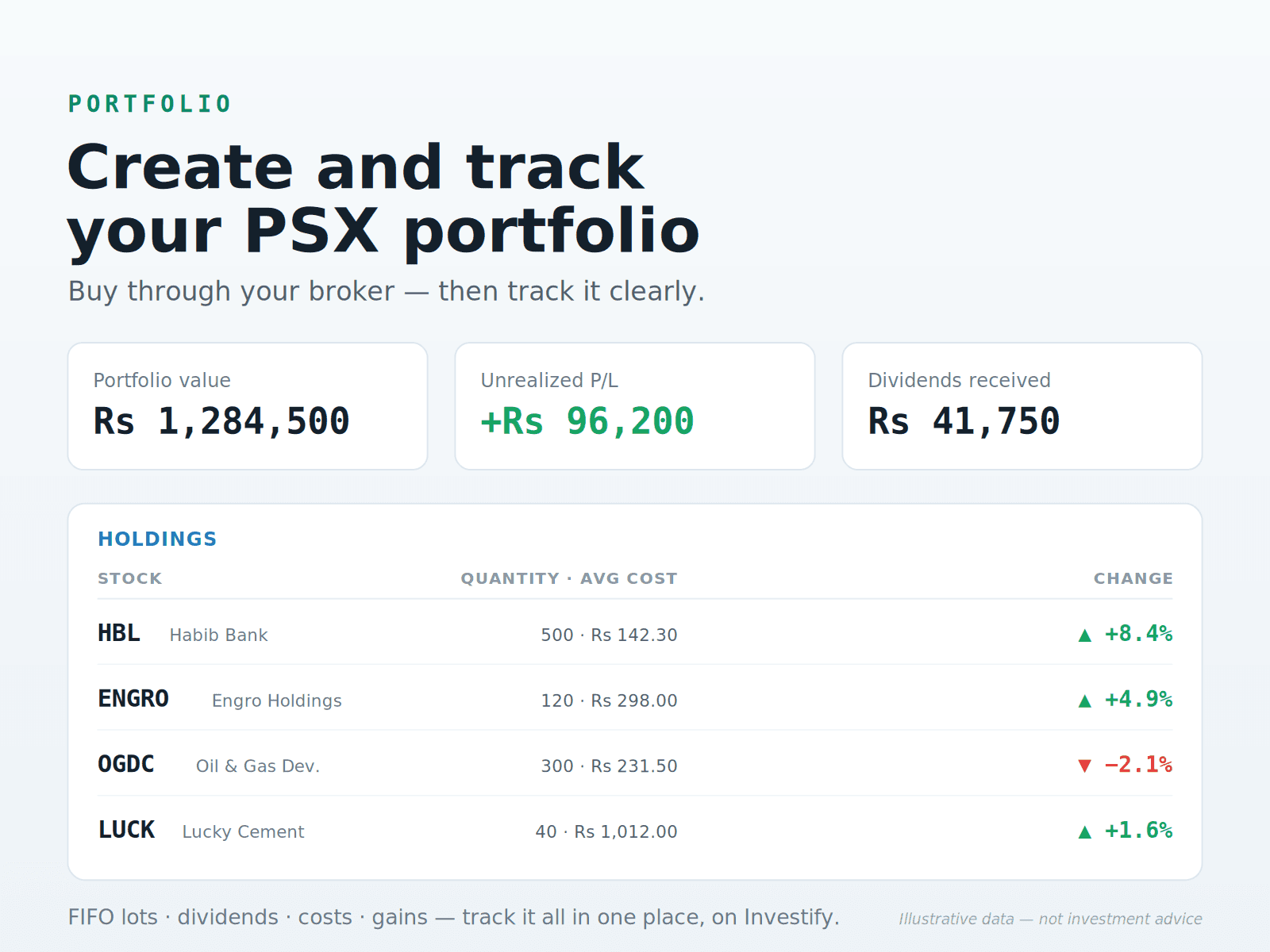
How to Create and Track a PSX Stock Portfolio
Learn how to create a PSX stock portfolio through a licensed broker and track it with FIFO, dividends, costs and corporate actions.
Read guide