
Loan EMI Calculator
YOUR LOAN
What it costs you every month
EVERY MONTH, FOR 3 YEARS
Rs 36,152
Borrow Rs 1,000,000, pay back Rs 1,301,486 (13.01 lakh).
PAY IT OFF FASTER
Your first instalment is 41% markup
Every rupee you pay early comes off what you owe, so it stops earning markup for the bank. Most banks charge a fee on part-payments, so ask yours first.
Extra every month
A bonus or a lump sum paid on top of one instalment.
LONGER OR SHORTER
A smaller instalment costs more markup
- Principal repaid
- Markup paid
Each column is one year of instalments. Early payments are mostly markup; later ones are mostly principal.
Instalments are calculated monthly on the reducing balance, the way banks quote it. Your bank may round instalments or charge extra fees, so confirm the final figure on your offer letter. For a car or a home use the car financing calculator or the home finance calculator.
How the loan calculator works
You enter the amount, the yearly markup rate and the period. The calculator divides the yearly rate by 12, then finds the one fixed monthly payment that repays the loan exactly by the last month. Every month it charges markup on the balance you still owe, takes the rest of the instalment off the principal, and carries the smaller balance forward. That is why the schedule starts markup-heavy and ends principal-heavy.
- P
- loan amount (principal)
- i
- monthly rate = yearly markup rate / 12
- n
- number of monthly instalments
The extra options run the same month-by-month loop with one change each: a prepayment or extra amount reduces the balance, a rate change recalculates the instalment for the months left, and a processing fee is treated as cash you never receive. The true yearly cost (APR) is the monthly rate that makes the money you receive equal to the present value of everything you repay, multiplied by 12. It describes the loan contract, so it is worked out without any prepayment or extra monthly payment you choose to make.
A worked example
Borrowing Rs 1,000,000 at 18% for 3 years means 36 instalments of Rs 36,152. You repay Rs 1,301,486 in total, of which Rs 301,486 is markup. Here is how a few common changes move that result.
| Scenario | Instalment | Total markup | Loan lasts |
|---|---|---|---|
| Plain loan, 18% for 3 years | Rs 36,152 | Rs 301,486 | 36 months |
| Rs 200,000 prepaid after year 1, finish sooner | Rs 36,152 | Rs 229,357 | 29 months |
| Rs 200,000 prepaid after year 1, lower instalment | Rs 26,168 after the prepayment | Rs 261,851 | 36 months |
| Rate rises to 20% after year 1 | Rs 36,856 from month 13 | Rs 318,374 | 36 months |
| 2% processing fee (true cost 19.5% a year) | Rs 36,152 | Rs 301,486 + Rs 20,000 fee | 36 months |
Paying the same Rs 200,000 to finish sooner saves more markup than using it to lower the instalment, because the shorter loan stops charging markup earlier. Lowering the instalment helps your monthly cash flow instead. Pick the one that matches your goal.
Loans in Pakistan: KIBOR, spreads and what banks check
Most bank loans in Pakistan are floating: the rate is a benchmark plus a fixed spread. The benchmark is KIBOR, published daily by the State Bank. On October 30, 2026 the 1-year KIBOR offer rate was 13.05%, and the SBP policy rate was 12% after the October 26, 2026 decision. When the State Bank raises or cuts its policy rate, KIBOR usually moves with it, and your instalment changes at the next repricing date in your offer letter. Use the rate-change option under More options to see how much a one or two point move would cost you.
Banks also check how much of your income is already committed. For consumer loans the SBP debt burden ratio is 40% of net income, counting every loan and card instalment together. A loan that fits the calculator can still be refused if it pushes you over that line. For a specific purpose, use the car financing calculator (which applies SBP down payment and tenure rules) or the home finance calculator (which checks affordability).
Flat rate vs reducing rate
Some lenders, shops and informal schemes quote a flat rate. Ten percent flat on Rs 1,000,000 for 3 years adds Rs 300,000 of markup, so you repay Rs 1,300,000 in 36 equal payments of Rs 36,111. Because you are repaying principal every month, that is the same cost as about 17.9% a year on a reducing balance (total markup Rs 300,000). When comparing two offers, always convert both to the same basis. Under More options, the flat rate box does the conversion and can fill in the markup rate for you. You can also ask the lender for the APR.
Pay off a loan or invest the money?
Every rupee you use to repay a loan earns a certain return equal to the loan's markup rate, with no market risk. A loan at 18% means prepaying it "earns" 18%, before tax and any early settlement fee. A PSX portfolio may earn more over many years, but not every year and not for sure (see what the market really did in the KSE-100 return calculator). As a rule of thumb, clear expensive consumer debt (credit cards, personal loans) first, and invest regularly alongside cheaper long-term debt. Project what regular investing could grow to with the SIP calculator and compare it with the markup you would save here.
Common mistakes
- Comparing only the monthly instalment. A longer period lowers the instalment but raises total markup. Look at total paid and the APR.
- Ignoring fees and insurance. Processing, documentation and mandatory insurance or takaful can add a meaningful amount. Add the fee under More options.
- Forgetting the floating rate. If your loan is KIBOR-linked, the instalment today is not guaranteed for the whole period.
- Skipping the early settlement terms. Part-payments and full settlement can carry a penalty. Ask before you plan a prepayment.
Sources and assumptions
KIBOR (October 30, 2026) and the SBP policy rate (12% from October 27, 2026) checked October 31, 2026.
- State Bank of Pakistan, KIBOR rates, October 30, 2026 (data: Refinitiv)
- State Bank of Pakistan, Monetary Policy Statement, October 26, 2026
- SBP Prudential Regulations for Consumer Financing, debt burden ratio (BPRD Circular Letter 29 of 2021)
- Calculation: EMI on the reducing balance, monthly compounding of the yearly markup rate; APR = monthly IRR of the contractual cash flows (fee in, instalments out, no voluntary extra payments) x 12
Results are estimates for information and planning only, not tax, legal or investment advice. Check your own case with a tax adviser, your broker or the official source before acting.
FAQ
Loan EMI Calculator: common questions
How is the monthly instalment (EMI) on a loan calculated?+
The standard formula is EMI = P x i x (1 + i)^n / ((1 + i)^n - 1), where P is the loan amount, i is the monthly markup rate (the yearly rate divided by 12) and n is the number of monthly instalments. Each instalment is the same size. Early on most of it is markup, and over time more of it repays the principal. The calculator also handles a 0% rate, where the instalment is simply the amount divided by the months.
What is the difference between a flat rate and a reducing-balance rate?+
A flat rate charges markup on the original loan amount for the whole period, even though you keep repaying principal. A reducing-balance rate charges markup only on what you still owe. They are not comparable numbers: a loan quoted at 10% flat for 3 years costs the same as about 17.9% a year on a reducing balance. This calculator uses the reducing-balance rate, which is how banks quote KIBOR-linked loans.
What is KIBOR and why can my instalment change?+
KIBOR is the Karachi Interbank Offered Rate, published daily by the State Bank of Pakistan. Most bank loans are priced as KIBOR plus a spread, so when KIBOR is reset the bank recalculates your rate and instalment. The 1-year KIBOR offer rate was 13.05% on October 30, 2026. Under More options, see what a rate change after a year or more does to your instalment and total cost.
Does paying a loan early save markup?+
Yes. Markup is charged on the outstanding balance, so a lump sum that cuts the balance cuts all the markup that would have been charged on it. On a Rs 1,000,000 loan at 18% over 3 years, a Rs 200,000 prepayment after the first year saves about Rs 72,130 if you keep the instalment and finish earlier. Check your bank's early settlement or part-payment fee first, because it can eat part of the saving.
What is APR and why is it higher than the markup rate?+
The annual percentage rate (APR) is the true yearly cost of the loan once fees are included. A processing fee is paid upfront, so you receive less cash than you borrow but repay the full amount. On the example above, a 2% processing fee lifts the true cost from 18% to about 19.5%. SBP's housing finance rules, for example, require banks to disclose the annualized percentage rate upfront, and any lender should give it to you if you ask, so compare offers on APR.
Is a conventional loan markup the same as Islamic financing profit?+
The arithmetic is the same shape: Islamic banks quote a profit rate or rental on the outstanding amount, often benchmarked to KIBOR as well, and the monthly payment is calculated the same way. The structure is different (a sale, lease or diminishing partnership instead of a loan), but for comparing monthly cost you can use this calculator with the profit rate your Islamic bank quotes.
How much of my income can go to loan payments?+
SBP's consumer financing rules cap total monthly debt payments at 40% of your net income (the debt burden ratio, lowered from 50% in 2021). Housing finance has its own, higher ceiling. Banks may apply a stricter limit, so a smaller loan or a longer period is the usual fix if you are over it.
Keep going
Related tools
Car Financing Calculator
Monthly instalment on a bank car loan from KIBOR plus spread, down payment and insurance.
Home Finance Calculator
Instalment, eligibility and total cost of a KIBOR-linked home loan.
Compound Interest Calculator
Compounding daily, monthly, quarterly, half-yearly or yearly, with regular additions.
PSX guides
Learn the ideas behind the numbers
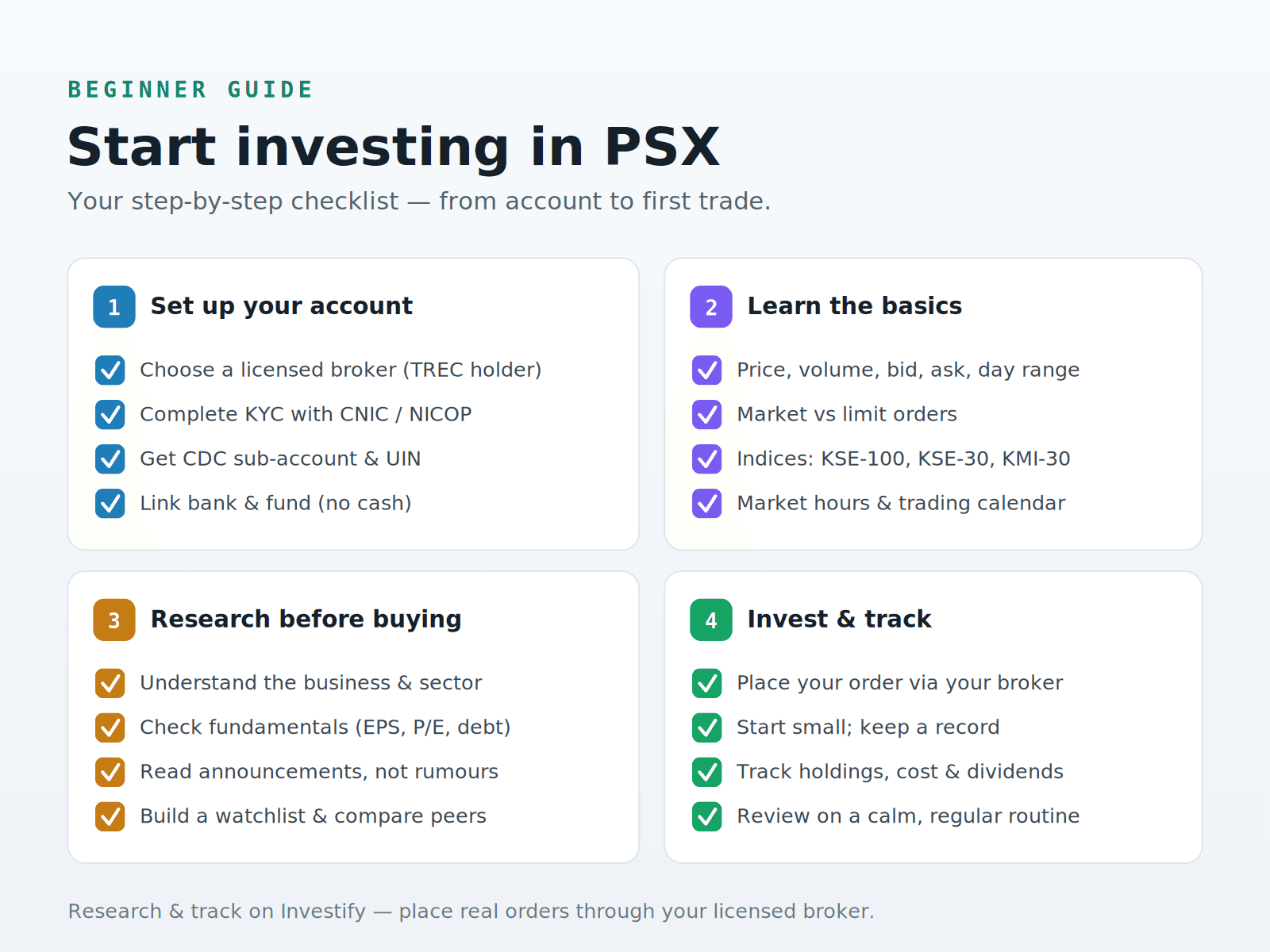
How to Start Investing in the Pakistan Stock Exchange as a Beginner
A complete beginner guide to investing in the Pakistan Stock Exchange: account setup, brokers, PSX concepts, research, risk management, portfolio tracking and daily market routines.
Read guide
What Is the Minimum Amount Needed to Start Investing in PSX?
Understand how much money a beginner may need to start investing in the Pakistan Stock Exchange, including account requirements, share prices, charges and practical starting ranges.
Read guide
Common Mistakes Beginners Make in the Pakistan Stock Exchange
A practical guide to common PSX beginner mistakes, including chasing tips, overtrading, ignoring risk, skipping research and not tracking portfolio decisions.
Read guide