
National Savings (NSS) Profit Calculator
NATIONAL SAVINGS
Pick a certificate, see your profit
Scheme
Swipe for all 10
Monthly. Open to every resident Pakistani adult. 5-year certificate. Encashing in the first year reportedly carries a 2% charge on face value.
Filing your tax return puts you on the list. The tax on the profit is 15% on it and 30% off it.
CERTIFICATE OF PROFIT
Regular Income Certificates
Rs 1,000,000 for 5 years
Rs 8,585
net profit a month
Rs 10,100 before Rs 1,515 tax (15%).
THE NEXT 12 PROFITS, ABOUT
- Nov 2026
- Dec
- Jan 2027
- Feb
- Mar
- Apr
- May
- Jun
- Jul
- Aug
- Sep
- Oct
Rs 8,585 each, every month for 5 years, counted from the day you invest.
Net profit over 5 years
Rs 515,100
Yearly return after tax
10.8%
THE ATL ON THIS PROFIT
Being on the list keeps Rs 1,515 more a month
Withholding on National Savings profit is 15% for people on the Active Taxpayers List and 30% for everyone else.
EVERY SCHEME, THE SAME RS 1,000,000
Best open to everyone: Defence Savings, 10 years
Net yield after tax as a yearly compound rate, so monthly and lump-sum schemes compare fairly. Tap one to see it.
Put Rs 1,000,000 somewhere else
Year by year
| Period | Profit | Tax | Net profit | Net profit so far |
|---|---|---|---|---|
| Year 1 | Rs 121,200 | Rs 18,180 | Rs 103,020 | Rs 103,020 |
| Year 2 | Rs 121,200 | Rs 18,180 | Rs 103,020 | Rs 206,040 |
| Year 3 | Rs 121,200 | Rs 18,180 | Rs 103,020 | Rs 309,060 |
| Year 4 | Rs 121,200 | Rs 18,180 | Rs 103,020 | Rs 412,080 |
| Year 5 | Rs 121,200 | Rs 18,180 | Rs 103,020 | Rs 515,100 |
Rates effective October 21, 2026, as announced by the Central Directorate of National Savings. Tax follows the tax year 2027 withholding rates. Rates change when CDNS revises them, usually every month or two. Profit dates are approximate.
How the National Savings calculator works
National Savings pays profit in four different patterns, and the calculator applies the right one to each scheme. Monthly schemes (Behbood, Pensioners' Benefit, Shuhada, Regular Income, the five-year Sarwa Islamic Term Account and the savings accounts) pay a twelfth of the yearly profit each month. Special Savings Certificates and the three-year Sarwa Islamic Term Account pay every six months. Short Term Savings Certificates and the one-year Sarwa account pay once, at maturity. Defence Savings Certificates are cumulative: nothing is paid until you encash, and CDNS publishes the encashment value for each completed year.
- Monthly
- amount × annual rate ÷ 12
- Half-yearly
- amount × annual rate ÷ 2 (Special Savings: the sixth payment uses the higher last-period rate)
- Short Term
- amount × annual rate × months ÷ 12, paid at maturity
- Defence
- amount × cumulative profit per Rs 100 for the year ÷ 100
- Net profit
- gross profit × (1 − withholding tax rate)
Tax is taken from each payment, so the calculator applies it payment by payment. To compare schemes that pay at different times, it also works out a net yield: the compound annual rate that turns the money you put in into the after-tax payouts plus your principal. It assumes each payout is reinvested at the same rate, which is the like-for-like way to compare a monthly payer with a cumulative certificate.
Monthly profit on Rs 100,000, Rs 500,000 and Rs 1,000,000
People most often search for the monthly profit on a round amount. Here is the gross profit each month for the schemes that pay monthly, at the rates effective October 21, 2026.
| Scheme | Rate | Rs 100,000 | Rs 500,000 | Rs 1,000,000 |
|---|---|---|---|---|
| Behbood, Pensioners' Benefit and Shuhada | 12.96% | Rs 1,080 | Rs 5,400 | Rs 10,800 |
| Regular Income Certificates | 12.12% | Rs 1,010 | Rs 5,050 | Rs 10,100 |
| Sarwa Islamic Term Account, 5 years | 12.12% | Rs 1,010 | Rs 5,050 | Rs 10,100 |
| Sarwa Islamic Savings Account | 11.84% | Rs 987 | Rs 4,933 | Rs 9,867 |
| National Savings Account | 10% | Rs 833 | Rs 4,167 | Rs 8,333 |
After withholding tax, the monthly figure for filers and non-filers differs. Behbood, Pensioners' Benefit and Shuhada are modelled without withholding (no tax is taken at payment), so the filer and non-filer figures are the same there.
| Scheme | Rs 100,000, filer / non-filer | Rs 500,000, filer / non-filer | Rs 1,000,000, filer / non-filer |
|---|---|---|---|
| Behbood, Pensioners' Benefit and Shuhada | Rs 1,080 / Rs 1,080 | Rs 5,400 / Rs 5,400 | Rs 10,800 / Rs 10,800 |
| Regular Income Certificates | Rs 859 / Rs 707 | Rs 4,293 / Rs 3,535 | Rs 8,585 / Rs 7,070 |
| Sarwa Islamic Term Account, 5 years | Rs 859 / Rs 707 | Rs 4,293 / Rs 3,535 | Rs 8,585 / Rs 7,070 |
| Sarwa Islamic Savings Account | Rs 839 / Rs 691 | Rs 4,193 / Rs 3,453 | Rs 8,387 / Rs 6,907 |
| National Savings Account | Rs 708 / Rs 583 | Rs 3,542 / Rs 2,917 | Rs 7,083 / Rs 5,833 |
Current rates and who can invest
The table shows the gross profit on Rs 100,000 for each scheme at its standard term. Rates are announced by the Central Directorate of National Savings and revised every month or two, so check the effective date before you rely on a figure.
| Scheme | Rate | Pays | Profit on Rs 100,000 | Who can invest |
|---|---|---|---|---|
| Behbood Savings Certificates | 12.96% | Monthly | Rs 1,080 a month | Senior citizens, widows and persons with disabilities. CDNS sets the age threshold and documents. |
| Pensioners' Benefit Account | 12.96% | Monthly | Rs 1,080 a month | Retired government employees (pensioners). |
| Shuhada Family Welfare Account | 12.96% | Monthly | Rs 1,080 a month | Families of martyrs (Shuhada). |
| Regular Income Certificates | 12.12% | Monthly | Rs 1,010 a month | Open to every resident Pakistani adult. |
| Special Savings Certificates | 12% | Every 6 months | Rs 6,000 every 6 months, last Rs 6,400 | Open to every resident Pakistani adult. |
| Defence Savings Certificates | 12.16% compound | Cumulative, paid on encashment | Rs 315,000 after 10 years | Open to every resident Pakistani adult. |
| Short Term Savings Certificates | 11.12% to 11.72% | At maturity | Rs 2,780 / Rs 5,750 / Rs 11,720 (3 / 6 / 12 months) | Open to every resident Pakistani adult. |
| National Savings Account | 10% | Monthly (assumed) | Rs 833 a month (assumed) | Open to every resident Pakistani adult. |
| Sarwa Islamic Savings Account | 11.84% | Monthly (expected profit) | Rs 987 a month (assumed) | Open to every resident Pakistani adult. |
| Sarwa Islamic Term Account | 11.84% to 12.12% | Depends on term | Rs 11,840 (1 year), Rs 6,050 per 6 months (3 years), Rs 1,010 a month (5 years) | Open to every resident Pakistani adult. |
Behbood certificates start at Rs 5,000, and Pensioners' Benefit and Shuhada accounts at Rs 10,000. The ceiling for these three schemes is Rs 7,500,000 per holder. Other schemes have their own denominations and limits, so ask your National Savings centre.
Tax on National Savings profit
For tax year 2027, profit on National Savings certificates and accounts carries withholding tax of 15% for filers and 30% for non-filers. For an individual this is a final tax up to Rs 5 million of profit in the year, which means the amount withheld settles the tax on that income.
Behbood, Pensioners' Benefit and Shuhada profit is paid without withholding tax: the Second Schedule of the Income Tax Ordinance (Part IV, clause 36A) switches off the usual deduction at payment. If you declare it in your return, the tax on it is capped at 5% of the profit (Part III, clause 6), and tax at your normal slab rates can come out lower, so 5% is a ceiling, not a flat rate. Under More options the calculator shows the profit taxed at that ceiling. Zakat is separate: it is generally deducted at source at 2.5% on 1 Ramadan from savings certificates and accounts unless you file a declaration, and the three senior schemes are exempt. Use the zakat calculator for your own position, and the income tax calculator to see where this income sits in your return.
A worked example
A filer invests Rs 1,000,000 in Regular Income Certificates at 12.12%. Each month pays Rs 10,100, tax takes Rs 1,515 and Rs 8,585 reaches the account. Over the five-year term that is Rs 515,100 of net profit, and the Rs 1,000,000 comes back at maturity.
| Rs 1,000,000 for a filer | Pays | Net profit per payout | Total net profit | Net yield |
|---|---|---|---|---|
| Behbood (eligible holders, no withholding assumed), 10 years | Monthly | Rs 10,800 | Rs 1,296,000 | 13.76% |
| Regular Income, 5 years | Monthly | Rs 8,585 | Rs 515,100 | 10.8% |
| Special Savings, 3 years | Every 6 months | Rs 51,000 | Rs 309,400 | 10.56% |
| Defence Savings, 10 years | On encashment | Rs 1,827,500 | Rs 1,827,500 | 10.95% |
The best net yield among schemes open to everyone is Defence Savings Certificates, 10 years at 10.95%, and the best among all is Behbood / Pensioners' Benefit / Shuhada at 13.76%, because no withholding tax is taken from it. A cumulative certificate looks modest on a yearly basis but compounds, which is why Defence Savings does well over its full ten years and poorly if you cash it in early.
Before you invest
- Compare after tax and after inflation. A 12.12% certificate gives a filer about 10.8% net. Check it against current price rises with the inflation calculator.
- Look at the alternatives. Treasury bills, PIBs and bank term deposits compete with National Savings, and the deposit calculator compares all three for your amount and period.
- Know the exit terms. Early encashment can carry a charge or a lower profit rate. Regular Income Certificates are reported to charge 2% of face value in the first year.
- Rates change. New investments get the current rate. How a revision affects a certificate you already hold depends on the scheme, so ask your National Savings centre.
- Retirement income. If monthly profit is meant to fund living costs, the SWP calculator and the retirement calculator show how long a sum lasts.
Sources and assumptions
National Savings rates effective October 21, 2026. Withholding tax rates for tax year 2027 (July 1, 2026 to June 30, 2027).
- Central Directorate of National Savings (CDNS): profit rates and scheme rules
- ProPakistani: National Savings announces higher profit rates (October 21, 2026)
- FBR, Income Tax Ordinance 2001 (amended up to June 30, 2026), Second Schedule: Part III clause (6), Part IV clause (36A), Part I clause (103)
- FBR Withholding Tax Rates Card, tax year 2027
- KPMG Taseer Hadi & Co., A Brief of Finance Act 2026
- Net yield: effective annual yield (IRR) of the amount invested, each after-tax payout and the principal returned
National Savings revises its rates every month or two and may change eligibility, limits and payout dates. Check savings.gov.pk before investing, and confirm eligibility with your National Savings centre. Results are estimates for information and planning only, not tax, legal or investment advice. Check your own case with a tax adviser, your broker or the official source before acting.
FAQ
National Savings (NSS) Profit Calculator: common questions
How much profit will I get on Rs 1 million in National Savings every month?+
At the rates effective October 21, 2026, Rs 1,000,000 in Behbood Savings Certificates, Pensioners' Benefit or Shuhada accounts pays Rs 10,800 a month. No withholding tax is taken from these schemes (Second Schedule, Part IV, clause 36A of the Income Tax Ordinance), so that is shown as the net figure too. In Regular Income Certificates it pays Rs 10,100 a month before tax, which is Rs 8,585 after 15% withholding tax for a filer and Rs 7,070 after 30% for a non-filer.
Which National Savings scheme gives the highest profit?+
Behbood, Pensioners' Benefit and Shuhada accounts pay the highest headline rate (12.96%) and carry no withholding tax at payment, but only eligible people can open them: senior citizens, widows and persons with disabilities for Behbood, retired government employees for Pensioners' Benefit, and families of martyrs for Shuhada. For everyone else, Defence Savings Certificates, 10 years gives the best net yield in this calculator (10.95% a year after tax for a filer).
Is National Savings profit taxable in Pakistan?+
Yes for most schemes. CDNS deducts withholding tax from the profit at 15% for filers and 30% for non-filers (Active Taxpayers List status decides). Behbood, Pensioners' Benefit and Shuhada profit is paid without withholding. If you declare it in your return, the tax on it is capped at 5% of the profit. Individuals' tax on profit on debt is final up to Rs 5 million of profit a year. Zakat is a separate deduction, usually 2.5% on 1 Ramadan, unless you file a declaration.
How is the profit on Defence Savings Certificates calculated?+
Defence Savings Certificates pay nothing until you encash. Instead, National Savings publishes a table of cumulative profit per Rs 100 for each completed year, from 10% after year 1 to 215% after year 10. Rs 100,000 becomes Rs 315,000 after 10 years before tax, which is about 12.16% a year compounded. The calculator applies withholding tax to the profit on encashment, so a filer receives Rs 2,827,500 on Rs 1,000,000.
How do Special Savings Certificates pay profit?+
Special Savings Certificates run for three years and pay profit every six months. At the current rates each of the first five payments is Rs 6,000 per Rs 100,000 (12% a year), and the sixth and last payment is Rs 6,400 per Rs 100,000 (12.8% a year).
What are the Short Term Savings Certificate rates?+
Short Term Savings Certificates run for 3, 6 or 12 months and pay the whole profit at maturity: 11.12% for 3 months (Rs 2,780 per Rs 100,000), 11.5% for 6 months (Rs 5,750) and 11.72% for 12 months (Rs 11,720), before withholding tax.
Can anyone invest in Behbood Savings Certificates?+
No. Behbood Savings Certificates are for senior citizens, widows and persons with disabilities. Pensioners' Benefit Accounts are for retired government employees, and Shuhada Family Welfare Accounts are for families of martyrs. Documents and the exact age threshold are set by the Central Directorate of National Savings, so confirm them at your nearest National Savings centre or bank branch.
Are National Savings certificates safe?+
National Savings schemes are issued by the Government of Pakistan, so the principal and profit carry the government's backing, the same sovereign risk as treasury bills and PIBs. The main risks are inflation (profit may not keep up with prices), changes to the rate or tax rules for future investments, and early encashment charges on some schemes.
Keep going
Related tools
PSX guides
Learn the ideas behind the numbers

How to Start Investing in the Pakistan Stock Exchange as a Beginner
A complete beginner guide to investing in the Pakistan Stock Exchange: account setup, brokers, PSX concepts, research, risk management, portfolio tracking and daily market routines.
Read guide
What Is the Minimum Amount Needed to Start Investing in PSX?
Understand how much money a beginner may need to start investing in the Pakistan Stock Exchange, including account requirements, share prices, charges and practical starting ranges.
Read guide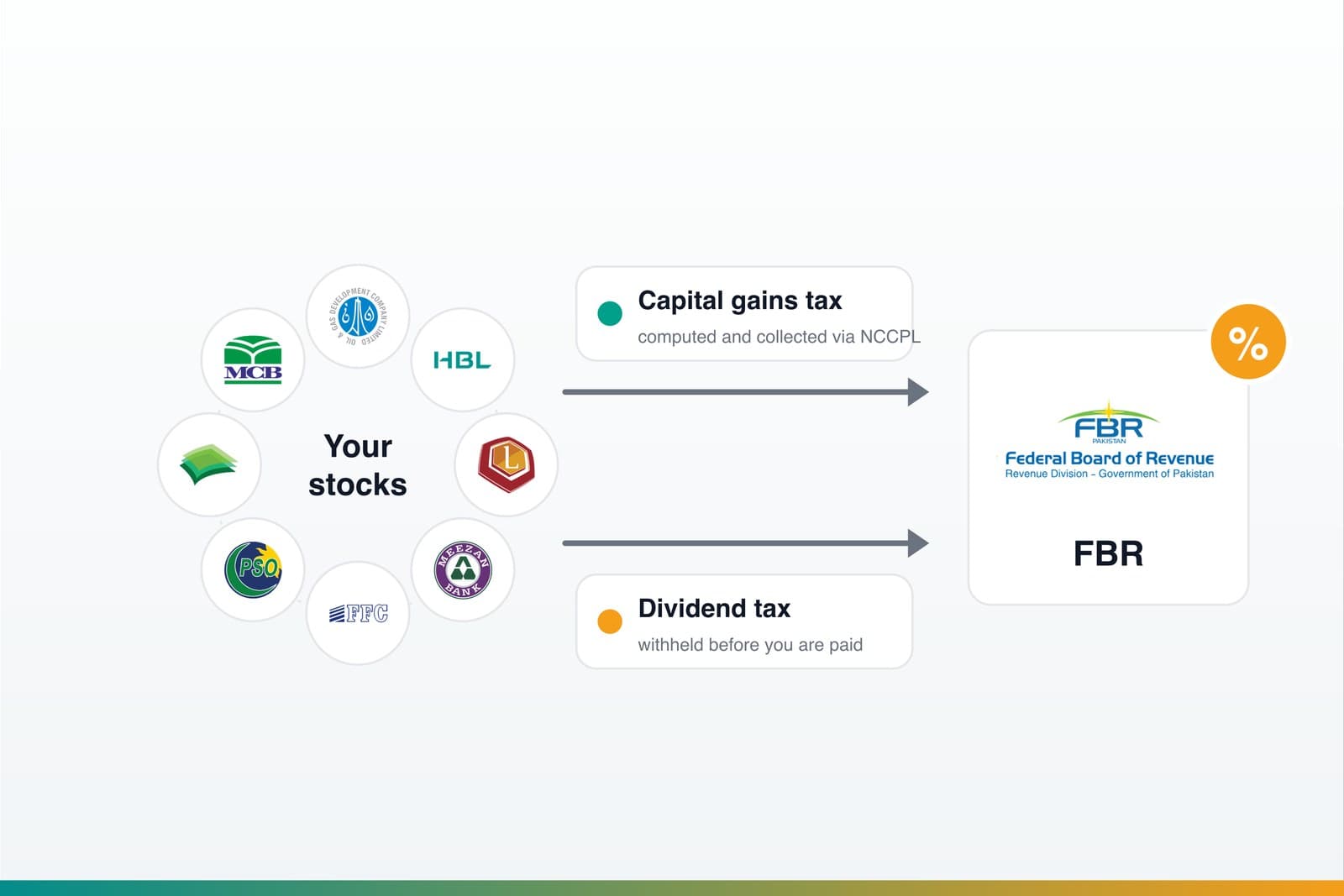
Capital Gains Tax & Dividend Tax on PSX Stocks (Pakistan)
A plain-English guide to how capital gains tax (CGT) and dividend tax work on Pakistan Stock Exchange shares - filer vs non-filer rates, how holding period and acquisition date matter, how NCCPL collects CGT, and what you still have to declare.
Read guide