
Dividend Reinvestment (DRIP) Calculator
THE SNOWBALL
Reinvest every dividend and watch it roll
Loading live data for MEBL. Example figures show until it arrives.
Starting yield 6.25% (Rs 25.00 on Rs 400.00). Is it safe? See the payout and cover.
IN 15 YEARS, REINVESTING
Rs 4,036,808
Keeping the dividends as cash ends at Rs 2,809,852. Reinvesting adds Rs 1,226,956.
Rs 500,000
you put in
14.9% a year
your money grew
Before any capital gains tax on selling.
THE INCOME SNOWBALL
In year 15, dividends pay Rs 12,271 a month
Reinvesting, dividends a year after taxKeeping the cash
That is 29.5% a year on the money you put in: more shares and a growing dividend make the snowball.
ADD EVERY MONTH
Feed the snowball as well
WHAT TAX AND COSTS TAKE
Rs 193,099 over 15 years
Rs 193,099
tax withheld at 15% (filer)
Rs 0
brokerage: add it under More options
Being on the Active Taxpayers List keeps the tax at the lower rate. Dividends are reinvested after the tax is withheld.
- Reinvest dividends
- Keep dividends as cash
Dividends are reinvested at the payout month's price after the final tax is withheld; kept cash earns nothing here. Values are before capital gains tax on selling: see the capital gains tax calculator. Prices and dividends are not guaranteed.
How the DRIP calculator works
The calculator steps through every month. The share price grows smoothly at your yearly rate. The dividend per share is fixed for each year and grows once a year. In each payout month (for example every third month if the company pays quarterly) it pays dividends on the shares you hold, takes off the withholding tax, and uses what is left to buy more shares at that month's price. Extra monthly investments, if any, are bought at the start of each month.
- Shares
- shares held just before the payout
- DPS
- dividend per share for that payout, Rs
- Tax
- final withholding tax rate on the dividend
- Price
- share price in the payout month
The second line of every chart shows the same plan with the dividends kept as cash that earns nothing. The gap between the two is the value of reinvesting, nothing else. Everything starts from your pick of stock, so the starting dividend and price come from live data and stay editable.
A worked example
Invest Rs 500,000 in a share at Rs 400 that pays Rs 25 a year (a 6.25% yield), quarterly, for 15 years. Dividend growth and price growth are the two assumptions that move the answer most:
| Case | Reinvested | Kept as cash | Reinvesting adds | Net income in year 15 |
|---|---|---|---|---|
| Dividend +8%, price +10%, filer | Rs 4,036,808 | Rs 2,809,852 | Rs 1,226,956 | Rs 147,254 |
| Same, non-filer (30% tax) | Rs 3,595,552 | Rs 2,682,577 | Rs 912,975 | Rs 108,463 |
| Flat dividend, flat price, filer | Rs 1,103,495 | Rs 898,438 | Rs 205,058 | Rs 56,727 |
The flat case isolates the effect of reinvesting alone: with no price or dividend growth, every dividend buys more shares at the same price and the holding still grows from 1,250 to about 2,759 shares. The tax rate matters too: moving from filer to non-filer cuts the final value by Rs 441,256.
Reinvesting on the PSX in practice
- No automatic plan. Listed companies pay dividends in cash to the bank account linked to your CDC account. To reinvest you place a buy order yourself. Some mutual funds can reinvest payouts automatically.
- Whole shares only. A Rs 3,000 dividend cannot buy a Rs 4,000 share, so the cash waits. The whole shares option under More options carries leftovers forward the way your account would.
- Costs. Each purchase pays brokerage, sales tax on brokerage and exchange charges, about 0.18% in total at a typical broker (see brokerage calculator). With whole shares and these costs, the example ends at Rs 4,022,142 instead of Rs 4,036,808. Reinvesting a few payouts together keeps the percentage down.
- Tax first. You can only reinvest what is left after the final tax, so a lower-tax payer type (see the dividend tax calculator) compounds faster.
Choosing your assumptions
- Starting yield. It comes from live data: the latest annual dividend over today's price. The dividend yield calculator shows the payout ratio and cover behind it.
- Dividend growth. A dividend can only keep growing if earnings do. Look at the payout history and the earnings trend on the company page, and treat a company paying out nearly all its profit as a weak candidate for growth. Zero is the cautious setting.
- Price growth. The calculator applies one steady rate. Real prices move in cycles, and a long flat or falling stretch makes reinvesting buy more shares at lower prices, while a long rise does the opposite.
- The alternative. The base case compounds at about 14.94% a year, before any capital gains tax on selling. A 12-month T-bill gave 12.89% at the October 28, 2026 auction, about 10.96% after a filer's tax, and is fixed if held to maturity, while the stock's path is not. Set your assumptions with that comparison in mind, and see the T-bill calculator.
Assumptions that change the answer
A starting yield and a growing dividend produce a powerful chart, and the chart is only as honest as its inputs. Dividends are cut when profits fall or a company retains cash for growth. Share prices can go sideways or down for years while dividends keep coming, which makes reinvestment buy more shares cheaply, or can fall because the business is struggling. Use a flat dividend as the baseline, compare with a cautious price growth near long-run inflation (see the inflation calculator), and test the starting yield against the stock's payout history with the dividend yield calculator. To estimate the income itself, use the dividend income calculator. For regular contributions without the dividend element, try the SIP calculator. The final value is also before capital gains tax: a profit made when you sell shares is taxed under section 37A, so use the capital gains tax calculator to see what you would keep.
Sources and assumptions
Withholding rates checked October 31, 2026 against the FBR rate card for tax year 2027.
- FBR Withholding Tax Rates Card, tax year 2027
- PSX Schedule of Charges
- Method: month-by-month simulation, dividends paid in the payout months and reinvested at that month's price, tax withheld first
Results are estimates for information and planning only, not tax, legal or investment advice. Check your own case with a tax adviser, your broker or the official source before acting.
FAQ
Dividend Reinvestment (DRIP) Calculator: common questions
What is dividend reinvestment (DRIP)?+
DRIP means using each dividend you receive to buy more shares of the same company instead of spending it. The extra shares earn their own dividends in the next payout, so the income compounds. On the PSX there is no automatic plan for ordinary shares: the dividend arrives in your bank account and you place a buy order through your broker.
How much more do I end up with by reinvesting dividends?+
It depends on the yield, the growth and the time. Starting with Rs 500,000 in a 6.25% yielder, with 8% yearly dividend growth, 10% price growth and 15% tax, 15 years of reinvesting gives Rs 4,036,808, against Rs 2,809,852 if every dividend is spent or kept as cash.
Does the DRIP result include capital gains tax?+
No. The value is what the shares and any cash held would be worth before tax on selling. Dividend tax is already taken off every payout, but a profit made when you sell is taxed separately under section 37A, and in a long growth example most of the value is unrealised price gain. Work out that tax with the capital gains tax calculator before comparing the result with an after-tax return such as a T-bill.
Is the dividend tax taken before I reinvest?+
Yes. The company deducts the final tax when it pays, so only the net amount can be reinvested. For tax year 2027 that is 15% for a filer in an ordinary listed company and 30% for a non-filer. The calculator reinvests the net amount at each payout.
Can I buy fractions of a share on the PSX?+
No. Shares trade in whole numbers, so a small dividend may not buy a full share and the leftover cash waits until the next payout. Switch on whole shares only under More options to model this. Reinvesting several payouts together also saves on brokerage.
Do brokerage charges matter when reinvesting?+
Yes, each reinvestment is a purchase. A typical PSX purchase costs about 0.18% in brokerage, tax on brokerage and exchange charges, and some brokers have minimum fees that weigh more on small amounts. In the example with whole shares and those costs, 15 years end at Rs 4,022,142 instead of Rs 4,036,808.
What dividend growth and price growth should I assume?+
Use cautious figures. Dividends depend on company profits and policy, and prices can fall for years. A flat dividend (0%) is a safe baseline, and a price growth near long-run inflation is more cautious than a recent strong year. Run a few cases and plan around the middle one.
Should I reinvest in the same stock?+
Not necessarily. The calculator reinvests in the same stock to show the compounding effect. In practice you may prefer to spread dividends across several companies or a fund, to avoid putting more and more of your money into a single share.
Keep going
Related tools
Dividend Income Calculator
Dividend income from your PSX shares after withholding tax, per payout and per year.
Dividend Yield Calculator
Dividend yield and yield on cost for any PSX stock, from the latest annual payout.
SIP Calculator
What a fixed monthly investment in PSX stocks or mutual funds can grow to, with yearly step-up.
PSX guides
Learn the ideas behind the numbers
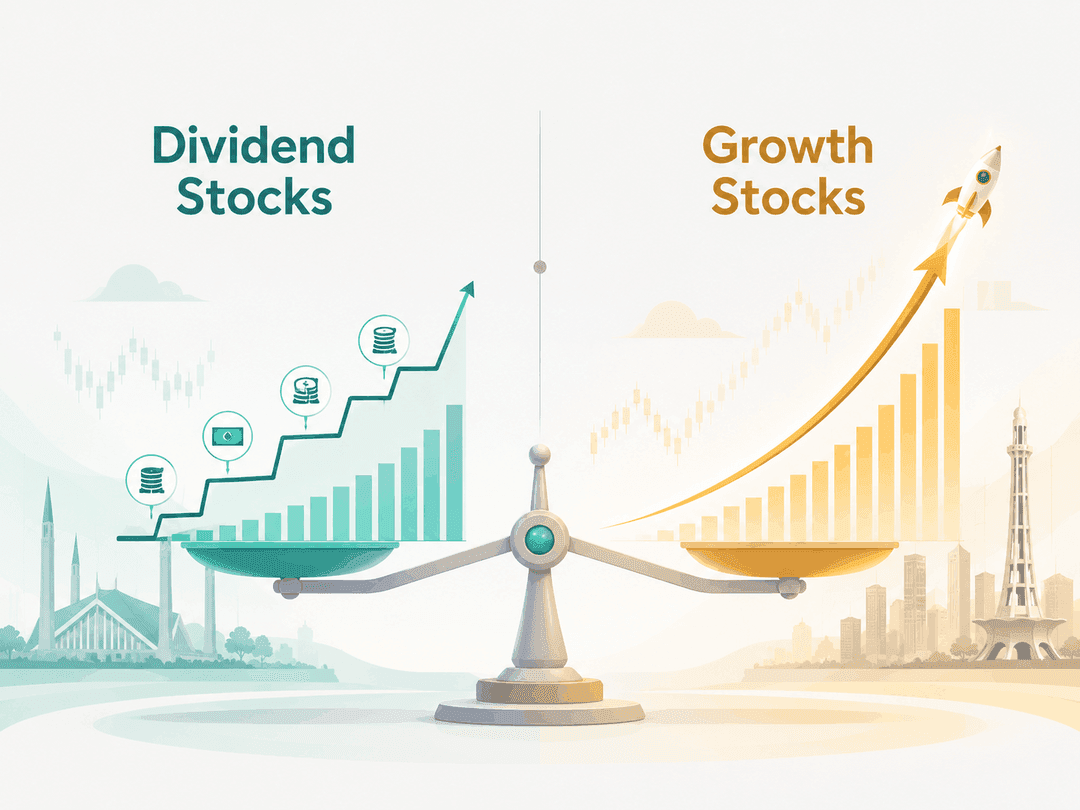
Dividend Stocks vs Growth Stocks on PSX
A beginner-friendly PSX guide comparing dividend stocks and growth stocks, including risks, investor fit, sectors, interest rates and market cycles.
Read guide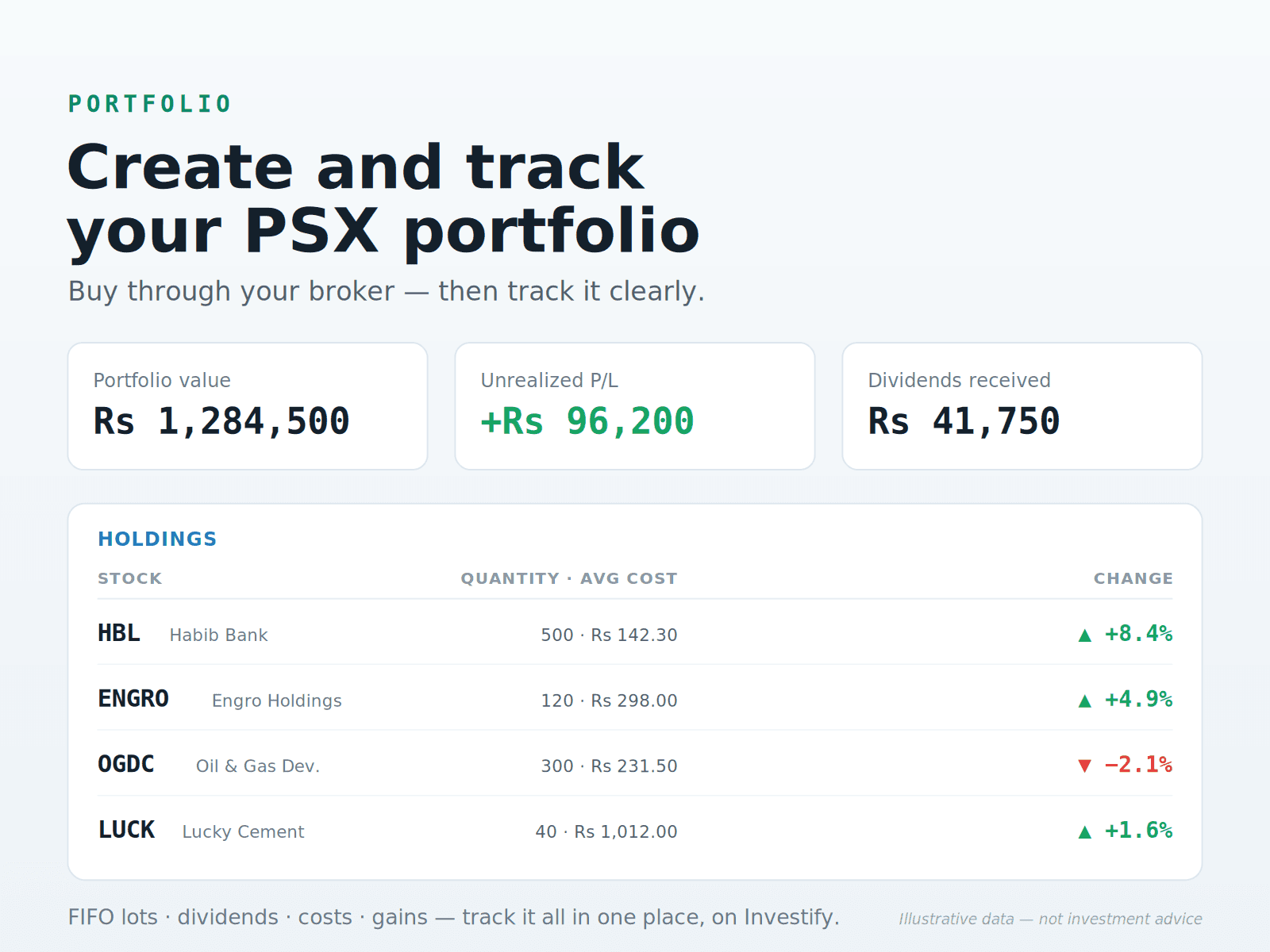
How to Create and Track a PSX Stock Portfolio
Learn how to create a PSX stock portfolio through a licensed broker and track it with FIFO, dividends, costs and corporate actions.
Read guide
PSX Trading Fees & Charges: What a Trade Actually Costs in Pakistan
Every fee on a PSX trade explained - brokerage commission structures, sales tax on commission, CDC and NCCPL charges, regulatory levies and taxes - with a worked example of a full Rs 100,000 buy-and-sell round trip.
Read guide