

Most "best trading app" articles rank a list of apps by star rating. For a first-time Pakistani investor, that is the wrong question. Every real PSX trading app is the front end of a licensed broker, so you are choosing a broker first and an app second. And for a beginner with a small amount, the details that matter are unglamorous: how much you must deposit, how much commission a Rs 10,000 order really costs, and whether you can practise before risking a rupee.
This guide is deliberately different from our full app roundup, Best PSX Apps in Pakistan, which compares tracking apps against trading apps. Here we focus on a beginner's checklist, the new Sahulat account, a worked example of small-order costs, and virtual-trading options for people who want to start without investing. Facts about each firm come from its own website as of October 2026. We list who a platform may suit, not which is best, because that depends on you.
Key takeaways
- A trading app is only as legitimate as the broker behind it. Check the firm on SECP's list of registered brokers before depositing anything.
- A Sahulat Account is built for first-timers. Minimal paperwork, a Rs 3 million per-account limit (raised from Rs 1 million in March 2026), and leveraged products are restricted. SECP says all licensed securities brokers offer it.
- Small orders cost proportionally more. A per-share commission floor of 3 paisa can turn into 0.6% or more per side on a low-priced share.
- You can practise for free. PSX's own My Portfolio tool, and demo accounts at brokers such as KTrade and Foundation Securities, use virtual money.
- Investify is a tracking app, not a broker. It cannot take deposits or place orders, so it sits alongside a broker app rather than replacing one.
The two kinds of "trading app"
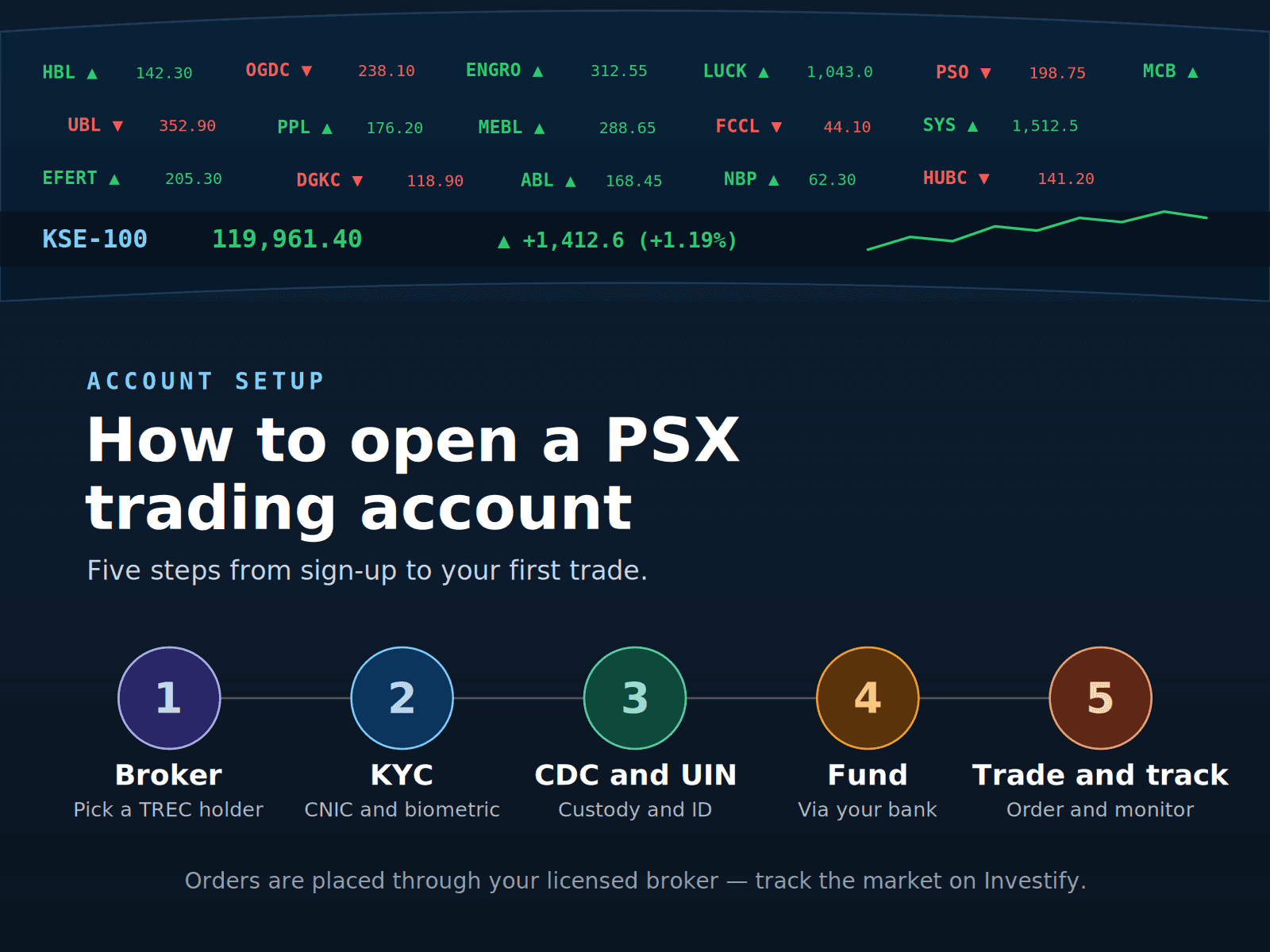
A broker app belongs to a PSX trading-right-entitlement-certificate (TREC) holder licensed by SECP. It opens your account, takes your money, sends orders to the exchange and keeps records. A tracking or analysis app shows prices, charts, news and your portfolio, but never touches your money or shares. When someone searches for the "best trading app in Pakistan," they are usually looking for the first kind. But the second kind is where most beginners should start learning.
For a deeper comparison of both categories, see our app roundup and the broker selection guide.
A beginner's checklist
| Question | Why it matters | What to look for |
|---|---|---|
| Is the broker registered? | Your money and shares are only protected by the regulatory framework if the firm is licensed | The firm appears on the SECP list of registered brokers; the app names its licensed company |
| What is the minimum to start? | Sets your entry cost | A published figure, not a vague "low" |
| How fast and digital is account opening? | Paperwork is the main barrier for beginners | Online onboarding; SECP's framework targets one working day for Sehl/Sahulat accounts and two for normal accounts |
| What does commission look like on a small order? | Percentage or per-share floors hit small trades hardest | The written tariff, including any floor or minimum |
| Is there a Shariah option? | Some beginners want to avoid conventional leverage or non-compliant stocks | A Shariah-compliant stock option, ideally without leverage |
| Can you practise first? | Learning with virtual money is free | A demo or virtual mode |
| How do deposits and withdrawals work? | Slow withdrawals are the commonest complaint | Same-day bank transfer options; ask how long withdrawals take |
The Sahulat Account, explained
In March 2026 SECP raised the investment limit for Sahulat Accounts from Rs 1 million to Rs 3 million, aligned with banking-sector limits. As reported, the account is meant for low-risk retail investors and first-time participants, requires only a CNIC at brokers that describe the process, and can be opened online. Brokers use simplified due diligence for low-risk applicants. You can hold Sahulat accounts with several brokers, but only one per broker.
Foundation Securities' description of its own Sahulat product shows what that looks like in practice:
- Starting amount: Rs 5,000.
- Documents: a valid CNIC, a bank account and a registered mobile number.
- Limit: purchase positions up to Rs 3,000,000 per brokerage account; you may sell securities up to their full value.
- What you can trade: the regular delivery (ready) market. Trading in leveraged products such as margin trading, margin financing, stock lending and borrowing, and the negotiated deals market is restricted.
- Flexibility: the account can be converted to a normal trading account at any time.
In August 2026 SECP also issued Circular No. 19 of 2026, a unified digital onboarding framework. As reported, Sehl/Sahulat accounts are to be processed within one working day and normal accounts within two working days, with tracking IDs for applicants and written reasons for rejections. Individual brokers still describe their own timelines: KTrade and Finqalab both say activation takes two to three working days after documents are submitted, so ask what to expect when you apply.
What a small order really costs
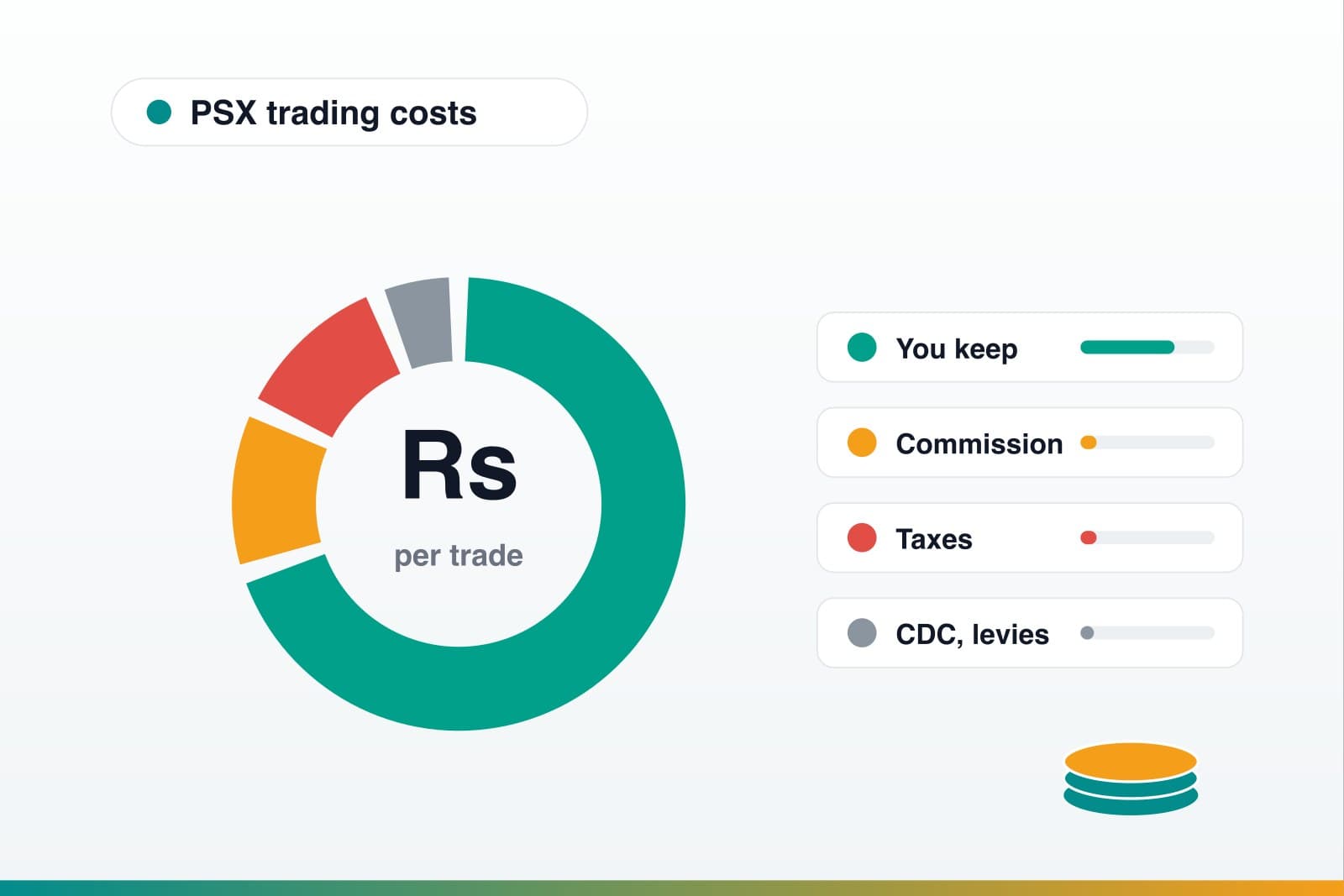
Commission is the number that surprises beginners. Many brokers charge "a per-share rate or a percentage, whichever is higher." That floor is invisible on a large order and obvious on a small one.
Two published structures show the pattern:
- KTrade Classic plan: Rs 0.03 per share for shares priced at Rs 20 or below, 0.15% of traded value for shares above Rs 20.
- Foundation Securities Edge Value: 3 paisa per share below Rs 2; 3 paisa or 0.15% of value, whichever is higher, from Rs 2 upward. (The firm's FAQ is undated, so confirm current rates.)
Provincial sales tax is then charged on the commission itself (roughly 13% to 16% depending on province; this example uses 15%), as explained in our trading fees guide. Here is what that means for four small orders using the "3 paisa or 0.15%, whichever is higher" rule:
| Order | Shares | Commission | Commission plus 15% sales tax | Cost per side | Round trip |
|---|---|---|---|---|---|
| Rs 5,000 in a Rs 100 share | 50 | Rs 7.50 (0.15%) | Rs 8.63 | 0.17% | about 0.35% |
| Rs 10,000 in a Rs 200 share | 50 | Rs 15.00 (0.15%) | Rs 17.25 | 0.17% | about 0.35% |
| Rs 10,000 in a Rs 10 share | 1,000 | Rs 30.00 (3 paisa floor) | Rs 34.50 | 0.35% | about 0.69% |
| Rs 5,000 in a Rs 5 share | 1,000 | Rs 30.00 (3 paisa floor) | Rs 34.50 | 0.69% | about 1.38% |
The lesson is not that low-priced shares are bad. It is that a per-share floor penalises small rupee amounts spread over many cheap shares, and that every round trip pays the cost twice. Add any one-off charges: Finqalab's FAQ, for example, mentions a one-time NCCPL fee of Rs 476 charged once you deposit funds. Ask each broker for its complete written tariff, whether it applies a flat minimum per order (none was shown on the KTrade or Foundation pages we checked), and whether the plan you are quoted is the one the app actually puts you on.
Broker apps and what each says about itself
The table below sticks to what the firms publish on their own sites. It is not a ranking and does not cover every licensed broker. Details change, so treat it as a starting point.
| Broker (app) | Licence and status | Starting amount | Account opening | Commission as published | Practice mode |
|---|---|---|---|---|---|
| KTrade (KTrade Securities Limited, KASB | KTrade) | PSX broker; claims 200,000+ investors | No minimum stated on the pages checked | Online form, "no branch visits"; documents: ID (CNIC, SNIC, NICOP, ARC, POC or passport), income proof, address proof, occupation proof; activation "within 2-3 business days" | Classic: Rs 0.03/share at or below Rs 20, 0.15% above Rs 20. Premier plans have different rates | Virtual trading with Rs 1 million demo money; Shariah stock trading on real accounts |
| Finqalab (app of Next Capital Limited) | Brokerage services by Next Capital, TREC licence #048, regulated by SECP, listed on PSX | "As low as Rs 5,000" per its Stocks page | Opened inside the app, no visits; review "generally 2-3 working days" | Not shown on the pages checked; ask for tariff | Not stated |
| Foundation Securities (Edge app) | Foundation Securities (Pvt.) Limited, PSX broker | Sahulat: Rs 5,000. Edge Value: Rs 25,000. Edge Prime: Rs 300,000 | Digital account and shared-KYC options offered; Sahulat needs CNIC, bank account, mobile | Edge Value: 3 paisa or 0.15%, whichever is higher; Edge Prime: 5 paisa or 0.17% | Demo account with Rs 1,000,000 virtual funds; a Shariah Edge product |
| AKD Securities (AKD Trade) | AKD Securities Limited; says it has operated online since 2002 and has 110,000+ online accounts | Minimum balance of Rs 1,000 to keep an account active | Account opening forms on its site; check whether full online onboarding is available | Separate commission-structure document on its site | Not stated |
A few reading notes. Finqalab is a technology front end; the licensed broker and the entity holding your account is Next Capital Limited, and your shares sit in a CDC sub-account maintained by it. Foundation describes its Edge account as 100% cash based with no margin facility. KTrade, Foundation and AKD publish different tariffs for different customer tiers, so the headline rate you see in an advert may not be the one on your account.
Who each might suit
These are matches, not endorsements:
- You want to try everything before depositing: KTrade and Foundation Securities both advertise Rs 1 million of demo money, and PSX's own My Portfolio needs no broker at all.
- You want the smallest published starting amount: Finqalab's Rs 5,000 and Foundation's Rs 5,000 Sahulat account are the lowest figures on the pages we checked. Ask other brokers for their Sahulat terms, because SECP expects licensed brokers to offer one.
- You prefer a Shariah-compliant product: KTrade says real accounts can trade Shariah stocks, and Foundation offers a Shariah Edge product limited to KMI All Shares index stocks, with no leverage.
- You expect to trade often: read each tariff for volume tiers and check how the platform behaves in busy sessions. Frequent trading magnifies the cost of every fee.
- You already have an account at a bank or broker that you trust: compare its Sahulat terms before opening something new.
Practising without investing
If "without investment" means you do not want to put in money yet, you have more free options than most people realise:
| Option | What it is | Cost | Good for |
|---|---|---|---|
| PSX My Portfolio | PSX's web-based virtual trading tool inside its data portal. You choose a virtual cash amount, "make a trade" with prices typed in or fetched, and enter a brokerage fee yourself | Free | Independent practice, tracking return and holdings by sector, multiple portfolios |
| KTrade virtual trading | Demo trading with Rs 1 million | Free signup | Learning an actual broker's app flow |
| Foundation Edge demo account | Real-time simulated market with Rs 1,000,000 | Free | Practising orders, portfolio tracking and research tools in the Edge app |
| Investify demo account and portfolio tracker | A free demo account to practise, plus a tracker for recording real or practice trades, with live prices and stock pages | Free | Learning to read quotes and track a portfolio without a broker |
Treat practice honestly. Virtual money teaches mechanics: how orders are placed, what a limit order does, how average cost moves. It does not teach how it feels to watch real savings fall, so scale up slowly once you trade for real. Our guide to your first portfolio and minimum amount guide cover sizing.
Where Investify fits
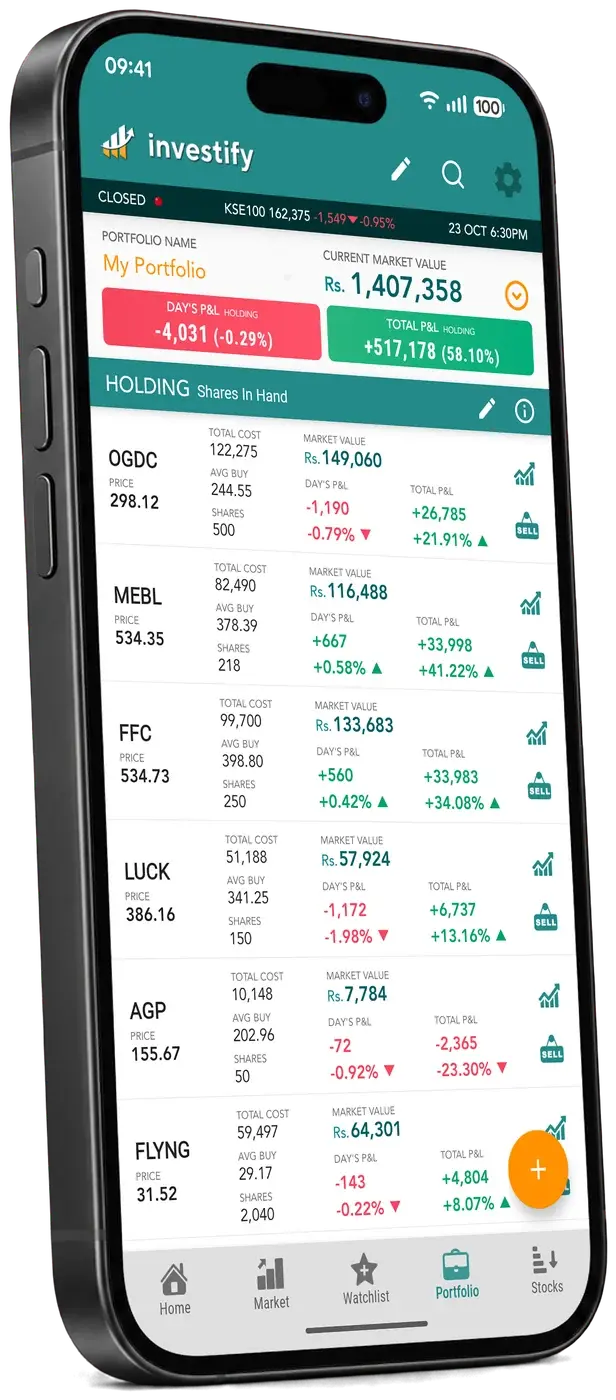
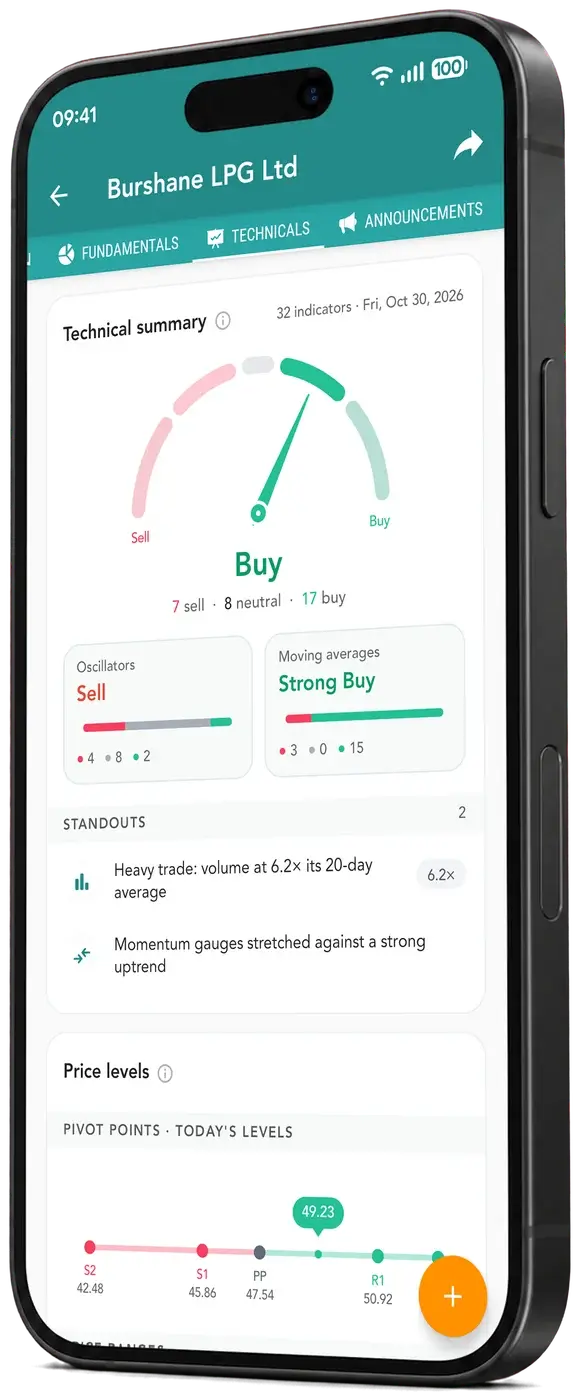
Investify is a free PSX market-data and portfolio-tracking app for web, Android and iOS. It shows live prices, stock pages, indices, the PSX Fear & Greed index, news, announcements and a portfolio tracker. It is not a broker: it cannot open an account, accept a deposit or place an order. Think of it as the dashboard next to the cash register.
Use Investify for your daily PSX workflow
Open market data, stock pages, charts, news, announcements, watchlists and portfolio tracking from one Investify account.
See how Investify works alongside your broker appBefore you deposit: a five-minute checklist
- Confirm the broker on the SECP list.
- Ask for the full written tariff, including any minimum per order, and the one-time and annual charges.
- Ask whether a Sahulat account is available and what it restricts.
- Practise with virtual money until you can place a limit order without hesitating.
- Start with an amount you could lose without it changing your month. Beginner mistakes are covered in our common mistakes guide.
Educational note
This article is for general education only. It is not investment advice and does not recommend any broker, app or security. Information about each firm comes from its own website as of October 2026 and may be out of date; commission rates, minimums, tiers and features change often. Sales tax rates differ by province, and the cost examples are illustrations. Verify any broker's licence, tariff and terms directly with the firm, SECP and PSX before depositing money. Investify is published by the operators of this blog and is a market-data and portfolio-tracking app, not a broker.
The bottom line
For a beginner, the best trading app is the one that sits on top of a licensed broker you have verified, lets you start with an amount you are comfortable with, charges a commission that does not eat small orders, and lets you practise first. The Sahulat Account makes the first step easier and safer, and virtual accounts from PSX and several brokers make practice free. Compare two or three brokers on their written tariffs, open one account, and use a tracking app such as Investify to learn the market without spending a rupee.
Related reading
Sources and references
- KTrade (KASB) - Invest in Stock Market
- Finqalab - FAQs
- Finqalab - Stocks
- Foundation Securities - Online Trading
- Foundation Securities - FAQs
- AKD Securities - Equities
- PSX Knowledge Center - My Portfolio
- Nukta - SECP eases stock market access for small investors
- ARY News - SECP one-day opening facility for Sehl/Sahulat accounts
- SECP - List of Registered Brokers of PSX