

If you invest on the Pakistan Stock Exchange, one question matters more than almost any stock pick when it comes to what you actually keep: are you a filer or a non-filer? The label decides how much is withheld from your dividends, which capital gains tax rate applies when you sell, and how much extra you pay on things like bank profit.
This guide explains what the term means, how to check your status in a minute, how the rates differ for shares, dividends and capital gains, and what a Rs 500,000 portfolio looks like under each status. The figures reflect tax year 2027 (1 July 2026 to 30 June 2027) as understood in October 2026. Rates are reset every June in the federal budget, so treat every number here as something to confirm, not something to copy blindly. For the full mechanics of the two share taxes themselves, read our companion guide on capital gains tax and dividend tax on PSX stocks.
Key takeaways
- Filer means "on the Active Taxpayers List (ATL)". It is a status you get by filing your income tax return, not just by registering for an NTN.
- Dividends: ordinary dividends are withheld at about 15% for filers and 30% for non-filers.
- Capital gains: the 15% rate on shares acquired on or after 1 July 2024 requires you to be on the ATL on both the purchase date and the sale date. Non-filer treatment is where sources disagree, so verify it on your NCCPL statement.
- The cost of staying a non-filer compounds. It also touches bank profit, cash withdrawals and large purchases, not just shares.
- You can check your status in seconds with an SMS to 9966.
- Investify is a market-data and portfolio app, not a broker or tax adviser. It helps you see holdings and dividends; the official records are your broker, CDC, NCCPL and FBR.
What "filer" actually means: the Active Taxpayers List
FBR publishes the Active Taxpayers List (ATL), a list of people and entities who have filed their income tax return and are therefore treated as active taxpayers. In everyday speech, "filer" means you are on that list and "non-filer" means you are not. PwC's tax summary uses the same idea, referring to "Active Taxpayer List" and "inactive taxpayer" rather than filer and non-filer.
Two things trip people up:
- Registering is not filing. Getting an NTN on FBR's IRIS portal creates your tax identity. You only land on the ATL after you file a return for the relevant tax year and FBR updates the list.
- Status can change. If you were a filer last year but missed this year's return, you can drop off the list, and the withholding on your next dividend can double.
How to check your ATL status
FBR lists three ways to check, and they all take under a minute:
- SMS: send
ATL, a space, then your 13-digit CNIC to 9966. Companies and associations of persons use their 7-digit NTN instead of a CNIC. - Online: use the ATL status service linked from FBR's "Check Active Taxpayer status" page.
- Download: FBR also lets you download the full list.
Check before you sell shares or when a large dividend is due. Because the 15% capital gains rate on newer shares depends on your status on both the day you bought and the day you sell, a lapse at either end can cost you.
Filer vs non-filer at a glance
| Filer (on the ATL) | Non-filer (not on the ATL) | |
|---|---|---|
| Ordinary dividends (TY2027) | About 15% withheld | About 30% withheld |
| Dividends from IPPs | 7.5% | 15% |
| Dividends from companies paying no tax (exemption, losses, credits) | 25% | 50% |
| CGT on shares bought on or after 1 July 2024 | 15%, if on the ATL on both purchase and sale dates | Ordinary slab rates for individuals with a 15% floor per FBR's text; sources differ on the exact figure |
| Bank profit (individuals, up to Rs 5 million) | 15% | 30% |
| Cash withdrawals above Rs 50,000 a day | 0% | 0.8% advance tax |
| High-value transactions | Normal | Restrictions apply under the "ineligible person" rules |
The dividend rows come from FBR's TY2027 rate card as reported by Pkrevenue. The bank profit and cash withdrawal rows come from a third-party summary of the same rate card, so confirm them on FBR's own card before relying on them.
Capital gains tax: filer vs non-filer
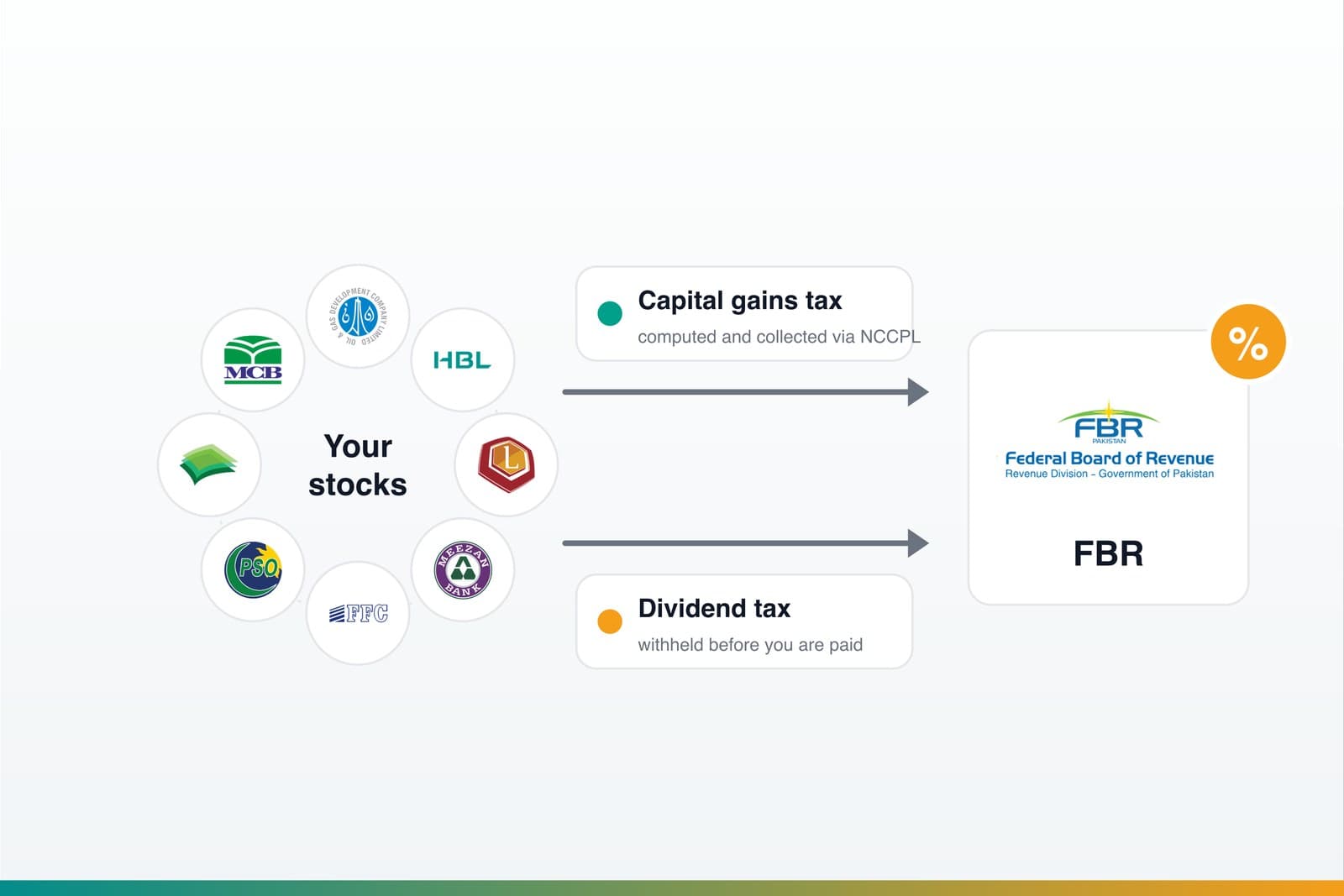
Capital gains tax (CGT) under Section 37A is computed by NCCPL and collected through the settlement system when you sell. It is not something you work out trade by trade. Our CGT and dividend tax guide covers the acquisition-date tiers in detail, so here is the filer vs non-filer angle only.
For filers, FBR's tax year 2027 text gives a flat 15% on securities acquired on or after 1 July 2024, provided you are on the ATL on both the acquisition date and the disposal date. Older holdings keep their own treatment: shares bought between 1 July 2013 and 30 June 2022 sit at 12.5%, shares bought between 1 July 2022 and 30 June 2024 follow a holding-period scale from 15% down to 0% after six years, and shares bought before 1 July 2013 are exempt.
For non-filers, FBR's text sends individuals to the ordinary rate schedule (Division I of the First Schedule), with the rule that the tax "cannot be less than 15%". PwC's summary says the same: personal income tax rates apply, with a floor of 15%. Beyond that floor the picture is less settled:
- NCCPL's notice for FY2026, reported by Profit, said a flat 15% applied to securities acquired from 1 July 2025 onward, regardless of ATL status.
- The Finance Bill 2026 proposed removing the provision that kept section 37A tax out of the ordinary rate schedule for non-filers. Pkrevenue described this as effectively doubling the tax for people not on the ATL. A later ICT summary, relying on KPMG's reading, says the Finance Act 2026 did remove it, and that the exact non-ATL figure should be confirmed in NCCPL's tax year 2027 notice.
Two more points apply to everyone:
- Losses can generally be set off only against other section 37A gains, and unused losses can be carried forward for a limited number of years.
- NCCPL keeps the books. It matches your sales against purchases and sends the provisional amounts to your broker. The annual CGT certificate is your record for the return.
Dividend tax: filer vs non-filer
Dividend tax is simpler because it is withheld at source before the money reaches you. For tax year 2027, the rates reported from FBR's card are:
| Dividend type | Filer | Non-filer |
|---|---|---|
| Ordinary dividends (REITs and other cases) | 15% | 30% |
| Independent power producers | 7.5% | 15% |
| Mutual fund income from equities | 15% | 30% |
| Mutual fund income from debt securities | 25% | 50% |
| Companies paying no tax due to exemption, losses or credits | 25% | 50% |
Dividend withholding on listed shares is generally a final tax, so it is not taxed again at your slab, but it still has to be declared in your return. Notice the pattern: wherever there is a filer rate, the non-filer rate is double. That "double" rule is the single most useful thing to remember about filer status.
You can see which companies have declared dividends, and the book closure dates that decide who receives them, on Investify's announcements page. Regular dividend payers such as FFC or OGDC are named here only as familiar examples of companies whose dividends are taxed this way, not as recommendations.
If you hold bonus shares, a separate withholding applies at issue. ICT's summary of the FBR rate card lists it at 10% for filers and 20% for non-filers, but confirm this with your broker or on FBR's card, because it is easy to overlook.
Other taxes where filer status matters to investors
Share taxes are only part of the story. If you invest, you probably also keep money in banks, buy savings products or move large sums, and the filer gap appears there too. Based on a third-party summary of the TY2027 rate card:
- Bank profit for individuals: 15% for filers and 30% for non-filers on profit up to Rs 5 million (final tax).
- Government securities held by individuals, up to Rs 5 million: 15% and 30%.
- Disposal of debt securities (outside exchange settlement): 20% and 40% after the Finance Act 2026 increase.
- Cash withdrawals: non-filers pay 0.8% advance tax on withdrawals above Rs 50,000 in a day.
- Property and vehicles: since the Finance Act 2025, people who are not on the ATL face restrictions on certain high-value transactions under the "ineligible person" rules, and banks are required to check tax status before processing some of them. The thresholds change, so check the current ones with FBR or your bank.
None of these is a reason to file on its own, but together they explain why many advisers treat becoming a filer as basic financial hygiene.
Know what you own before tax time
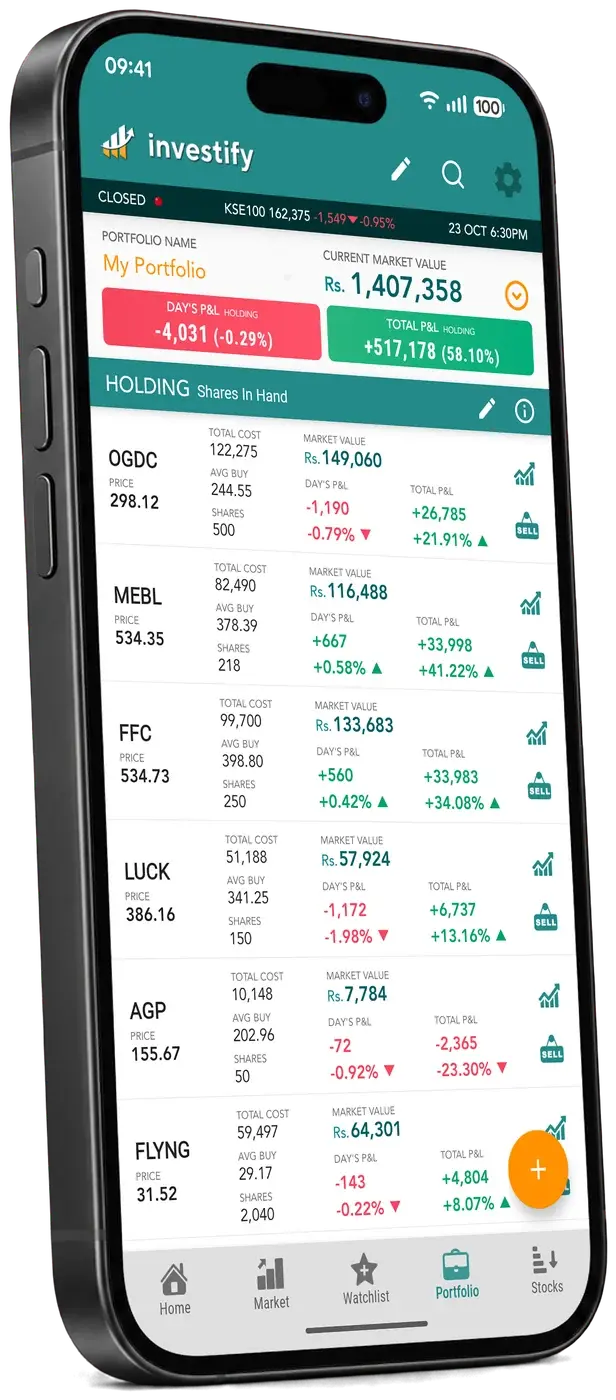
Investify's portfolio tracker shows your holdings, purchase dates and dividend history in one place, which is the context you need when you or your adviser prepare a return.
Track your holdings and dividendsA worked example: Rs 500,000 portfolio, filer vs non-filer
Numbers below are illustrative only. They use rounded amounts and a few simple assumptions to show the shape of the difference, not a forecast for any real portfolio.
Assumptions: an investor puts Rs 500,000 into listed shares bought after 1 July 2024. Over the year the holdings pay Rs 30,000 in gross dividends. At year end the investor sells everything for Rs 575,000, a Rs 75,000 gain. Dividends are taxed at the 15% (filer) and 30% (non-filer) ordinary rates. For the non-filer CGT, two scenarios are shown because sources differ: the 15% floor, and a doubled 30%.
| Filer | Non-filer (CGT at 15% floor) | Non-filer (CGT doubled to 30%) | |
|---|---|---|---|
| Gross dividends | Rs 30,000 | Rs 30,000 | Rs 30,000 |
| Dividend tax | Rs 4,500 (15%) | Rs 9,000 (30%) | Rs 9,000 (30%) |
| Capital gain | Rs 75,000 | Rs 75,000 | Rs 75,000 |
| Capital gains tax | Rs 11,250 (15%) | Rs 11,250 (15%) | Rs 22,500 (30%) |
| Total tax | Rs 15,750 | Rs 20,250 | Rs 31,500 |
| Pre-tax dividends plus gain | Rs 105,000 | Rs 105,000 | Rs 105,000 |
| Kept after tax | Rs 89,250 | Rs 84,750 | Rs 73,500 |
Even in the kinder non-filer scenario the investor pays Rs 4,500 more in a single year. In the harsher scenario the gap is Rs 15,750, which is roughly 15% of the pre-tax total. Scale the portfolio up and the cost of being a non-filer grows with it, while the effort of filing a return is largely fixed.
How to become a filer
The process is the same one every taxpayer uses, and registration carries no official fee. In outline:
- Register on IRIS. Go to FBR's IRIS portal and choose the option for an unregistered person. Individuals use their 13-digit CNIC (no dashes) as the user ID. IRIS sends verification codes to your mobile and email, then issues a password.
- File your return. Log in, pick the return that matches your income, declare your income, dividends, capital gains and tax already withheld, complete the wealth statement where required, pay any balance and submit. Keep the acknowledgment.
- Wait for the list to update. After processing, your name appears on the ATL when FBR next refreshes it. If you still show as inactive, confirm that the return was submitted and not left as a draft.
- Mind the deadline. The normal deadline for individuals is 30 September. In 2026 FBR extended it to 15 October. Late filing can carry a default surcharge, reported at up to Rs 25,000 for individuals, and the rules for late filers have been in flux, so check FBR's latest notices.
If your affairs are straightforward, a tax practitioner can set you up once, and later years become routine.
Common mistakes
- Treating an NTN as filer status. Without a filed return you are not on the ATL.
- Checking status only once. Status is assessed at each purchase and sale date for CGT purposes, so a lapse in the middle of your holding period matters.
- Forgetting dividends and gains in the return. They are collected at source, but they still need to be declared.
- Assuming last year's rate applies. Budgets change rates every June. Confirm against NCCPL's current notice and FBR's rate card.
- Ignoring multiple brokers. NCCPL consolidates your CGT across brokerage accounts, so reconcile its statement against your own records.
Educational note
This article is general educational information about how filer status affects PSX-related taxes. It is not tax, legal, financial or investment advice, and it does not recommend buying or selling any security. Tax rates, thresholds and procedures in Pakistan change with each federal budget, and several figures here come from secondary summaries of FBR and NCCPL notices. Where sources disagreed, the article says so. Verify every rate with the Federal Board of Revenue, NCCPL and your broker, and speak to a qualified tax professional about your own position. Investify is a PSX market-data and portfolio-tracking app and is not a broker or tax adviser.
The bottom line
Being a filer is not a clever trick, it is simply being on FBR's list. On ordinary dividends it halves the withholding from about 30% to 15%, it is the condition for the 15% capital gains rate on shares bought since July 2024, and it lowers the tax on bank profit and other transactions. The exact non-filer capital gains figure has been moving, which is itself a reason not to stay on the wrong side of the line. Check your status with a text to 9966, register and file if you are off the list, and keep your NCCPL statement and dividend advices for your return.
Related reading
Sources and references
- FBR - Check Active Taxpayer statusSMS to 9966, online portal and downloadable ATL.
- FBR - Withholding Tax Rate Card for Tax Year 2027Official rate card, updated to 30 June 2026 per Finance Act 2026.
- Pkrevenue - FBR releases capital gains tax rates on securities for tax year 2027CGT rates by acquisition period.
- Pkrevenue - FBR notifies dividend withholding tax rates for TY2027Dividend rates for ATL and non-ATL persons.
- Pkrevenue - Finance Bill 2026 proposes 100% higher tax for non-filer stock market investorsThe proposal to remove the Tenth Schedule exclusion for section 37A.
- Profit - NCCPL announces revised Capital Gains Tax rates effective in FY26NCCPL's FY2026 notice on filer and non-filer treatment.
- PwC - Pakistan individual taxes on income determinationDividend and securities capital gains treatment.
- ICT - Tax on PSX share trading in Pakistan: 2026 CGT rulesSecondary summary of the Finance Act 2026 and NCCPL mechanics.
- ICT - FBR filer guide 2026IRIS registration, return filing and deadlines (secondary source).
- Baco Consultants - FBR withholding tax rates 2026-27Third-party summary of bank profit, cash withdrawal and debt security rates.
- Zameen - FY2025-26 restrictions for non-filers beginBackground on the ineligible-person rules.