

Few corporate actions confuse new investors as much as bonus shares and right shares. A company announces "50% bonus shares" and holders wonder if they have been given free money. Another announces a "right issue" and a chart suddenly looks as if the price has collapsed. Both are normal events, and both change what you hold in ways that are easy to track once you see the arithmetic.
This guide explains each from the shareholder's side: what is issued, how the price adjusts, what you have to do (nothing for bonus shares, a decision for right shares), how Pakistan taxes bonus shares, and why unadjusted charts show fake cliffs.
Key takeaways
- Bonus shares are free extra shares in proportion to your holding. The price adjusts down by the same proportion, so the value of your holding is roughly unchanged at issue.
- Right shares are an offer to buy new shares, usually in proportion to your holding. You choose to subscribe, sell the right, or let it lapse.
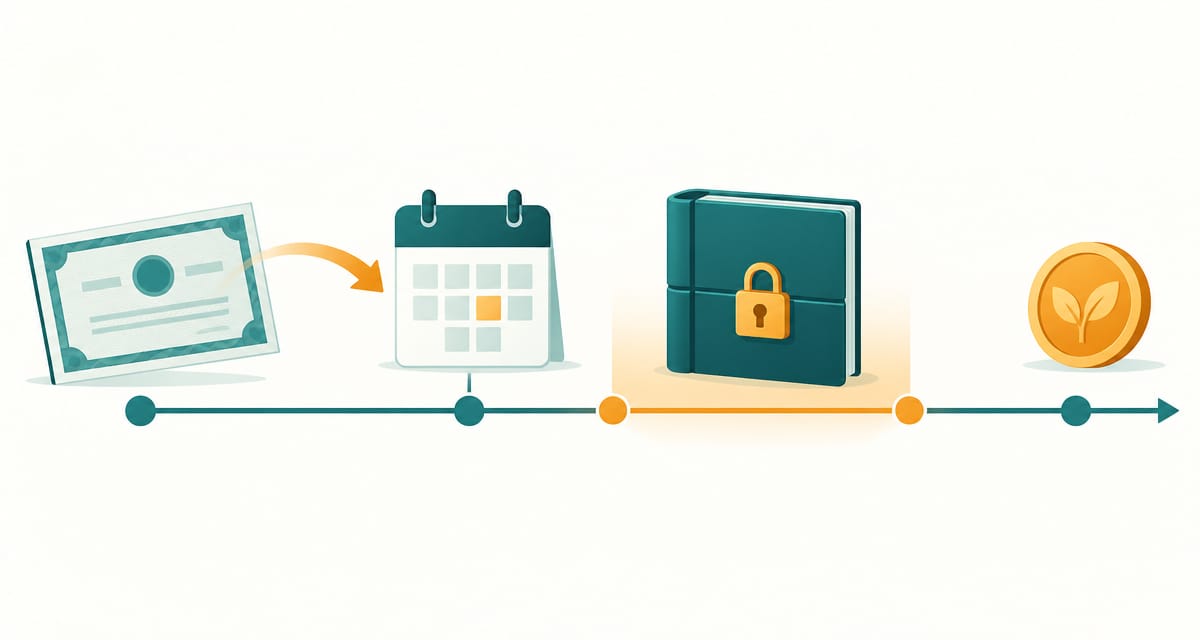
- Both use the same book closure and ex-date logic as dividends: you must own the shares before the ex-date. See our guide to book closure and ex-dividend dates.
- Pakistan taxes bonus shares at 10% (final tax) for filers, collected by the issuing company.
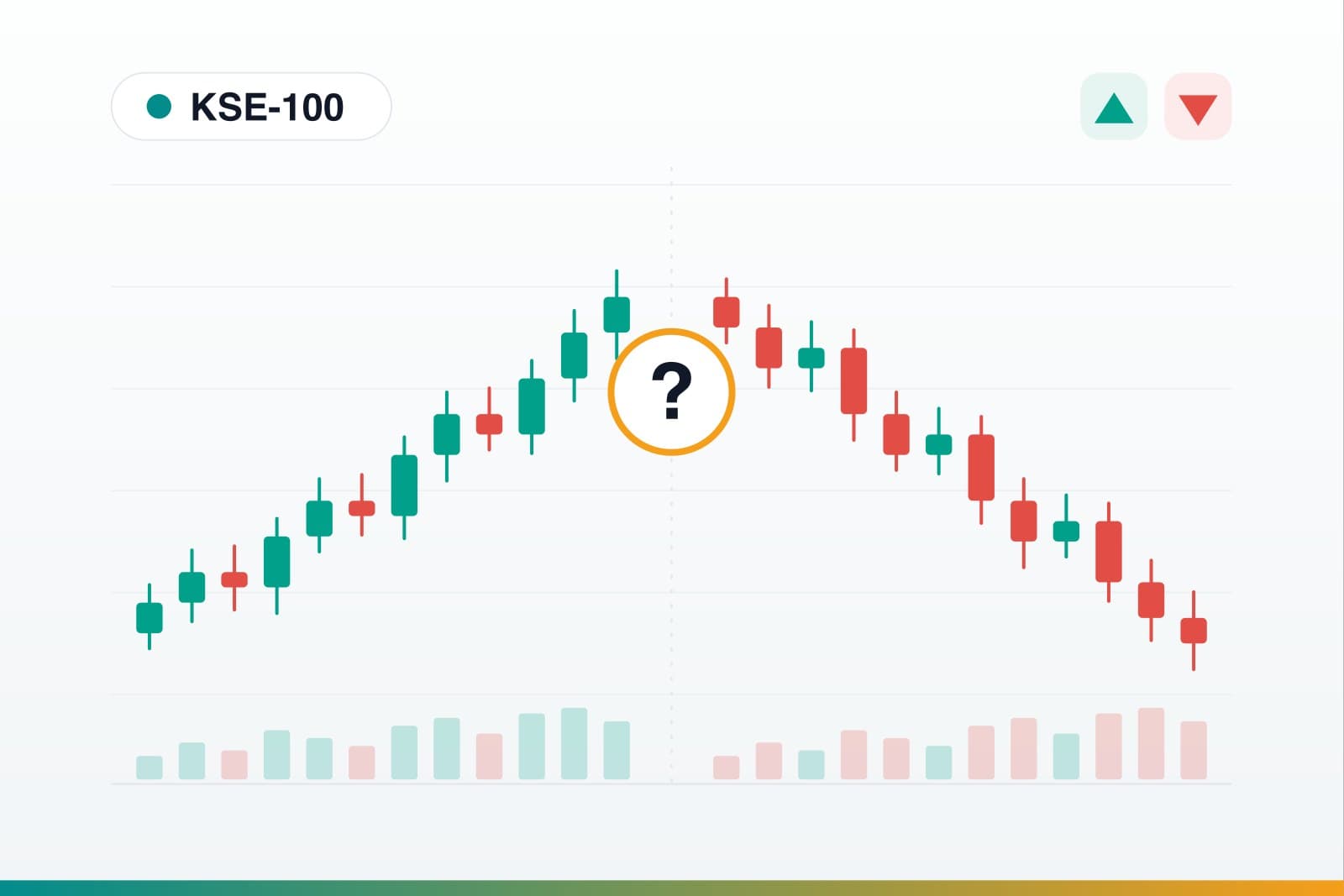
- A price cliff on a chart after a bonus or split is usually not a real loss. Adjusted charts remove it.
Bonus shares: the mechanics
A bonus issue (also called a stock dividend or capitalisation issue) converts part of a company's reserves into new shares given to existing shareholders. No new money comes into the company. PSX announcements express the ratio as a percentage: a 25% bonus means 25 new shares for every 100 held (one for every four), a 100% bonus means one for one, and an 800% bonus means eight new shares for every one held.
Because the company's value is not changed by the bonus, the market price adjusts. If you hold N shares and receive a bonus of B% (as a fraction, b = B/100):
- New share count = N × (1 + b)
- Theoretical ex-bonus price = old price ÷ (1 + b)
A worked example
You hold 1,000 shares at Rs 200, a holding worth Rs 200,000. The company announces a 25% bonus.
| Before ex-date | After ex-date (before tax) | |
|---|---|---|
| Shares held | 1,000 | 1,250 |
| Price per share | Rs 200 | Rs 160 (200 ÷ 1.25) |
| Value of holding | Rs 200,000 | Rs 200,000 |
Your slice of the company has not grown. You own more pieces, each worth less. What changes over time is what the company earns per share (earnings per share is spread over more shares), which is why ratios such as EPS and dividend per share are restated after bonus issues. Our guide to beginner financial ratios shows how they are read.
In reality the market price on the ex-date will be whatever buyers and sellers agree, so it will not land exactly on the arithmetic. The point is that a 20% fall in the headline price on the ex-date reflects the mechanics, not a market verdict.
What you have to do
Nothing. If you hold the shares in your CDC account on the register date, the bonus shares are credited in book-entry form after the company completes its allotment. The notice or your broker will tell you the timing. Fractions that arise are handled as set out in the company's notice. Check your CDC statement and broker portal afterwards that the count matches the ratio.
Tax on bonus shares
Pakistan treats bonus shares as taxable. Under section 236Z of the Income Tax Ordinance, 2001, every company issuing bonus shares collects tax on them. FBR's withholding rate card for tax year 2026 lists section 236Z at 10%, as a final tax. Secondary commentary from October 2026 reports that a higher rate of 20% applies to shareholders who are not on the Active Taxpayers List, and no change for tax year 2027. Treat that as a pointer, and confirm the current rate with FBR or your tax adviser, since budgets can change it.
How it works in practice, per that commentary:
- The tax is on the value of the bonus shares, using the day-end price on the first day of book closure for listed companies.
- The company either withholds 10% of the bonus shares due to you or collects the tax from you in cash so you receive all of them.
- The company must deposit the tax with FBR within 15 days of book closure, whether or not it has yet collected it.
- It is a final tax on this income.
Continuing the example, with a 25% bonus on 1,000 shares you are due 250 bonus shares. By the first day of book closure the share has already gone ex-bonus and trades near Rs 160:
| Step | Calculation | Result |
|---|---|---|
| Bonus shares due | 1,000 × 25% | 250 shares |
| Value for tax | 250 × Rs 160 | Rs 40,000 |
| Tax at 10% (filer) | Rs 40,000 × 10% | Rs 4,000 |
| Shares withheld to settle the tax | Rs 4,000 ÷ Rs 160 | 25 shares |
| Bonus shares you receive | 250 − 25 | 225 shares |
| Shares after the bonus | 1,000 + 225 | 1,225 shares (worth about Rs 196,000 at Rs 160) |
A non-filer at 20% would lose 50 shares instead. This is another reason the filer versus non-filer difference matters so much. How your cost of the bonus shares is recorded for later capital gains purposes is something to confirm with your broker or tax professional, and to keep records of.
Why charts show a "cliff" without adjustment
A price chart plots the traded price. After a 100% bonus, the price falls by half on the ex-date. An unadjusted chart shows that as a 50% crash overnight, even though holders lost nothing. The same happens after a share split.
A real example: MARI issued an 800% bonus in September 2024. Eight bonus shares for each share held meant the price was divided by nine, from roughly Rs 3,500 to roughly Rs 390. On a raw chart that looks like an 89% collapse in one session.
Investify's historical price charts are adjusted for splits and bonus issues, so the earlier prices are restated on the new share basis and the line continues smoothly. Cash-dividend ex-date drops are not removed, because they are real transfers of value out of the share price. If you ever see an unexplained overnight cliff on a chart, check the stock's announcements for a bonus or split. Our guide on reading PSX stock charts covers more ways to avoid misreading a price history.
Right shares: the mechanics
A rights issue raises fresh money from existing shareholders. The company offers each shareholder the right to buy new shares at a stated price in a stated ratio. Under the Companies Act, 2017 and the Companies (Further Issue of Shares) Regulations, 2020, the offer goes to existing members first.
Terms you will see in the notice, with an example from a small-cap company's right issue filed with PSX in August 2026:
| Term | Meaning | In the August 2026 example |
|---|---|---|
| Ratio | New shares offered per share held | 3 right shares for every 1 held (300%) |
| Subscription price | What you pay per right share | Rs 10, equal to par (face value) |
| Register date | Cut-off for who gets the offer | Close of business on 19 August 2026 |
| Book closure | Transfer books closed | 20 August 2026 |
| Unpaid rights credited / trading window | Rights appear in your CDC account and can be traded | Credited 21 August; traded on PSX 24 August to 7 September 2026 |
| Last date for acceptance and payment | Deadline to subscribe | 14 September 2026 |
| Allotment | New shares credited | 28 September 2026 |
Notes from the same letter of right: right shares rank equally with existing shares including voting rights; fractional entitlements are consolidated and sold on PSX, with the proceeds paid to entitled shareholders; and if payment is not received by the deadline the letter is treated as cancelled. CDC also supports online payment of subscription via 1Link for investor-account and sub-account holders.
Your three choices
When rights are credited to your CDC account, you generally have three options:
| Choice | What happens | Consequence |
|---|---|---|
| Subscribe | Pay the subscription price by the last payment date | You get the new shares; your stake keeps pace with the company's new capital |
| Sell the unpaid right | Sell it on PSX during the stated trading window | You receive its market price and your holding is diluted |
| Do nothing | Let the deadline pass | The right lapses, you receive nothing for it, and your holding is diluted |
This is a financial decision with a deadline, so the date discipline matters more than for a bonus issue. Your broker and the company's notice explain the exact process for your account, including how to renounce or sell a right.
Price effect and a worked example
New shares sold below the market price pull the average price down. The usual way to estimate the new price is the theoretical ex-rights price (TERP). It is a standard finance calculation, not a PSX rule:
TERP = (shares held × market price + new shares × subscription price) ÷ (shares held + new shares)
Suppose a stock trades at Rs 100 and the company offers a 1-for-4 right at Rs 80 (one new share for every four held, 25%). For 4 existing shares:
- Cum-rights value: 4 × Rs 100 = Rs 400
- Cost of 1 new share: Rs 80
- Total: Rs 480 over 5 shares, so TERP = Rs 96
If you hold 1,000 shares, you are offered 250 right shares costing Rs 20,000.
| Subscribe | Sell the rights | Lapse | |
|---|---|---|---|
| Shares after | 1,250 | 1,000 | 1,000 |
| Price per share (at TERP) | Rs 96 | Rs 96 | Rs 96 |
| Value of shares | Rs 120,000 | Rs 96,000 | Rs 96,000 |
| Cash paid / received | pay Rs 20,000 | receive about Rs 4,000 | Rs 0 |
| Total position (value + cash) | about Rs 100,000 net of the Rs 20,000 paid | about Rs 100,000 | Rs 96,000 |
The right to buy a Rs 96 share for Rs 80 is worth about Rs 16 per right share, so 250 × Rs 16 = Rs 4,000, which is exactly the 1,000 × Rs 4 fall in the price. Subscribe or sell, and you are about even with where you started (before costs); do nothing and you absorb the price fall without compensation. Real prices will differ from TERP, as the market moves for many other reasons, and companies sometimes set the price at par or at a premium. A right issue also tells you something about the company's need for capital, which is why reading the stated purpose in the announcement matters. Our guide to company announcements covers that.
Bonus versus right: side by side
| Bonus shares | Right shares | |
|---|---|---|
| Do you pay? | No (but tax is withheld in Pakistan) | Yes, if you subscribe |
| Do you decide anything? | No | Yes: subscribe, sell or lapse |
| Money raised by company | None; from reserves | Yes, fresh capital |
| Price effect | Falls by the bonus ratio | Falls toward TERP |
| Deadline risk | None | Yes: miss the date and the right lapses |
| Tax | Section 236Z, 10% final for filers | Depends on the transaction; confirm with a tax professional |
Where to follow these on Investify
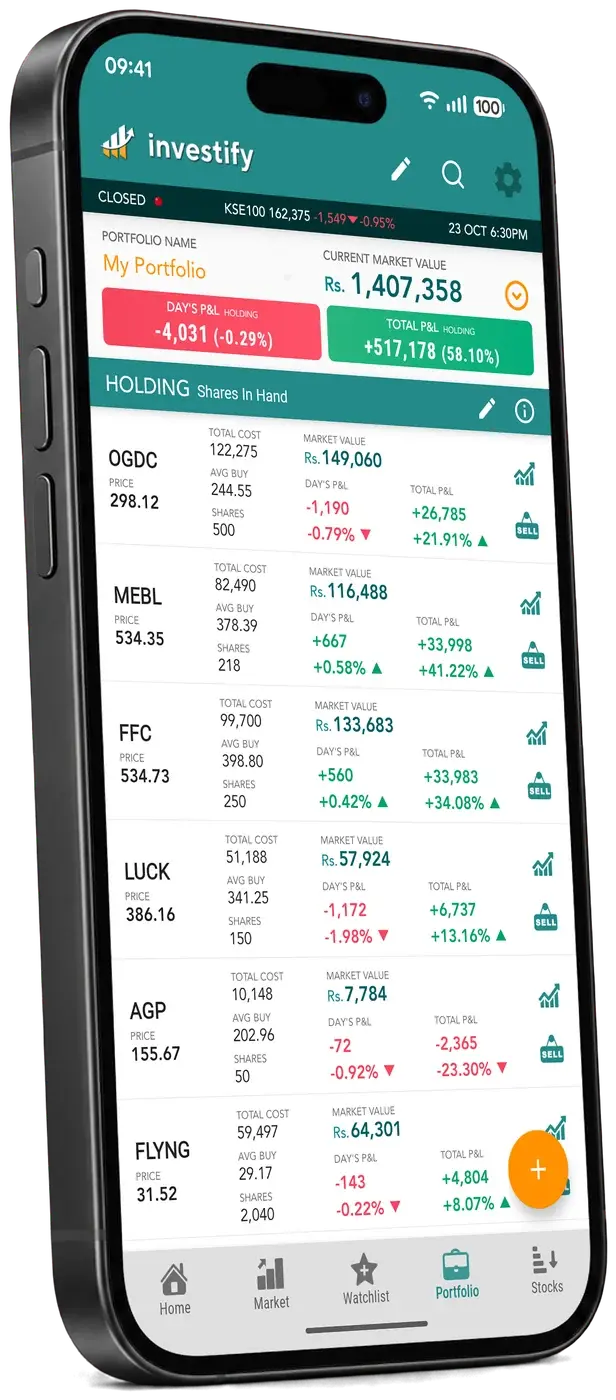
Bonus and rights notices appear on Investify's Company Announcements page and in each stock's Announcements section, for instance MARI's announcements. Keep the companies you own in a portfolio, because a rights issue has a payment deadline that is easy to miss, and a holding count that suddenly looks higher or lower after a bonus is easier to understand with the announcement beside the price history.
See bonus and rights notices next to the chart
Read the ratio, dates and terms in the notice, then open the stock page to compare with price, chart and fundamentals.
Browse Company AnnouncementsEducational note
This article is for general education only. It is not investment, tax or legal advice, and it does not recommend buying, selling or subscribing to any security. Company names are used only as real examples of how corporate actions appear. The calculations are simplified illustrations; actual market prices, fractions, costs and timelines differ. Tax rates and rules, including section 236Z, are set by law and the annual Finance Act and may change; verify them with FBR and a qualified tax professional. Investify is a market-data and portfolio-tracking app, not a broker or tax adviser.
The bottom line
A bonus issue hands you extra shares for free but cuts the price in proportion, so the value you own does not rise at the moment of issue, and in Pakistan 10% of the value for filers is taken as final tax. A rights issue is a choice with a deadline: subscribe, sell the right while it trades, or let it lapse and be diluted. Both follow the same book closure and ex-date logic as dividends, and both explain the cliffs you see on unadjusted charts. Read the ratio, the price and the dates in the announcement, do the arithmetic before the ex-date rather than after, and confirm the details with your broker.
Related reading
Sources and references
- KPMG - Withholding Tax Collection / Deduction Rate Card, Tax Year 2026Lists section 236Z (bonus shares issued by companies) at 10% as a final tax.
- Pakera - Tax on Bonus Shares in PakistanSecondary commentary on valuation, withholding mechanics and the 20% non-filer rate. Verify against FBR.
- Right issue letter and schedule filed with PSX (August 2026)Example schedule: register date, unpaid rights trading window, payment deadline and allotment.
- PSX Data Portal - PayoutsCompany payout and book closure records.
- Federal Board of Revenue (FBR)Income Tax Ordinance, 2001, the Finance Acts and the Active Taxpayers List.
- SECP - Companies Act, 2017 and related regulationsLegal basis for further issue of shares.
- Central Depository Company (CDC)Custody and the procedures for crediting bonus and right shares.