

A dividend announcement on the Pakistan Stock Exchange (PSX) usually comes with a small cluster of dates: a board meeting, a book closure period, sometimes a "register date", and a payment date that arrives later. Newcomers tend to ask the same question about them: which day do I have to buy by to actually receive this dividend?
The answer depends on how PSX settles trades. Since 9 February 2026 that settlement cycle is T+1, which changed the maths that older guides and forum posts still describe. This article explains each date, shows how they fit together on a real calendar, and points to where you can read them for any listed company.
Key takeaways
- Book closure is the window in which a company stops updating its shareholder register. Trading continues; only the registration of transfers pauses.
- Register (record) date is the cut-off: shareholders whose names are on the register at close of business on that day are entitled. In recent notices it is the business day before book closure starts.
- Ex-dividend date is the first day the share trades without the entitlement. With T+1 settlement it generally falls on the register date, which is the business day before the closure begins. You have to buy before it.
- Payment date comes later, and a final dividend is subject to approval at the AGM.
- Buying on or after the ex-date, or during book closure, does not earn that dividend. The share price typically drops by about the dividend on the ex-date.
The cast of dates, in plain English
| Term | What it means | What it decides |
|---|---|---|
| Board meeting date | The day directors meet to consider results and any dividend, bonus or rights proposal | Nothing yet; it is the heads-up |
| Book closure | A period in which the company closes its share transfer books, stated as "from ... to ... (both days inclusive)" | Fixes who is on the register |
| Register / record / entitlement date | The cut-off: names on the register at close of business that day qualify | Who gets the dividend, bonus or right |
| Last cum-dividend day | The last day you can buy and still receive the entitlement | Your buying deadline |
| Ex-dividend date (ex-date) | The first day the share trades without the entitlement | Price adjusts down by about the dividend |
| AGM date | When shareholders meet; for a final dividend, they approve it | Whether a final dividend is confirmed |
| Payment date | When the cash is credited to your bank account | When money arrives |
Different companies use different labels. One notice may talk about a "register of members", another about a "record date" or "entitlement date". They describe the same idea: a cut-off after which new buyers do not qualify.
Why T+1 matters for the buying deadline
PSX's settlement cycle moved from T+2 to T+1 on 9 February 2026. A trade on day T now settles on the next business day. The SECP and PSX described the change as bringing buyers their shares, and sellers their money, within one business day.
Why does that matter for dividends? Because the company can only pay the people whose names are on the register at the cut-off, and a share you buy only reaches your name when the trade settles. Work it backwards:
- The cut-off is close of business on the register date.
- Shares must have settled into your CDC account by then.
- Under T+1, a trade settles one business day after it is made.
- So the last day to buy is the business day before the register date.
- The ex-date, the first day a buyer misses out, is therefore the register date itself.
Under the old T+2 cycle, every one of those deadlines sat one business day earlier. Some websites and older blog posts still say "subtract two working days from book closure" or "ex-date is two days before closure". That was right under T+2. A current dividend calendar lists the ex-date as the business day before the book closure starts, which matches the T+1 logic above.
A worked timeline: a real final dividend notice
On 14 September 2026, Pakistan Petroleum Limited (PPL) filed a notice with PSX recommending a final cash dividend of Rs 6.00 per share (60%) for the year ended 30 June 2026. The notice said:
- The dividend is subject to approval at the AGM on 27 October 2026.
- It would be paid to members whose names appear in the register as at close of business on 20 October 2026.
- The share transfer books would be closed from 21 October to 27 October 2026, both days inclusive.
Laying that on a calendar with T+1 settlement:
| Date (2026) | Day | What happens |
|---|---|---|
| 14 Sep | Mon | Board recommends the final dividend; notice filed with PSX |
| 19 Oct | Mon | Last cum-dividend day. A purchase made today settles on 20 Oct and is on the register in time |
| 20 Oct | Tue | Register date and ex-date. Close of business on this day is the cut-off. A purchase made today settles on 21 Oct, too late. The share trades without the dividend and the price adjusts down by about Rs 6 |
| 21 to 27 Oct | Wed to Tue | Book closure. Trading continues; transfers are not registered |
| 27 Oct | Tue | AGM; shareholders vote on the final dividend |
| After the AGM | - | Cash dividend is paid to the bank account (IBAN) linked to your CDC account, within the payment timeline in the company's notice |
(These dates are used here to illustrate the mechanics, and they are the company's own. For any dividend you act on, use the company's current notice.)
Now put rupees on it. Suppose you owned 1,000 shares on the register at the cut-off:
| Item | Filer (on the ATL) | Non-filer |
|---|---|---|
| Gross dividend (1,000 × Rs 6.00) | Rs 6,000 | Rs 6,000 |
| Withholding tax | 15% = Rs 900 | 30% = Rs 1,800 |
| Cash credited | Rs 5,100 | Rs 4,200 |
The notice itself lists these two rates for dividend withholding tax under section 150 of the Income Tax Ordinance, and it says the company ascertains each member's tax status as at the first day of book closure. So if you file returns, make sure your name is on FBR's Active Taxpayers List before book closure begins, not after it. Our capital gains and dividend tax guide covers the rates in full and the difference between filer and non-filer treatment.
What happens to the price on the ex-date?
On the ex-date, a new buyer will not receive the dividend, so the share is worth about that much less than it was the day before. Using the Rs 6.00 dividend above and a purely hypothetical closing price of Rs 300 on the last cum-dividend day, an otherwise unchanged market would put the reference price near Rs 294 on the ex-date.
Two things are worth remembering:
- It is not a loss. A holder of 1,000 shares still has a share worth Rs 294 each plus Rs 6 of cash coming, and nothing about the business has changed. Treating the ex-date drop as "the stock fell" is a common beginner misread. Our guide to reading a PSX stock quote explains how the previous close and reference price fit together.
- It is not a trick. Buying just before the ex-date to "collect" the dividend does not create value. The market has priced the dividend into the share before the ex-date, and then removes it. You also pay tax on the dividend you receive, as the table above shows. Dividend capture is a trade like any other, with brokerage and tax costs on top.
Common mix-ups
"I bought during book closure; why no dividend?" The register date falls before the closure begins. A purchase during closure settles after the cut-off.
"I sold the day after the ex-date; did I lose the dividend?" No. If you were on the register at the cut-off, the dividend is yours, even if you have since sold. The buyer paid a price that excluded it.
"The announcement says 60%, but I got Rs 6." PSX companies state dividends as a percentage of the face value of the share, which is usually Rs 10. So 60% means Rs 6.00 per share. The notice often gives the rupee figure too.
"Is a bonus or right issue the same?" The register date and book closure logic is the same, but the share price adjusts differently and some entitlements need a payment. We cover those in our guides on bonus shares and right shares and in the corporate actions section of PSX company announcements explained.
"The book closure got revised." Companies sometimes revise their closure dates by a day or postpone them. A revised notice replaces the earlier one, so check you are looking at the latest filing.
"I hold shares in physical form." Most retail holdings now sit in CDC accounts. If you still hold certificates, transfers lodged with the share registrar before the cut-off have their own rules, which are in the company's notice.
What about XD, XB and XR labels?
You may see tags such as XD (ex-dividend), XB (ex-bonus) or XR (ex-rights) beside a share on some data terminals or foreign exchanges. They are shorthand for "this share is now trading without the dividend, bonus or rights entitlement". Do not rely on a label to work out your buying deadline: the dates in the company's notice, the PSX Payouts page and your broker's confirmation are what count, and how a given screen displays the marker is up to the data provider.
How to read a notice for these dates
Take the company's dividend or book closure notice and find:
- The type: interim or final, cash, bonus or rights.
- The amount: rupees per share and percentage of face value.
- "Recommended" or "declared": a recommended final dividend still needs AGM approval.
- The register date: "names appearing in the register as at close of business on ...".
- The book closure window: "from ... to ... both days inclusive".
- The AGM date, if the notice includes one.
- The tax paragraph: filer and non-filer withholding rates, and the date on which tax status is checked.
Then count back from the register date: one business day for the ex-date, two for your last chance to buy, under T+1 settlement.
Where to see these dates on Investify
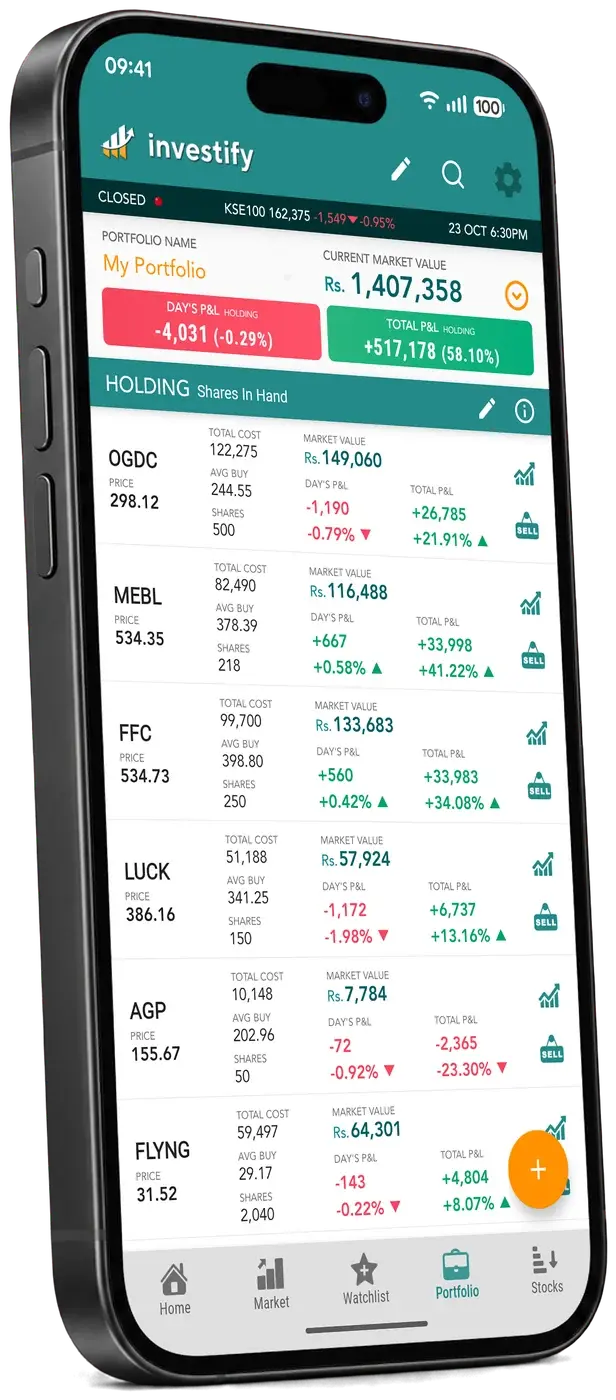
Investify's Company Announcements page lists recent notices from across the market, including dividend and book closure filings. Each stock page also has an Announcements section, for example UBL's announcements or FFC's announcements, where you can read the notice next to the price, chart and fundamentals. Watching the chart across the ex-date shows the price step-down for yourself.
Check dividend and book closure dates before you plan a trade
Browse recent PSX notices, then open a stock page to see its announcements alongside price, charts and fundamentals.
Read Company AnnouncementsFor companies you own, add them to a portfolio so that dividend notices show up where you already look, rather than being found after the cut-off has passed.
Educational note
This article is for general education only. It is not investment, tax or legal advice, and it does not recommend buying or selling any security. The PPL example uses a real company notice only to illustrate how the dates work; it is not a suggestion about that or any other company, and the dates and figures may be revised by the company. Settlement cycles, ex-date conventions and tax rates can change, and the Finance Act sets dividend tax rates each year. Always verify the dates in the company's notice filed with PSX, confirm your entitlement with your broker, and check FBR's Active Taxpayers List and current rates. Investify is a market-data and portfolio-tracking app, not a broker or tax adviser.
The bottom line
A dividend is paid to whoever is on the company's register at the cut-off, and your share only gets onto that register when your trade settles. Since PSX moved to T+1 in February 2026, that means you must buy at least two business days before book closure starts, the ex-date is the business day before it starts, and anything you buy after that belongs to the seller's dividend. Read the register date and book closure window in the company's notice, count back on a real calendar, and make sure you are on the Active Taxpayers List before the closure begins.
Related reading
Sources and references
- PSX - T+1 settlement cycle implementationOfficial PSX event page for the move to T+1 settlement.
- Profit - PSX to shift to T+1 settlement cycle from February 9, 2026Press coverage of the SECP-led switch from T+2 to T+1.
- Pakistan Petroleum Limited - Notice of Final Dividend 2025-26 and Book ClosureCompany notice filed with PSX, 14 September 2026: register date, book closure window, AGM date and tax paragraph.
- PSX Data Portal - PayoutsCompany-by-company payout and book closure records.
- BSL - Book Closure glossary and ex-dates calendarBrokerage reference explaining the ex-date relative to book closure.
- Federal Board of Revenue (FBR)Active Taxpayers List and current withholding rates.
- Central Depository Company (CDC)Custody of your shares and the bank (IBAN) details used for dividend payments.