

If you have read our guide to KSE-100, KSE-30 and KMI-30, you know that KMI-30 is the Pakistan Stock Exchange's main Shariah-compliant index. What that guide could not fit is the part most investors actually ask about: how does a company get onto the list, and what happens to the dividends? Searches for "halal stocks PSX" and "KMI 30 index" keep growing, and the answer is more mechanical, and more interesting, than a simple yes or no.
This guide goes one level deeper. It explains the family of KMI indices, the six screens a stock must pass (with the thresholds that were revised in 2026), how often the list changes, how dividend purification works with a rupee example, and what Islamic funds and Islamic brokerage accounts add. Thresholds and company lists change, so treat the numbers as of October 2026 and confirm them against the latest PSX notice.
Key takeaways
- KMI-30 sits on top of a wider list. The PSX-KMI All Share Islamic Index holds every compliant listed company; KMI-30 keeps the 30 largest and most liquid of them.
- Six screens decide compliance: business activity, debt, non-compliant investments, non-compliant income, illiquid assets, and net liquid assets versus the share price.
- The debt cap was tightened in 2026. The interest-bearing debt to total assets limit was revised from 37% to 33% under the updated methodology.
- The list is reviewed twice a year, so compliance is a status that can change, not a permanent label.
- Purification is the investor's job. If you hold compliant shares directly, you work out and donate the impure share of each dividend. Islamic funds usually do this at fund level.
- Compliant does not mean attractive. The screens test religious eligibility, not valuation, quality or risk.
The KMI family of indices
PSX publishes several Shariah indices, and the names get mixed up. The ones to know:
| Index | What it is |
|---|---|
| KMI-30 (KSE Meezan Index 30) | The 30 largest, most liquid Shariah-compliant companies. Launched in 2008 and recomposed twice a year. |
| PSX-KMI All Share Islamic Index (KMIALL) | Every listed company that passes the screens, so a much broader Islamic market view. It had 309 companies after the June 2026 recomposition, as reported from the PSX notice. |
| Meezan Pakistan Index (MZNP) | A narrower Islamic index that uses the same screening framework, listed in the PSX index family alongside the others. |
| Meezan Islamic Index 30 (MII30) | A Shariah-compliant benchmark that draws on the Islamic universe. |
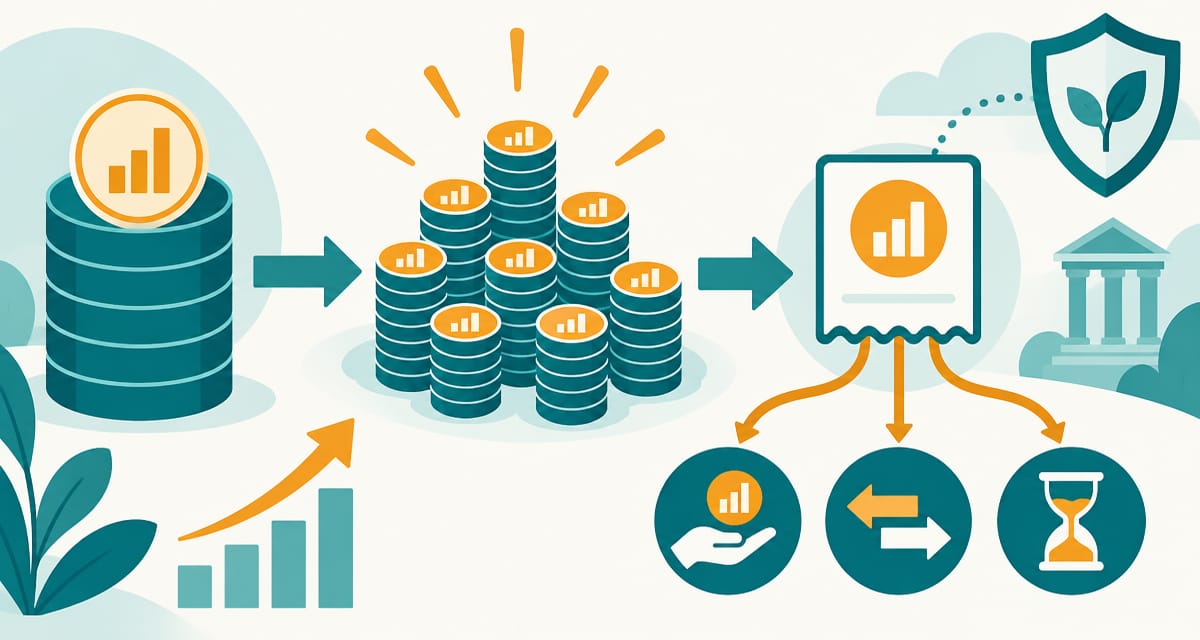
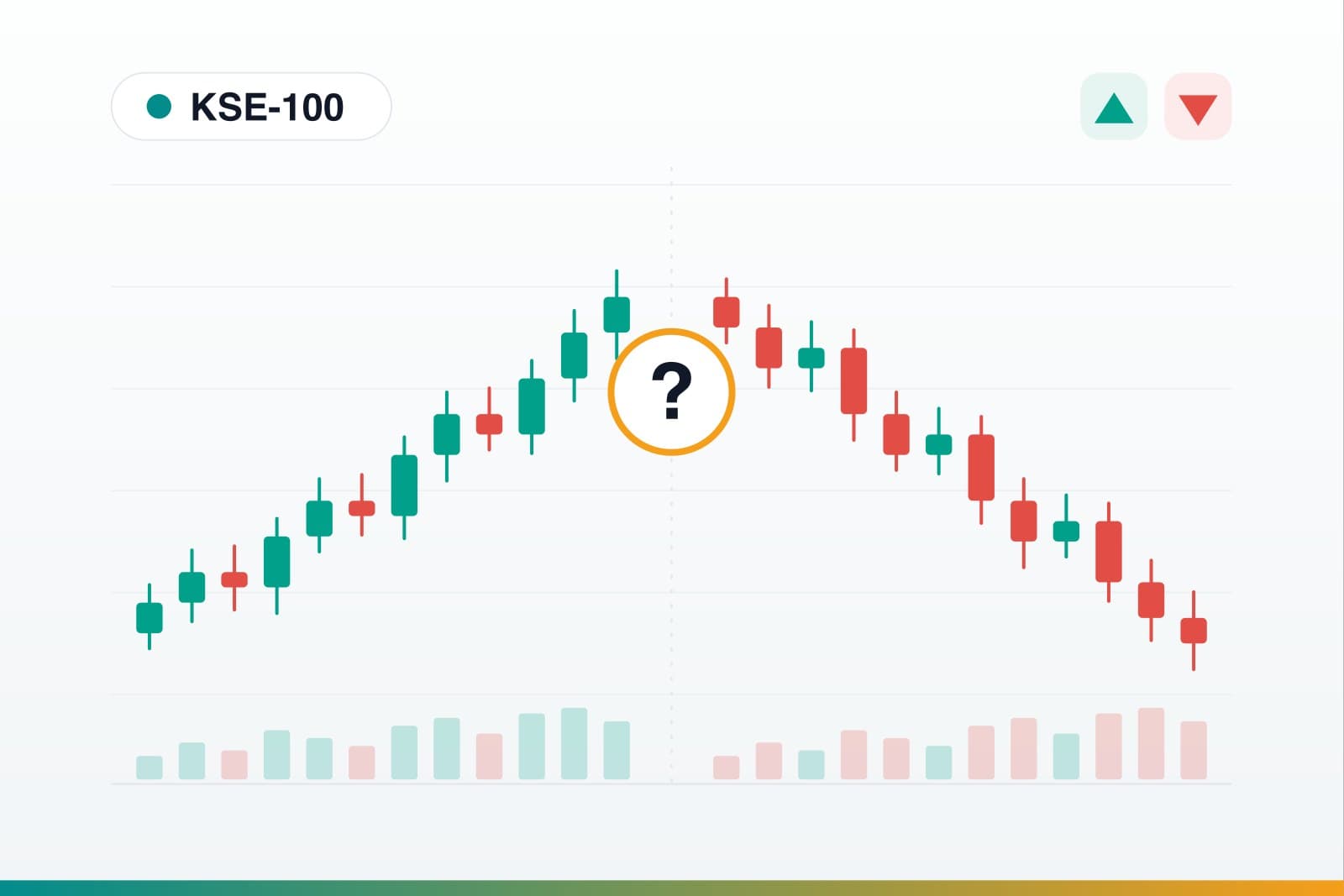
Think of it as a funnel. All listed shares sit at the top; only the stocks that pass the screening become part of the Islamic universe; and KMI-30 is the top slice of that universe. You can follow the live KMI-30 level and its constituents on Investify's KMI-30 index page, and compare it with the KSE-100 to see whether Islamic-screened stocks are moving differently from the wider market.
Who does the screening
Two parties matter here. Meezan Bank acts as the Shariah technical services and support provider for the KMI indices: it reviews each company's financial statements against the screens and issues a screening certificate. A company's own filing shows the process. In a June 2025 disclosure to PSX, Air Link Communication reported that Meezan had reviewed its audited accounts for December 2024, found it compliant with the KMI All Share screening criteria, and that the certificate remains valid until the next recomposition.
SECP sits above this. Under the Shariah Governance Regulations, 2023, screening methodologies for Shariah-compliant securities need SECP approval. The KMI All Share methodology was submitted jointly by PSX, Al Meezan Investment Management and Meezan Bank and approved by SECP in May 2024. In February 2026 SECP approved a revision to it, and PSX's Annual Report 2026 confirms the changes.
The six screens, in plain English
A company has to pass all of the following. The thresholds below reflect the methodology as reported by PSX and the press in 2026.
| # | Screen | Threshold | What it tests |
|---|---|---|---|
| 1 | Business activity | Core business must be permissible | Excludes conventional banking and insurance, alcohol, tobacco, gambling, pork products, adult entertainment and similar |
| 2 | Interest-bearing debt | Below 33% of total assets (revised from 37% in 2026) | How much of the balance sheet is financed through interest-bearing loans |
| 3 | Non-compliant investments | Below 33% of total assets | Money parked in interest-bearing or otherwise non-compliant instruments |
| 4 | Non-compliant income | Below 5% of total revenue | How much income comes from impure sources such as interest |
| 5 | Illiquid assets | At least 25% of total assets | The company must hold real, non-cash assets like plant, inventory and property |
| 6 | Net liquid assets per share | Must not exceed the market price per share | Stops a share from being little more than a claim on cash and receivables |
Screen 1: the business screen
This is a yes or no test on what the company does. A conventional bank fails by definition, so a conventional lender such as HBL cannot pass, while a full Islamic bank such as MEBL is tested like any other company, on the same financial screens. Companies in industries like cement, fertiliser or technology pass the business screen but still have to clear the financial ones below. These are examples of how the screen works, not statements about any company's current status.
Screens 2 to 4: how much interest touches the company
Screens 2, 3 and 4 measure interest exposure from three angles: what it owes (debt), what it holds (investments) and what it earns (income). A simple rupee illustration:
- A company has total assets of Rs 10 billion.
- It carries Rs 3 billion in interest-bearing loans: 30% of assets, which passes the 33% cap. At Rs 3.5 billion it would be 35% and would fail.
- It keeps Rs 1.5 billion in fixed-income investments: 15% of assets, a pass.
- Its revenue is Rs 8 billion, of which Rs 200 million is interest income: 2.5% of revenue, a pass under the 5% limit.
The 2026 change matters at the margin. A company with debt between 33% and 37% of assets would have passed under the old rule and fails under the new one. That is exactly why businesses funded heavily by borrowing, such as capital-intensive manufacturers in an expansion phase, are the most likely to drop out at a review. SECP also asked PSX to consider lowering the non-compliant investments limit from 33% to 30%, but as of the reports we reviewed that was a proposal, not a rule.
Screens 5 and 6: is the share a claim on real assets?
These two come from the Shariah principle that money can only be exchanged at par, so a share that is essentially a pile of cash and receivables cannot trade at a market price.
- Illiquid assets of at least 25% means a quarter or more of the balance sheet must be things like plant, machinery, inventory and property.
- Net liquid assets per share not above the market price is calculated as total assets minus illiquid assets and minus liabilities (current and long-term), divided by the number of shares. If a company's liquid surplus per share is higher than its share price, the screen fails.
Example: a company has Rs 8 billion of total assets, Rs 3 billion illiquid (37.5%, a pass), Rs 3 billion of total liabilities, and 500 million shares. Net liquid assets are Rs 8 billion minus Rs 3 billion minus Rs 3 billion, which is Rs 2 billion, or Rs 4 per share. As long as the market price is above Rs 4, the screen is passed.
How often the list changes
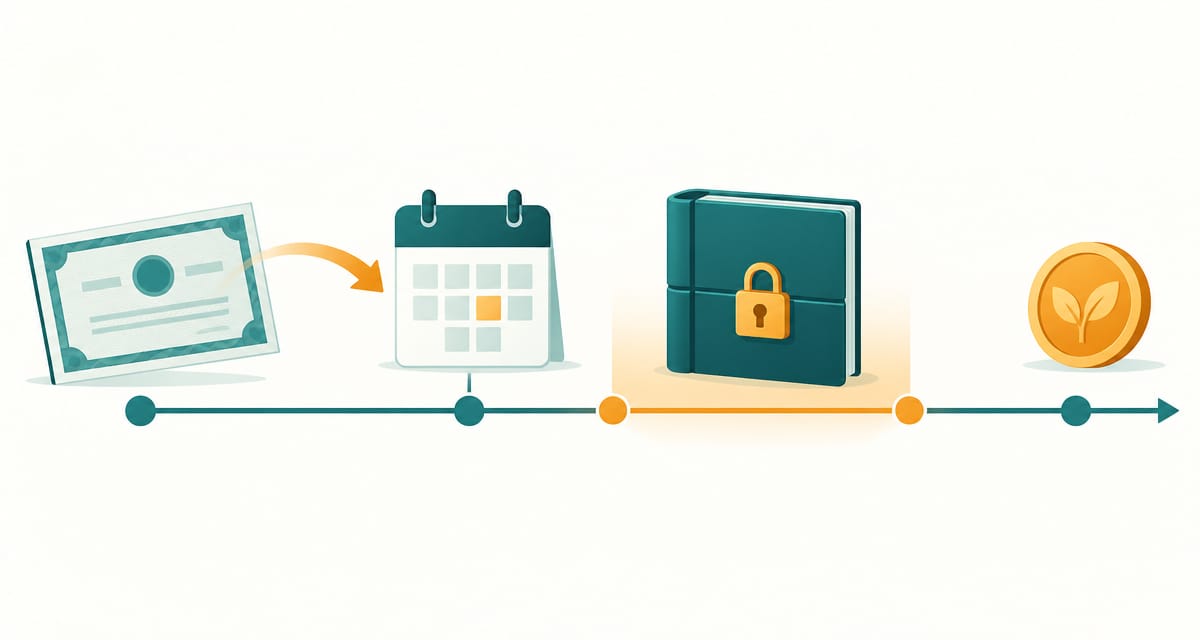
The compliant list is recomposed semi-annually, using each company's latest financial statements. Two recent cycles show the rhythm:
- December 2025 recomposition: effective early December 2025 and based on accounts to 30 June 2025. The All Share index was reported at 281 companies afterwards.
- June 2026 recomposition: PSX notice dated late May 2026, effective 5 June 2026 and based on accounts to 31 December 2025. The index was reported at 309 companies afterwards. A later corrigendum moved one company back in after it filed a revised Shariah disclosure.
The next review will be on accounts to 30 June 2026, which is why you can expect fresh list changes around the time this article is published. Check the PSX notice for the exact effective date and for which thresholds the new review applies.
The 2026 revision also added three process features for the All Share index:
- A star rating system (three, four or five stars) for constituents, to show how comfortably a company clears the screens.
- A five-working-day objection window after the draft list is published, so companies can request a review with evidence.
- An interim inclusion mechanism for newly listed companies, subject to KMI Index Committee approval.
For an investor, the practical lesson is that compliance is dated. A stock that clears the screens on its last annual accounts can fail on the next, and a company that fails can come back.
Dividend purification: a worked example
Passing the 5% income screen does not mean the company's income is perfectly clean. A compliant company can still earn up to just under 5% of its revenue from interest and similar sources. The Shariah answer is purification: the investor gives away the matching share of each dividend to charity so no impure income is kept.
The method most commonly described is:
- Find the purification percentage for the company, which comes from its non-compliant income as a share of total income, usually disclosed in the Shariah adviser's or company's report. Since 2026 listed companies must also publish separate Shariah disclosures with their half-yearly and annual statements.
- Multiply the dividend you received by that percentage.
- Donate that amount to charity. It is not yours to keep.
Example: you receive a cash dividend of Rs 20,000 from a compliant company whose disclosed non-compliant income share is 2.5%. The purification amount is Rs 20,000 x 2.5% = Rs 500. Note that the tax is withheld at source before the dividend reaches you (15% for filers, as recent PSX company dividend notices state), so ask your Shariah adviser whether to work from the gross or the net amount. Our guide to dividend and capital gains tax covers the withholding side.
Scholars also differ on whether capital gains need purification. If this matters to you, follow the ruling of the scholar or Shariah board you rely on.
Islamic funds: purification handled for you
If calculating purification yourself sounds like a chore, Shariah-compliant mutual funds are the other route. An Islamic equity fund invests only in screened stocks, has its own Shariah advisory board, and normally purifies at fund level. You pay the fund's management fee and take fund-level risk, and you should read the offering document for the screening rules the fund follows, which may be stricter than the KMI screens. Funds are regulated by SECP.
SECP's August 2026 summary also lists Islamic ETFs among the products Shariah brokerage windows can offer.
Islamic brokerage accounts
Until recently, a Shariah-conscious investor mostly had to build the compliance themselves: pick screened stocks, avoid margin financing and handle purification. That is changing fast.
In August 2026, SECP announced a dedicated Shariah-compliant brokerage segment at PSX, under amendments to the Securities Brokers (Licensing and Operations) Regulations, 2016. According to the reports:
- 33 brokerage houses run dedicated Shariah windows, handling roughly 52% of traded volume, and two other brokers offer a full Islamic range.
- Client money is held through Islamic banking channels and kept segregated.
- Trading is limited to screened Shariah-compliant securities, and investors can access shares, Sukuk and Islamic ETFs.
- The framework prohibits interest-based financing and non-compliant leveraged or speculative transactions.
- Brokers must have Shariah oversight and follow PSX, CDC and NCCPL rules.
The same reports say 308 of 535 listed securities are Shariah-compliant, about 65% of PSX market capitalisation. That figure shows how wide the compliant universe is, and why KMI-30 should not be mistaken for the whole of it. The push comes from Pakistan's legal timeline to remove riba from the financial system (PSX's annual report cites 1 January 2028 under the 26th Constitutional Amendment).
If you want an Islamic account, our guide to choosing a stockbroker lists what to compare, and the account opening guide explains the CDC and broker steps. Ask any broker which Shariah adviser it uses and whether it holds SECP approval for an Islamic window.
Using Investify to follow Shariah-screened stocks
Investify does not issue Shariah rulings and is not a broker. What it gives you is the data around the screens:
- The KMI-30 index page shows the live index and its constituents.
- On each company's stock page, the Announcements section carries the Shariah disclosure and financial-results filings. For example, check the announcements for EFERT to see how such filings appear.
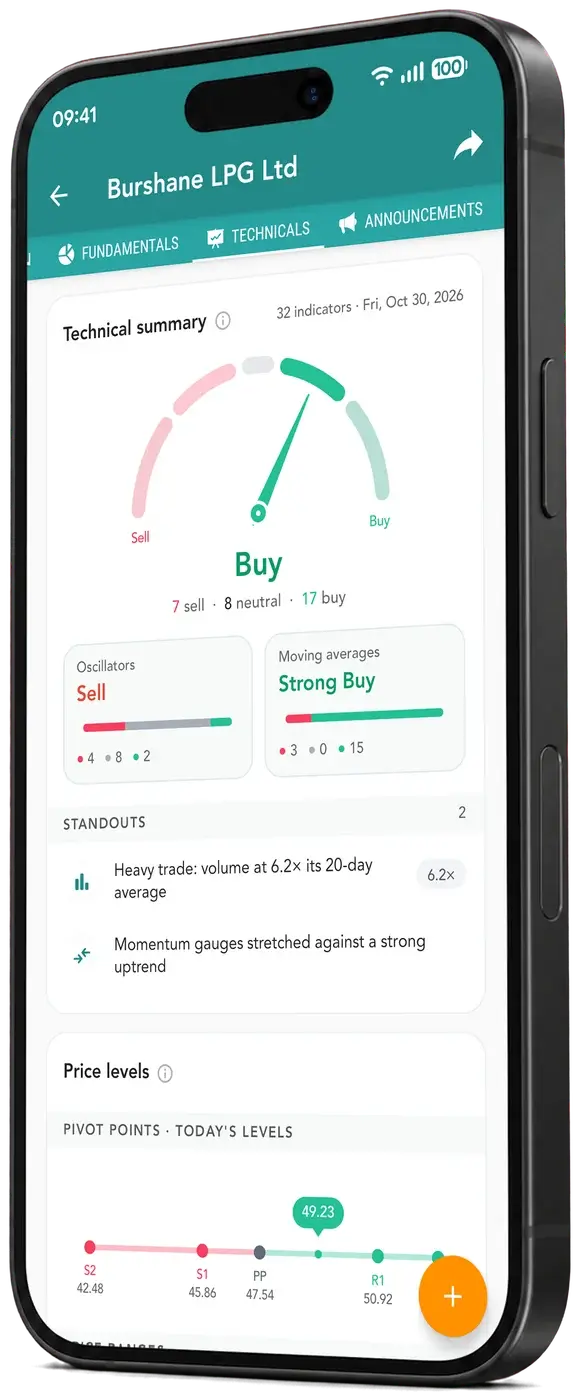
- The Fundamentals section lets you look at the debt and asset figures behind screens 2 to 6 for a company such as LUCK. These examples only show where to look; they say nothing about any company's compliance status.
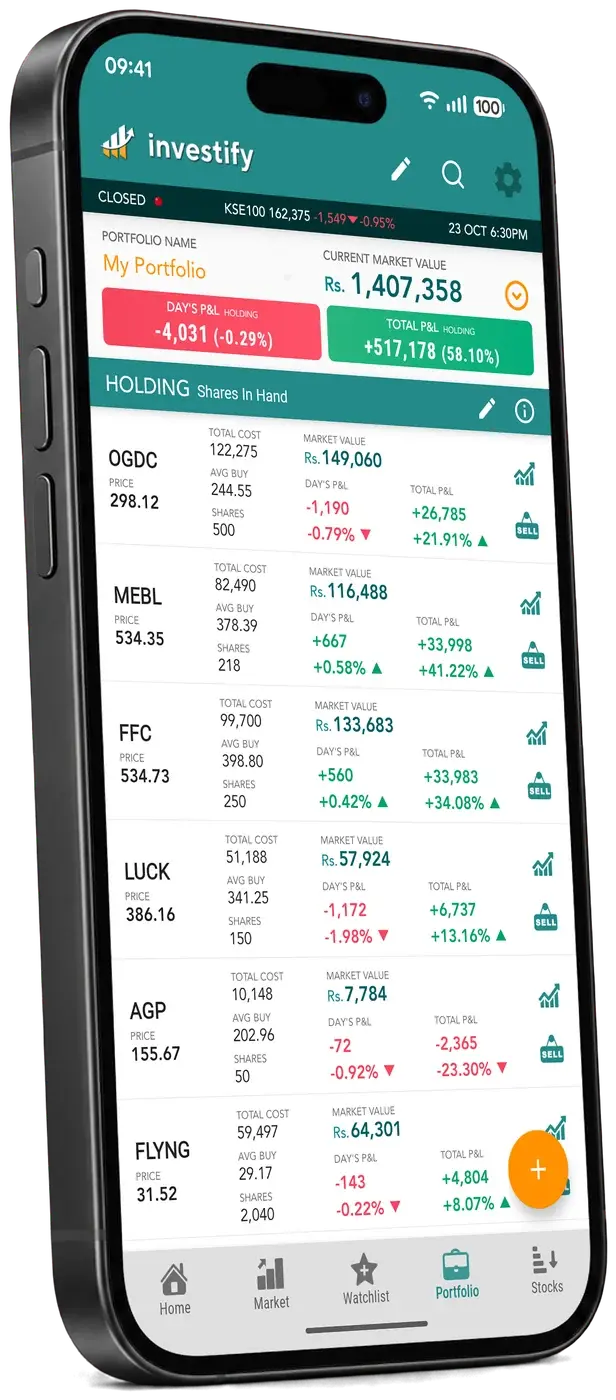
- The portfolio tracker records the dividends you receive, which makes year-end purification easier.
Follow KMI-30 live on Investify
See the Shariah-compliant benchmark's level, movers and constituents, then open any company's stock page for announcements and fundamentals.
Open KMI-30Educational note
This article is general educational information about how PSX's Shariah indices and screening work. It is not religious, investment, financial, legal or tax advice, and it does not say whether any company or fund is Shariah-compliant or worth buying. Companies and symbols mentioned are neutral examples of where to look, not recommendations. Screening thresholds, company lists and brokerage rules change; confirm them against the latest PSX notices, the KMI methodology, SECP announcements and your own Shariah adviser. Investify is a PSX market-data and portfolio-tracking app and is not a broker, a Shariah adviser or a tax adviser.
The bottom line
KMI-30 is the top slice of a much larger Shariah-compliant universe, built by passing six screens on business activity, debt, investments, income, illiquid assets and net liquid assets. The debt cap was tightened to 33% in 2026, the list is reviewed twice a year, and purification of the small impure share of dividends stays with the investor unless you use an Islamic fund. With a growing set of Islamic broker windows approved by SECP, Shariah-conscious investing on PSX is getting easier to do properly, but the screens test eligibility, not investment quality.
Related reading
Sources and references
- PSX - KMI 30 Index methodologyIndex construction, free-float basis and weight cap.
- PSX Annual Report 2026Revised KMI screening criteria, star ratings and Shariah disclosure rules.
- Profit - SECP revises Shariah screening criteria for PSX-KMI All Share IndexFebruary 2026 changes to the debt cap and process.
- Profit - SECP establishes Shariah-compliant brokerage segment33 Islamic windows, segment features and market coverage.
- Air Link Communication filing on Meezan Bank screening certificateExample of how screening certificates are disclosed.
- Musaffa Academy - Islamic stock screening in PakistanSecondary summary of the screening thresholds and technical filters.
- SECPRegulator of securities and Shariah governance.